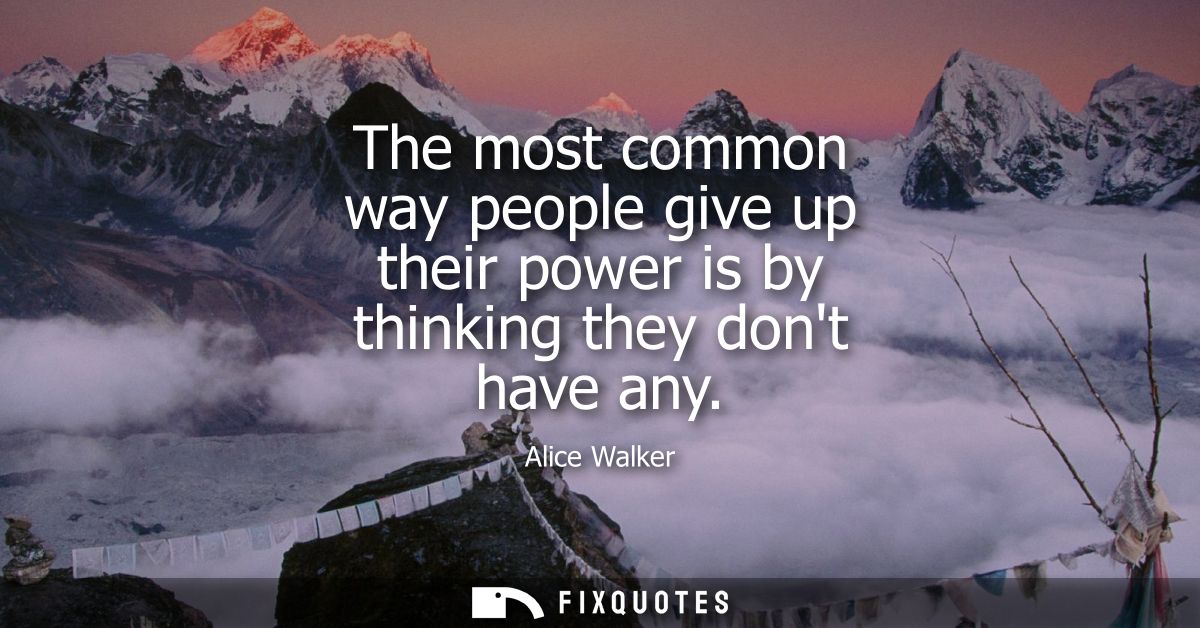
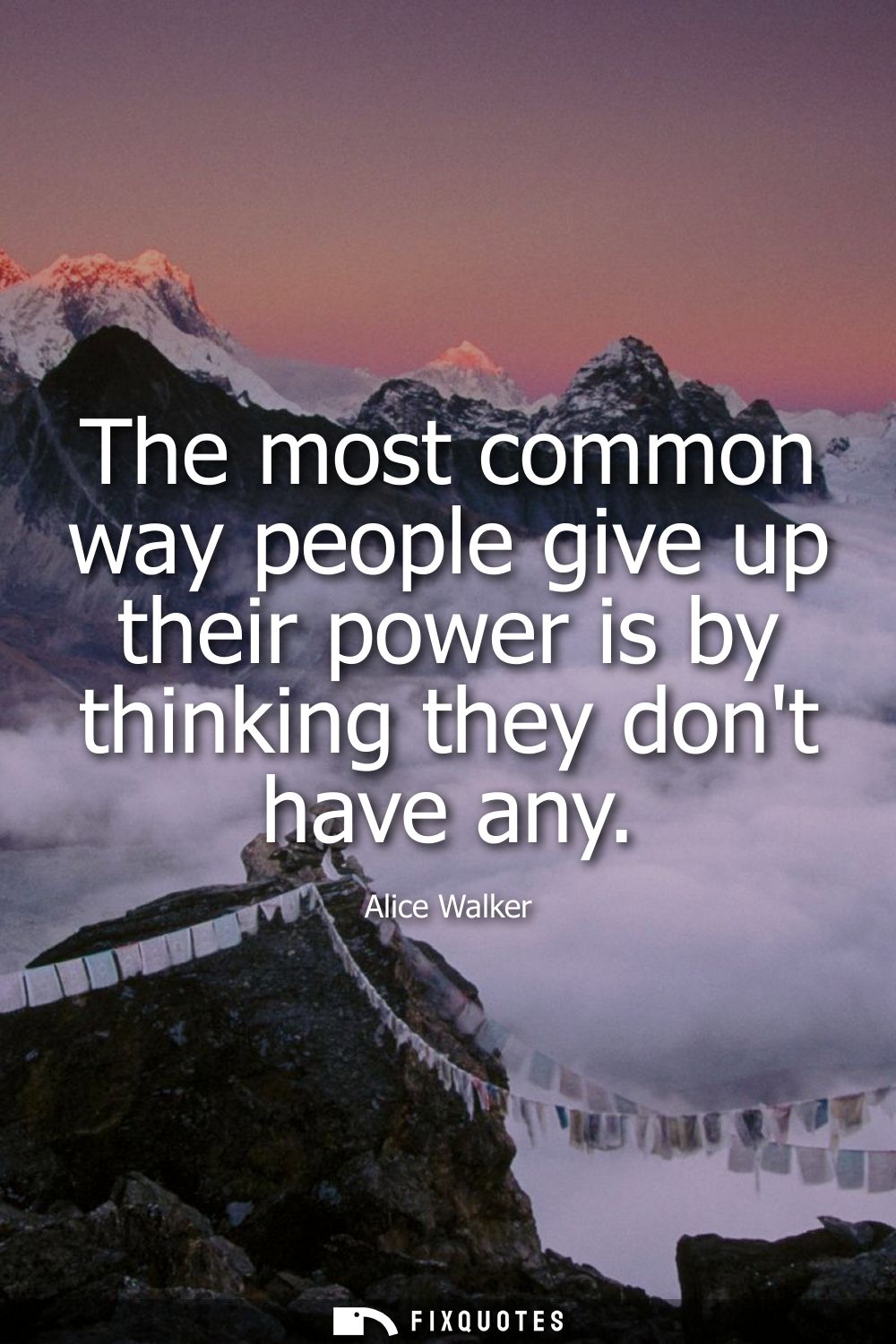
"The most common way people give up their power is by thinking they don't have any"
About this Quote
The subtext is classic Walker: power is not only institutional, it’s psychological, relational, and cultural. This is a writer shaped by the afterlives of slavery, Jim Crow, sexism, and poverty - conditions that don’t just restrict options, they train imagination. If you can be taught that your voice doesn’t matter, you’ll self-censor before anyone has to silence you. That’s the real efficiency of domination: it outsources enforcement to the oppressed.
The intent isn’t motivational-poster uplift; it’s a strategy note. Walker is pointing to the first battleground as perception, because perception shapes action: who speaks up in a meeting, who leaves a harmful relationship, who runs for office, who organizes. The quote works because it refuses both cynicism and naive optimism. It doesn’t pretend power is evenly distributed. It insists, instead, that even in unequal conditions, the belief in powerlessness is itself a lever the powerful rely on.
Quote Details
| Topic | Confidence |
|---|---|
| Source | Later attribution: Alice Walker (Alice Walker) modern compilation
Evidence: n 25 february 2001 the most common way people give up their power is by thinking they dont have any Other candidates (1) Enough Blood Shed (Mary-Wynne Ashford, 2006) compilation95.0% ... The most common way people give up their power is by thinking they don't have any . Alice Walker I n the middle o... |
| Cite |
Citation Formats
APA Style (7th ed.)
Walker, Alice. (2026, January 13). The most common way people give up their power is by thinking they don't have any. FixQuotes. https://fixquotes.com/quotes/the-most-common-way-people-give-up-their-power-is-37271/
Chicago Style
Walker, Alice. "The most common way people give up their power is by thinking they don't have any." FixQuotes. January 13, 2026. https://fixquotes.com/quotes/the-most-common-way-people-give-up-their-power-is-37271/.
MLA Style (9th ed.)
"The most common way people give up their power is by thinking they don't have any." FixQuotes, 13 Jan. 2026, https://fixquotes.com/quotes/the-most-common-way-people-give-up-their-power-is-37271/. Accessed 30 Mar. 2026.