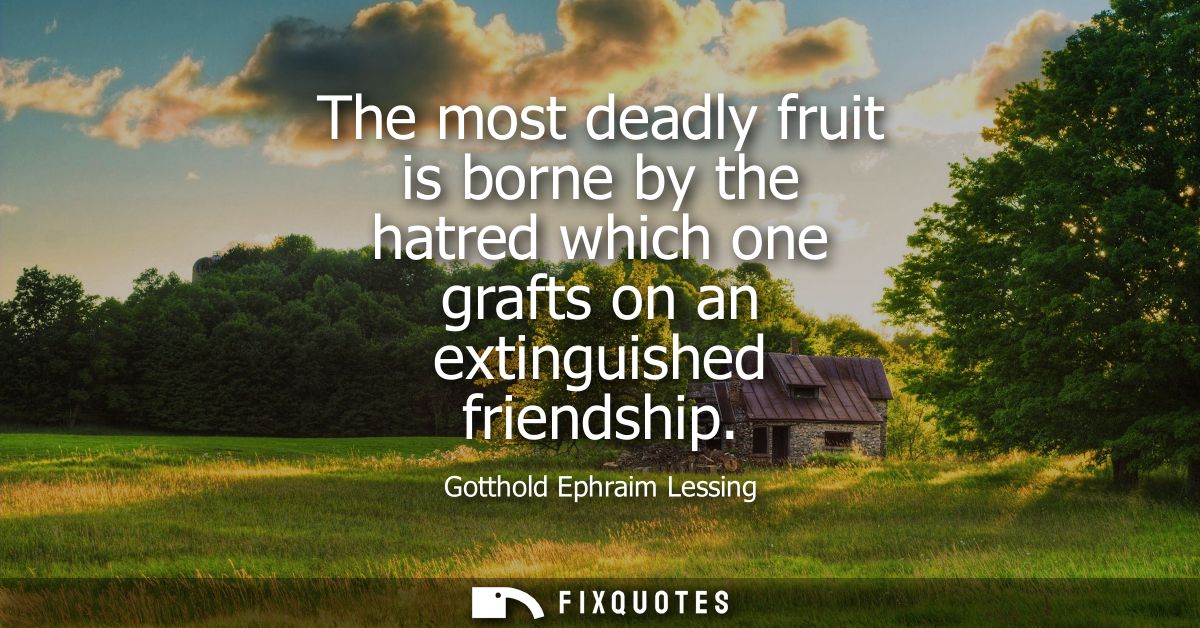
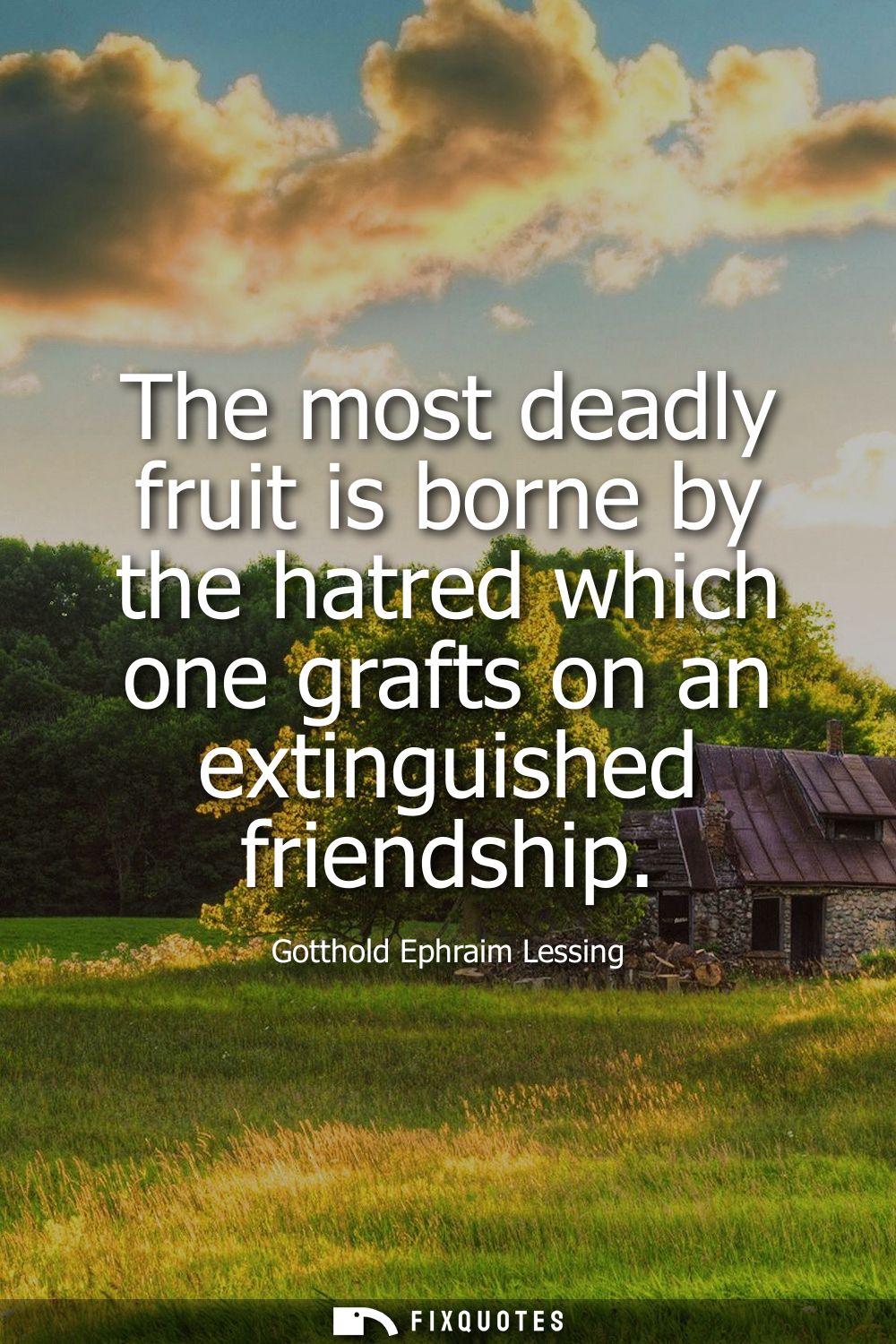
"The most deadly fruit is borne by the hatred which one grafts on an extinguished friendship"
About this Quote
The subtext is Lessing’s Enlightenment suspicion of passions that masquerade as principles. A friendship gone cold can be narrated as betrayal, and betrayal is the story people tell themselves to justify cruelty. By framing hatred as a graft, Lessing hints that it often piggybacks on moral certainty: I used to care, now I have a reason not to. That “reason” becomes permission.
As a critic working in an era of factional pamphlets, religious polemics, and salon reputations, Lessing would have seen how quickly intellectual life turns personal - and how personal injuries get laundered into ideological war. The sentence warns that the most dangerous conflicts aren’t between strangers; they’re between people with shared history who can convert affection into ammunition. It’s an anatomy of grievance, delivered with the scalpel of someone who’s watched culture make its sharpest knives out of old bonds.
Quote Details
| Topic | Broken Friendship |
|---|---|
| Source | Help us find the source |
| Cite |
Citation Formats
APA Style (7th ed.)
Lessing, Gotthold Ephraim. (2026, January 15). The most deadly fruit is borne by the hatred which one grafts on an extinguished friendship. FixQuotes. https://fixquotes.com/quotes/the-most-deadly-fruit-is-borne-by-the-hatred-48498/
Chicago Style
Lessing, Gotthold Ephraim. "The most deadly fruit is borne by the hatred which one grafts on an extinguished friendship." FixQuotes. January 15, 2026. https://fixquotes.com/quotes/the-most-deadly-fruit-is-borne-by-the-hatred-48498/.
MLA Style (9th ed.)
"The most deadly fruit is borne by the hatred which one grafts on an extinguished friendship." FixQuotes, 15 Jan. 2026, https://fixquotes.com/quotes/the-most-deadly-fruit-is-borne-by-the-hatred-48498/. Accessed 23 Mar. 2026.