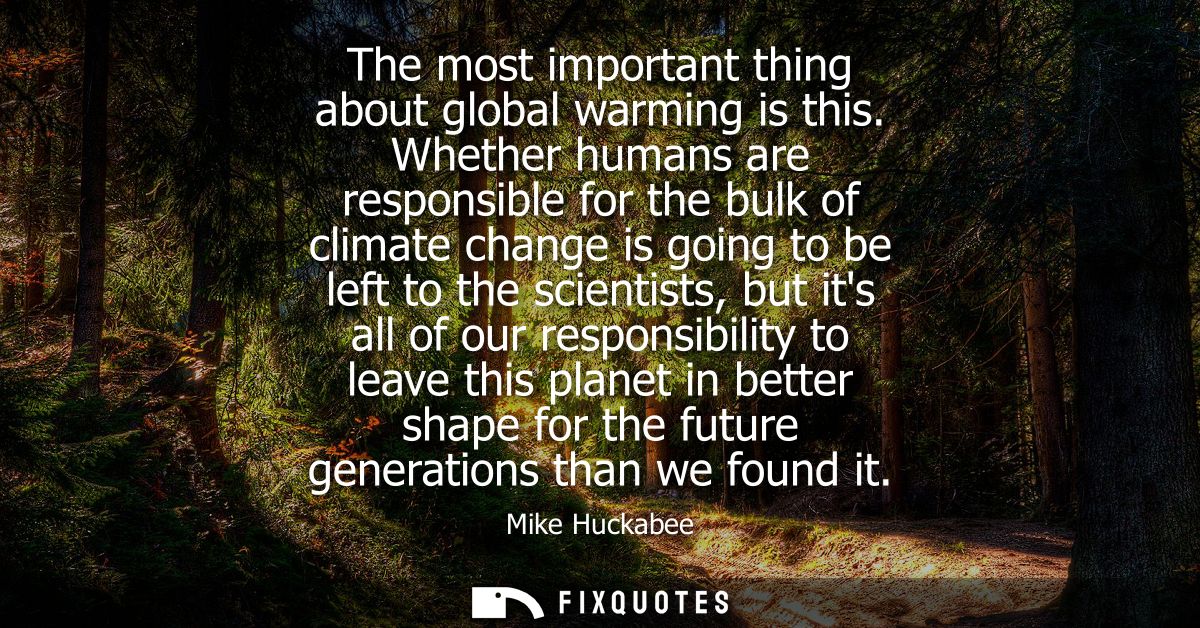
"The most important thing about global warming is this. Whether humans are responsible for the bulk of climate change is going to be left to the scientists, but it's all of our responsibility to leave this planet in better shape for the future generations than we found it"
About this Quote
Huckabee’s line is a political two-step: defer, then demand. By cordoning off the question of human causation as something “left to the scientists,” he signals respect for expertise while quietly sidestepping the most polarizing premise in U.S. climate politics. It’s a classic move for a conservative politician navigating a base that has often treated climate science as cultural tribalism. The sentence acknowledges the issue without fully joining the fight over blame.
Then comes the pivot to moral language: “it’s all of our responsibility.” That framing shifts global warming from an argument about emissions, regulation, and fossil fuels into a broad ethic of stewardship. The subtext is strategic: you don’t have to accept the full scientific consensus to accept a duty to conserve, innovate, or avoid waste. It’s climate concern repackaged as character.
The phrase “leave this planet in better shape” is intentionally roomy. It can mean cleaner air, energy independence, resilience, or simply not trashing national parks. That vagueness is a feature, not a bug: it invites agreement across ideological lines while avoiding commitments to specific policies that trigger partisan backlash. “Future generations” supplies the emotional leverage; it’s a safe constituency, impossible to heckle, and a reliable way to make sacrifice sound like legacy.
In context, this is less a scientific statement than a coalition-building tool: an attempt to make climate action culturally palatable by shifting from contested causality to shared obligation.
Then comes the pivot to moral language: “it’s all of our responsibility.” That framing shifts global warming from an argument about emissions, regulation, and fossil fuels into a broad ethic of stewardship. The subtext is strategic: you don’t have to accept the full scientific consensus to accept a duty to conserve, innovate, or avoid waste. It’s climate concern repackaged as character.
The phrase “leave this planet in better shape” is intentionally roomy. It can mean cleaner air, energy independence, resilience, or simply not trashing national parks. That vagueness is a feature, not a bug: it invites agreement across ideological lines while avoiding commitments to specific policies that trigger partisan backlash. “Future generations” supplies the emotional leverage; it’s a safe constituency, impossible to heckle, and a reliable way to make sacrifice sound like legacy.
In context, this is less a scientific statement than a coalition-building tool: an attempt to make climate action culturally palatable by shifting from contested causality to shared obligation.
Quote Details
| Topic | Nature |
|---|
More Quotes by Mike
Add to List