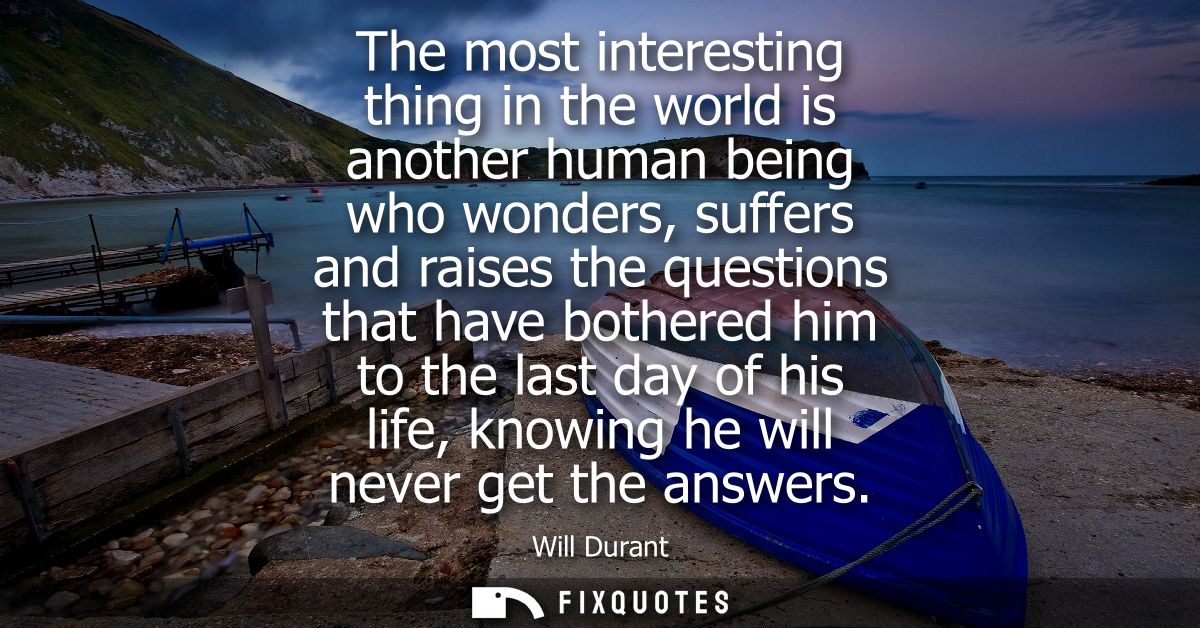
"The most interesting thing in the world is another human being who wonders, suffers, and raises the questions that have bothered him to the last day of his life, knowing he will never get the answers"
About this Quote
The subtext is almost combative. Durant is telling the reader to stop treating people as solved problems - characters filed under nation, class, generation, diagnosis. What makes someone worth your attention isn’t their résumé but their unresolvedness: the private ache, the stubborn return to the same unanswerable questions, the refusal to pretend closure. “Knowing he will never get the answers” is the keystone. It strips wonder of its reward and turns it into an ethical stance: to live awake is to accept uncertainty without anesthetizing it with certainty theater.
Context matters: Durant’s career was built on making the past legible without flattening it. After two world wars and the collapse of so many confident narratives, the historian’s temptation is either cynicism (nothing means anything) or dogma (everything was inevitable). Durant threads a third needle: history is compelling because human beings are compelling, and they’re compelling precisely because they don’t resolve. The quote reads like a manifesto for humane attention: curiosity as a form of respect, suffering as evidence of depth, questions as the true biography.
Quote Details
| Topic | Deep |
|---|---|
| Source | Help us find the source |
| Cite |
Citation Formats
APA Style (7th ed.)
Durant, Will. (2026, February 16). The most interesting thing in the world is another human being who wonders, suffers, and raises the questions that have bothered him to the last day of his life, knowing he will never get the answers. FixQuotes. https://fixquotes.com/quotes/the-most-interesting-thing-in-the-world-is-117940/
Chicago Style
Durant, Will. "The most interesting thing in the world is another human being who wonders, suffers, and raises the questions that have bothered him to the last day of his life, knowing he will never get the answers." FixQuotes. February 16, 2026. https://fixquotes.com/quotes/the-most-interesting-thing-in-the-world-is-117940/.
MLA Style (9th ed.)
"The most interesting thing in the world is another human being who wonders, suffers, and raises the questions that have bothered him to the last day of his life, knowing he will never get the answers." FixQuotes, 16 Feb. 2026, https://fixquotes.com/quotes/the-most-interesting-thing-in-the-world-is-117940/. Accessed 4 Apr. 2026.