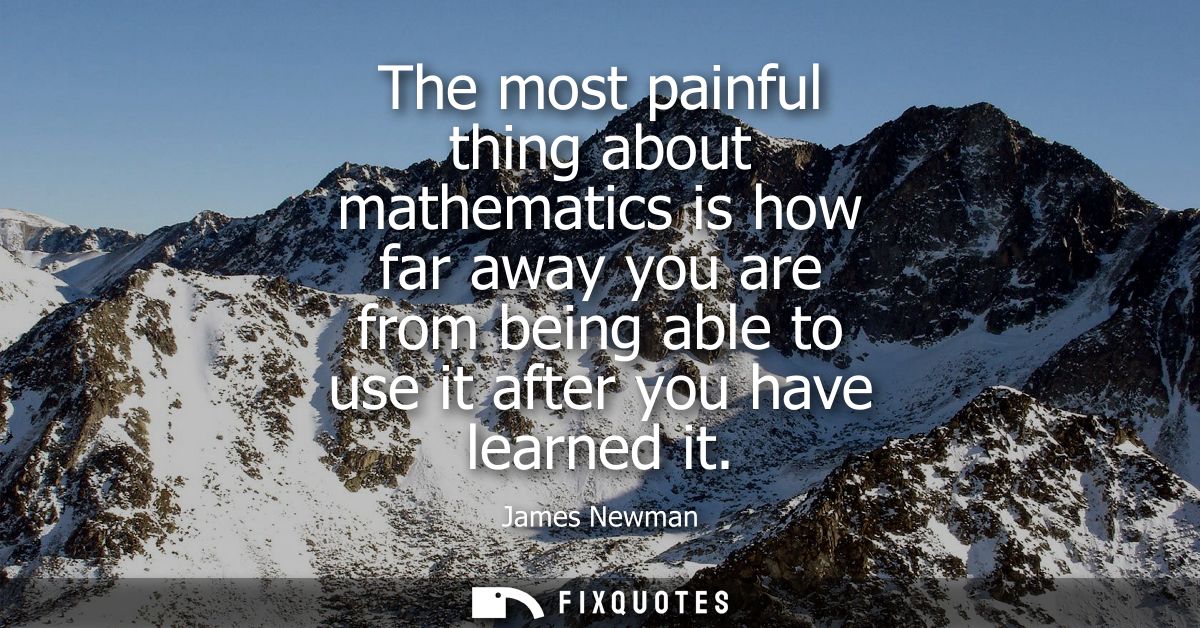
"The most painful thing about mathematics is how far away you are from being able to use it after you have learned it"
About this Quote
As an astronaut, Newman is the ideal messenger. Spaceflight is the public’s proof that mathematics “works.” Yet his complaint implies that even at NASA, math isn’t a button you push. You learn techniques in clean training environments, then spend years building the judgment to recognize when a situation is secretly a differential equation, when it’s better handled by a back-of-the-envelope approximation, or when the real bottleneck is not calculation but coordination, instrument limits, and time pressure. The subtext is a critique of education that confuses exposure with mastery: we teach procedures, grade them, and call it preparedness.
The line also has a sly emotional honesty. “After you have learned it” sounds definitive, then the sentence undercuts it: learning isn’t the finish line; it’s the awkward beginning. In a culture obsessed with credentials, Newman reminds us that transfer - moving knowledge from the textbook to the messy world - is its own discipline, and it’s the part we rarely train for, even when the stakes are literally life-or-death.
Quote Details
| Topic | Learning |
|---|---|
| Source | Help us find the source |
| Cite |
Citation Formats
APA Style (7th ed.)
Newman, James. (2026, January 15). The most painful thing about mathematics is how far away you are from being able to use it after you have learned it. FixQuotes. https://fixquotes.com/quotes/the-most-painful-thing-about-mathematics-is-how-153510/
Chicago Style
Newman, James. "The most painful thing about mathematics is how far away you are from being able to use it after you have learned it." FixQuotes. January 15, 2026. https://fixquotes.com/quotes/the-most-painful-thing-about-mathematics-is-how-153510/.
MLA Style (9th ed.)
"The most painful thing about mathematics is how far away you are from being able to use it after you have learned it." FixQuotes, 15 Jan. 2026, https://fixquotes.com/quotes/the-most-painful-thing-about-mathematics-is-how-153510/. Accessed 31 Mar. 2026.