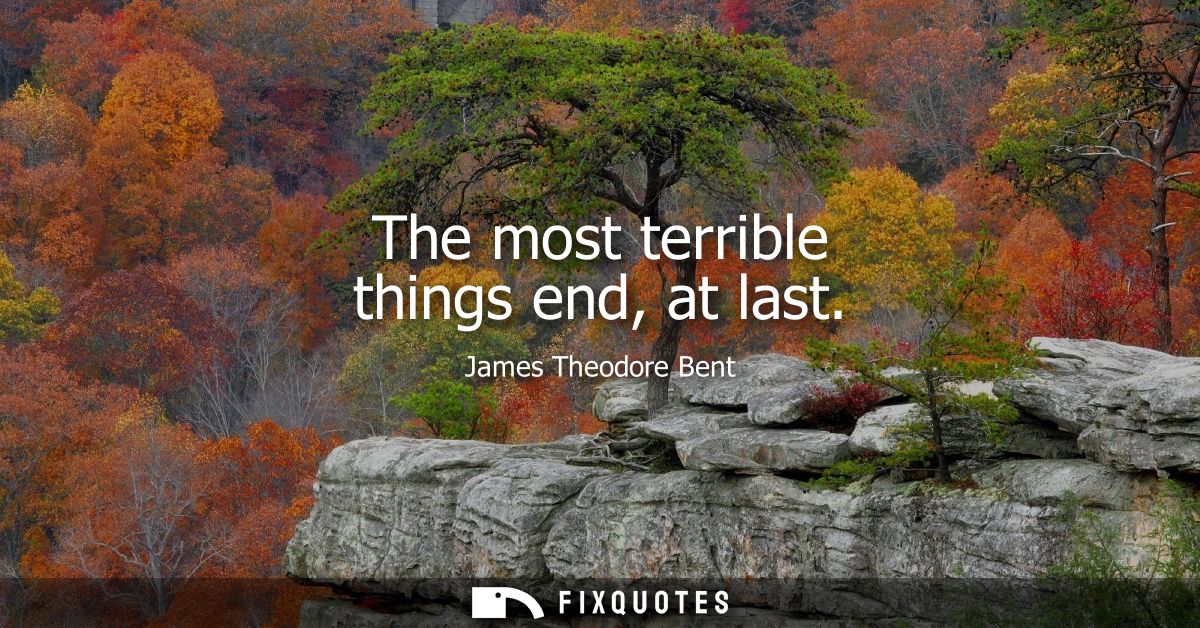
"The most terrible things end at last"
About this Quote
A Victorian explorer doesn’t need to dress up dread in metaphor; he’s seen enough of it firsthand. “The most terrible things end, at last” is blunt consolation, but it’s also a field note about time’s quiet authority. Bent isn’t promising justice, healing, or even meaning. He’s saying something colder and, in its way, sturdier: duration has limits. Catastrophe feels infinite while you’re inside it; the sentence works by puncturing that illusion.
The phrasing matters. “Most terrible” stakes out an extreme, not everyday disappointment, which gives the line its earned gravity. Then “end” arrives without adornment, a hard stop that refuses melodrama. The softening comes only in “at last,” a little sigh of delayed relief that also admits the cost: you have to outlast it. It’s hope stripped of sentimentality, the kind you can carry when comfort is unavailable.
Contextually, Bent belonged to a 19th-century culture that romanticized exploration while routinely colliding with disease, scarcity, and imperial violence. In journals and travelogues, endurance is often the real protagonist. Read through that lens, the line becomes less inspirational poster and more survival tactic, a mental tool for the person counting days, not triumphs.
Subtext: terror is not special enough to be permanent. That’s the quiet rebellion here. Even the worst chapter closes, not because the world turns kind, but because it keeps turning.
The phrasing matters. “Most terrible” stakes out an extreme, not everyday disappointment, which gives the line its earned gravity. Then “end” arrives without adornment, a hard stop that refuses melodrama. The softening comes only in “at last,” a little sigh of delayed relief that also admits the cost: you have to outlast it. It’s hope stripped of sentimentality, the kind you can carry when comfort is unavailable.
Contextually, Bent belonged to a 19th-century culture that romanticized exploration while routinely colliding with disease, scarcity, and imperial violence. In journals and travelogues, endurance is often the real protagonist. Read through that lens, the line becomes less inspirational poster and more survival tactic, a mental tool for the person counting days, not triumphs.
Subtext: terror is not special enough to be permanent. That’s the quiet rebellion here. Even the worst chapter closes, not because the world turns kind, but because it keeps turning.
Quote Details
| Topic | Hope |
|---|---|
| Source | Help us find the source |
| Cite |
Citation Formats
APA Style (7th ed.)
Bent, James Theodore. (2026, February 16). The most terrible things end at last. FixQuotes. https://fixquotes.com/quotes/the-most-terrible-things-end-at-last-167677/
Chicago Style
Bent, James Theodore. "The most terrible things end at last." FixQuotes. February 16, 2026. https://fixquotes.com/quotes/the-most-terrible-things-end-at-last-167677/.
MLA Style (9th ed.)
"The most terrible things end at last." FixQuotes, 16 Feb. 2026, https://fixquotes.com/quotes/the-most-terrible-things-end-at-last-167677/. Accessed 2 Apr. 2026.
More Quotes by James
Add to List