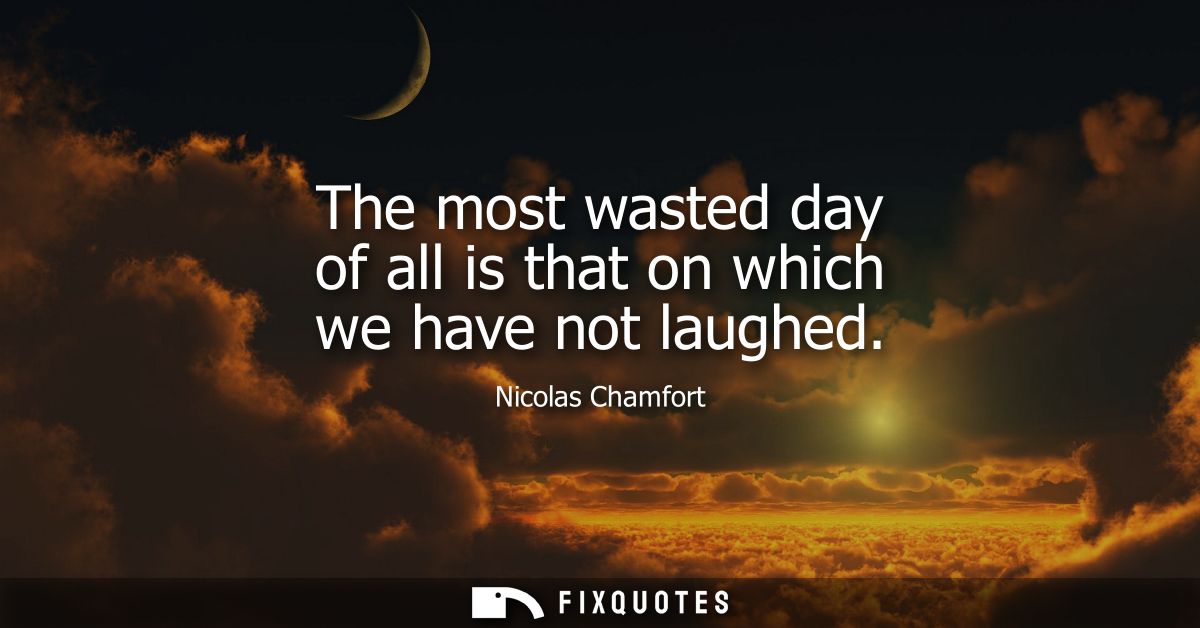
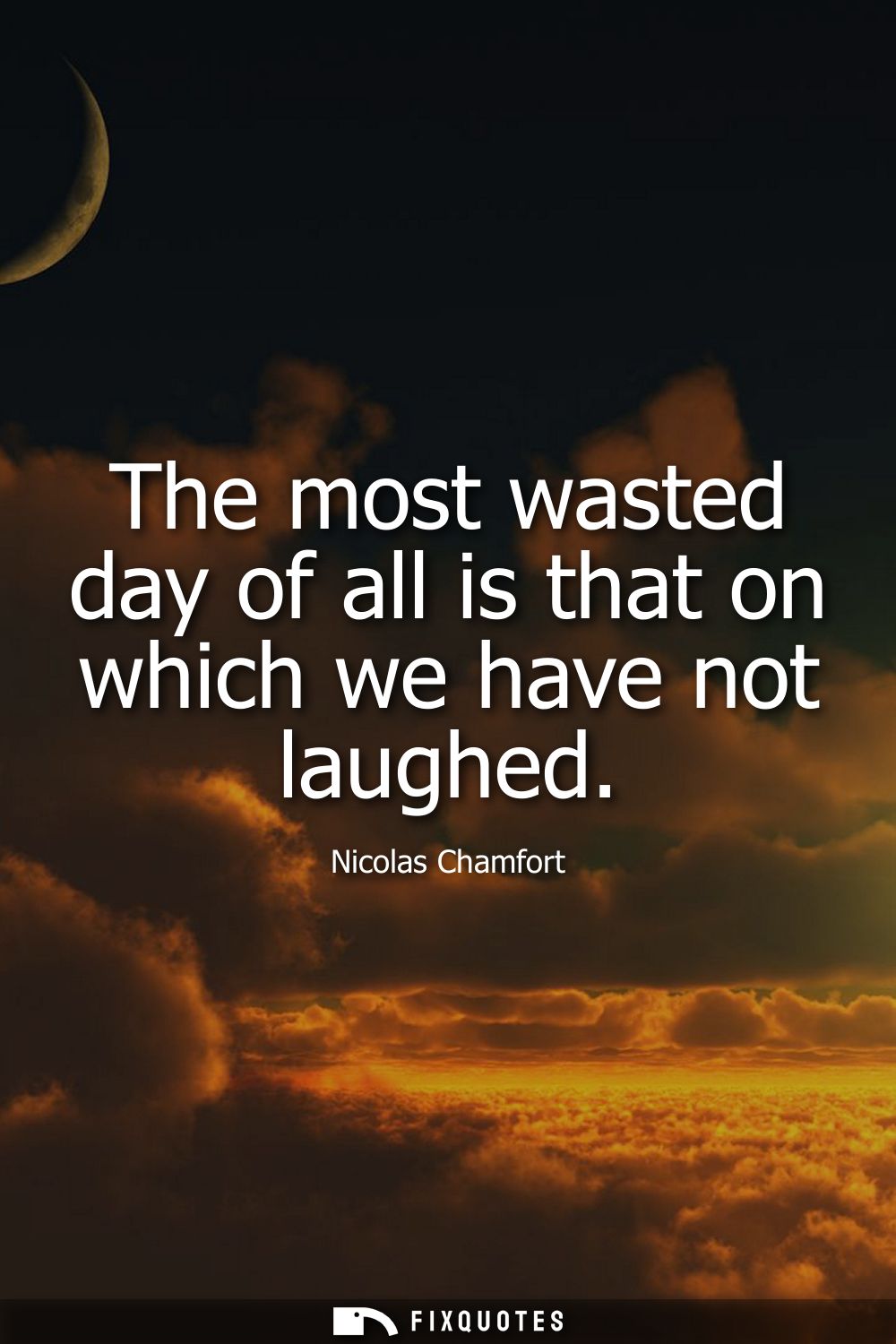
"The most wasted day of all is that on which we have not laughed"
About this Quote
A wasted day, Chamfort implies, isn’t one where nothing productive happens; it’s one where the spirit never gets to inhale. Coming from an 18th-century French moralist with a talent for the aphorism’s knife-edge, the line reads less like a greeting-card endorsement of giggles and more like a hardened survival strategy. Chamfort lived through the salon culture that treated wit as social currency and the Revolution that proved how quickly language can turn from sparkle to blood. In that arc, laughter isn’t frivolity; it’s a diagnostic. If you can’t laugh, you’re either under tyranny, under illusion, or already being conscripted by someone else’s seriousness.
The sentence works because it smuggles a value system into a single comparative: “most wasted day of all.” That absolutism is provocation, not measurement. Chamfort isn’t keeping a calendar; he’s staging a small rebellion against the moral bookkeeping of his era, where virtue was often performed as dourness and sensibility could curdle into self-regard. Laughter, in his framing, becomes proof of interior freedom: the ability to see the absurd, to resist pomposity, to puncture the ego’s melodrama.
There’s also an edge of cynicism. Laughter can be joy, but in Chamfort it’s often the last refuge of the clear-eyed. If you’ve spent a day unable to laugh, it suggests you’ve been fully captured by fear, vanity, or propaganda. The wasted day isn’t empty; it’s overfull of the wrong things.
The sentence works because it smuggles a value system into a single comparative: “most wasted day of all.” That absolutism is provocation, not measurement. Chamfort isn’t keeping a calendar; he’s staging a small rebellion against the moral bookkeeping of his era, where virtue was often performed as dourness and sensibility could curdle into self-regard. Laughter, in his framing, becomes proof of interior freedom: the ability to see the absurd, to resist pomposity, to puncture the ego’s melodrama.
There’s also an edge of cynicism. Laughter can be joy, but in Chamfort it’s often the last refuge of the clear-eyed. If you’ve spent a day unable to laugh, it suggests you’ve been fully captured by fear, vanity, or propaganda. The wasted day isn’t empty; it’s overfull of the wrong things.
Quote Details
| Topic | Happiness |
|---|---|
| Source | Help us find the source |
| Cite | Cite this Quote |
Citation Formats
APA Style (7th ed.)
Chamfort, Nicolas. (n.d.). The most wasted day of all is that on which we have not laughed. FixQuotes. https://fixquotes.com/quotes/the-most-wasted-day-of-all-is-that-on-which-we-16195/
Chicago Style
Chamfort, Nicolas. "The most wasted day of all is that on which we have not laughed." FixQuotes. Accessed February 2, 2026. https://fixquotes.com/quotes/the-most-wasted-day-of-all-is-that-on-which-we-16195/.
MLA Style (9th ed.)
"The most wasted day of all is that on which we have not laughed." FixQuotes, https://fixquotes.com/quotes/the-most-wasted-day-of-all-is-that-on-which-we-16195/. Accessed 2 Feb. 2026.
More Quotes by Nicolas
Add to List