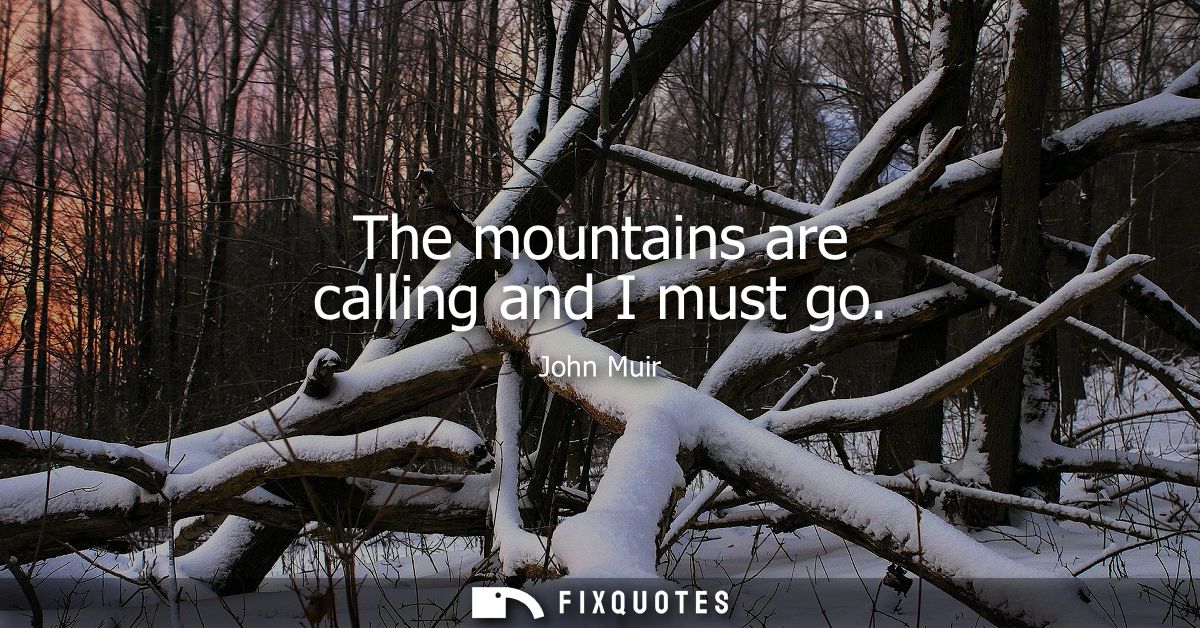
"The mountains are calling and I must go"
About this Quote
It reads like a telegram from the soul, but it’s also a piece of recruiting copy for a new American religion: the outdoors as moral reset. “Calling” turns geology into a voice with authority, and “must” turns leisure into obligation. Muir isn’t pitching a hobby; he’s describing compulsion, the kind that makes city life feel like a bad habit you’re desperate to quit.
The subtext is partly personal and partly strategic. Muir had the temperament of a mystic and the eye of a naturalist, and he wrote at a moment when industrial America was loud, fast, and extractive. By framing mountains as something that summons you, he sidesteps argument and goes straight to intimacy. You don’t debate a call; you answer it. That rhetorical move matters because early conservation had to do more than inventory landscapes. It had to generate attachment strong enough to compete with railroads, logging, mining, and the national appetite for “progress.”
Context gives the line its quiet bite. Muir helped popularize wilderness not as useless land waiting for development, but as a civic and spiritual asset worth protecting. The sentence also carries an unspoken rebuke: if the mountains are calling, what exactly is the alternative voice you’ve been listening to? Profit, duty, distraction. Its power is how it makes escape sound like responsibility, turning a private urge to wander into a public ethic: go, see, be changed, then defend what changed you.
The subtext is partly personal and partly strategic. Muir had the temperament of a mystic and the eye of a naturalist, and he wrote at a moment when industrial America was loud, fast, and extractive. By framing mountains as something that summons you, he sidesteps argument and goes straight to intimacy. You don’t debate a call; you answer it. That rhetorical move matters because early conservation had to do more than inventory landscapes. It had to generate attachment strong enough to compete with railroads, logging, mining, and the national appetite for “progress.”
Context gives the line its quiet bite. Muir helped popularize wilderness not as useless land waiting for development, but as a civic and spiritual asset worth protecting. The sentence also carries an unspoken rebuke: if the mountains are calling, what exactly is the alternative voice you’ve been listening to? Profit, duty, distraction. Its power is how it makes escape sound like responsibility, turning a private urge to wander into a public ethic: go, see, be changed, then defend what changed you.
Quote Details
| Topic | Mountain |
|---|---|
| Source | Help us find the source |
| Cite |
Citation Formats
APA Style (7th ed.)
Muir, John. (2026, January 15). The mountains are calling and I must go. FixQuotes. https://fixquotes.com/quotes/the-mountains-are-calling-and-i-must-go-14730/
Chicago Style
Muir, John. "The mountains are calling and I must go." FixQuotes. January 15, 2026. https://fixquotes.com/quotes/the-mountains-are-calling-and-i-must-go-14730/.
MLA Style (9th ed.)
"The mountains are calling and I must go." FixQuotes, 15 Jan. 2026, https://fixquotes.com/quotes/the-mountains-are-calling-and-i-must-go-14730/. Accessed 12 Feb. 2026.
More Quotes by John
Add to List