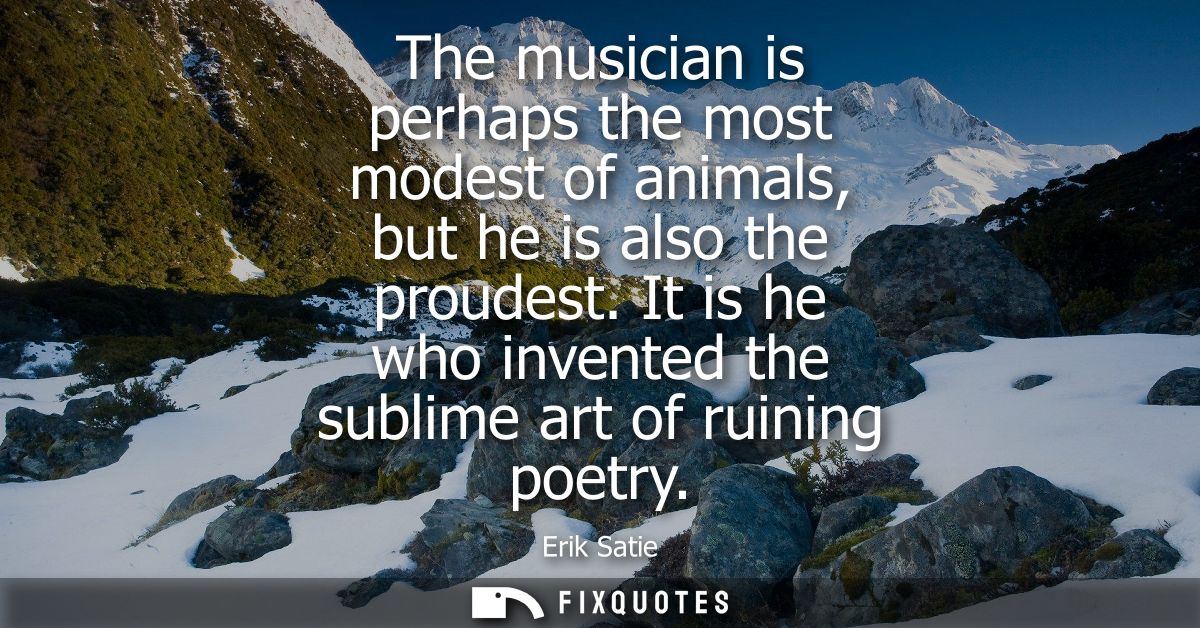
"The musician is perhaps the most modest of animals, but he is also the proudest. It is he who invented the sublime art of ruining poetry"
About this Quote
The punchline lands on poetry because Satie understood how music colonizes other arts. Set a poem to melody and you don't just "enhance" it; you overwrite it. Rhythm becomes literal, ambiguity gets pinned to a tempo, and the listener remembers the tune more than the line. "Ruining" is a deliberately provocative verb: it mocks the high-minded rhetoric of the "sublime" while admitting music's power to dominate, to turn language into accompaniment.
Context matters. Satie worked in a Paris thick with Symbolist reverence and Wagnerian grandeur, where "sublimity" was marketed like a luxury good. His own aesthetic - spare, deadpan, suspicious of virtuoso seriousness - thrived on puncturing inflated claims. The wit is a defense against artistic sanctimony, but also a confession: musicians can't help themselves. Even when they kneel to the poem, they do it loudly.
Quote Details
| Topic | Music |
|---|---|
| Source | Help us find the source |
| Cite |
Citation Formats
APA Style (7th ed.)
Satie, Erik. (2026, January 16). The musician is perhaps the most modest of animals, but he is also the proudest. It is he who invented the sublime art of ruining poetry. FixQuotes. https://fixquotes.com/quotes/the-musician-is-perhaps-the-most-modest-of-114907/
Chicago Style
Satie, Erik. "The musician is perhaps the most modest of animals, but he is also the proudest. It is he who invented the sublime art of ruining poetry." FixQuotes. January 16, 2026. https://fixquotes.com/quotes/the-musician-is-perhaps-the-most-modest-of-114907/.
MLA Style (9th ed.)
"The musician is perhaps the most modest of animals, but he is also the proudest. It is he who invented the sublime art of ruining poetry." FixQuotes, 16 Jan. 2026, https://fixquotes.com/quotes/the-musician-is-perhaps-the-most-modest-of-114907/. Accessed 1 Apr. 2026.