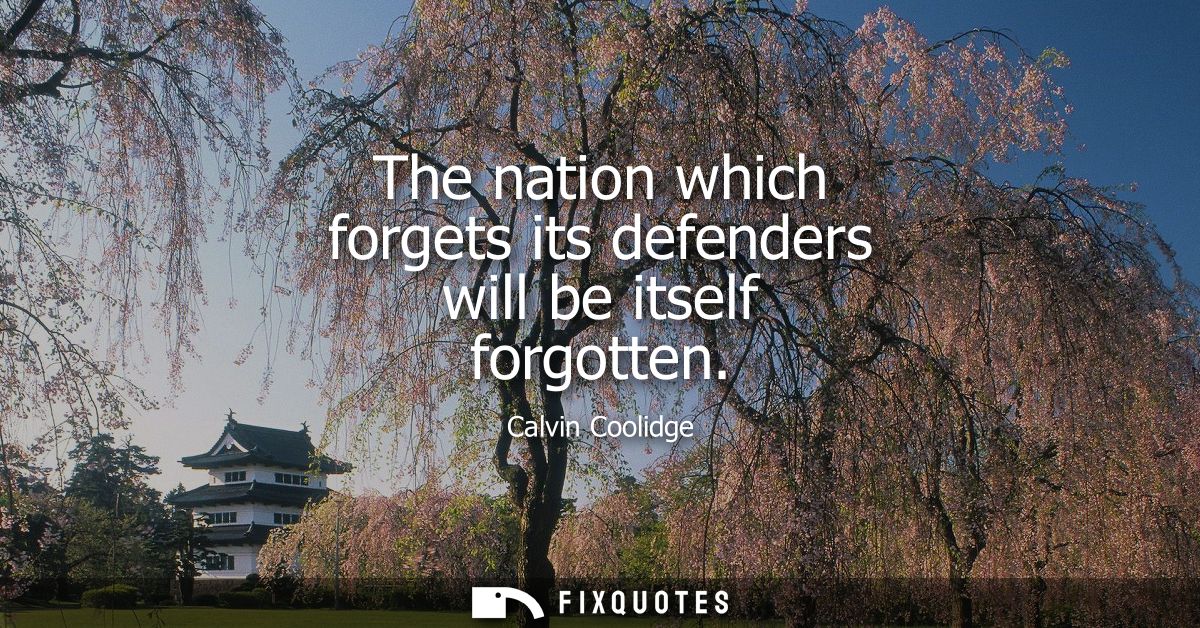
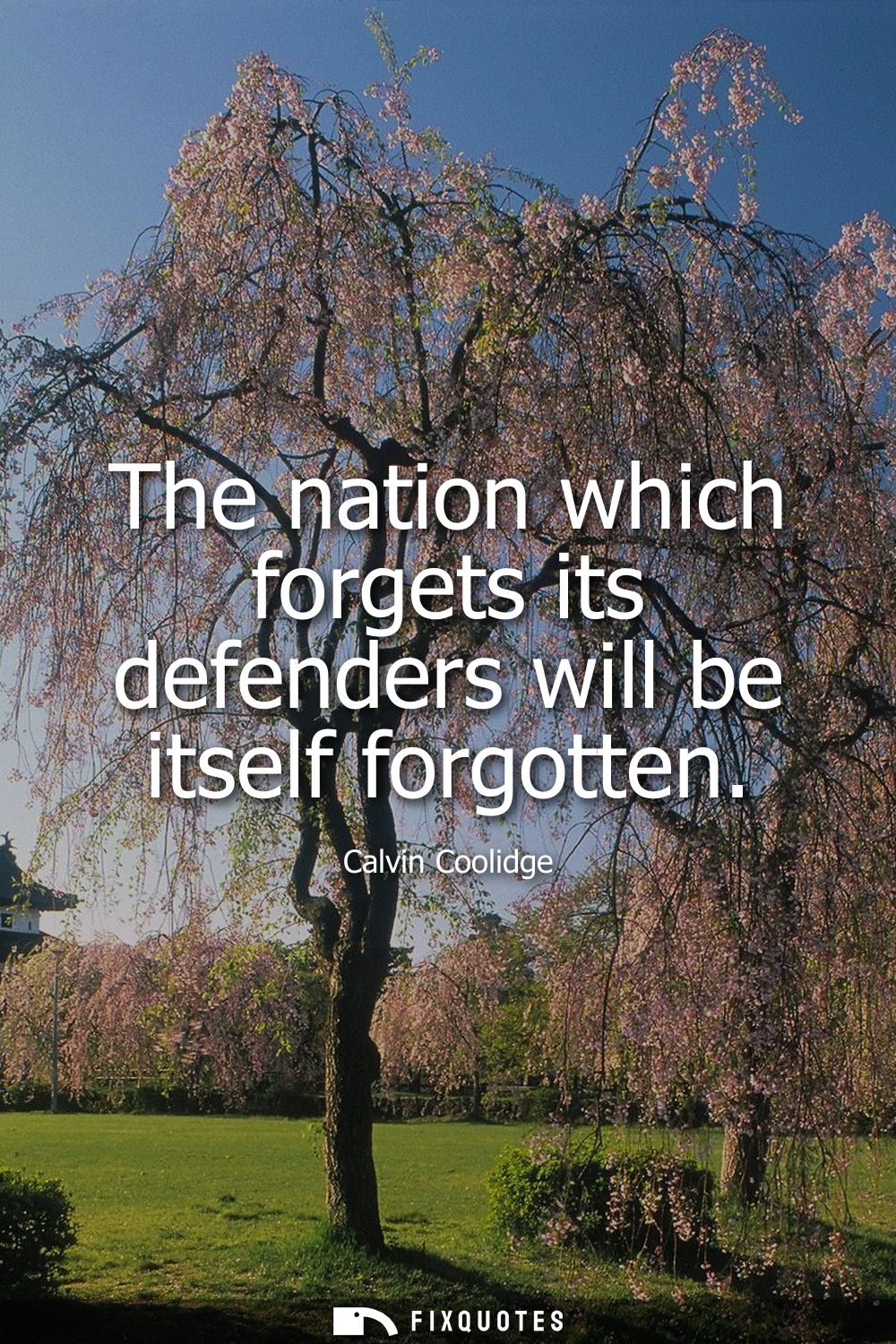
"The nation which forgets its defenders will be itself forgotten"
About this Quote
Memory is power in Coolidge's line, and he wields it like a warning label: gratitude isn’t just virtuous, it’s survival. Coming from a president not known for rhetorical fireworks, the sentence lands with a clipped, almost legal certainty. “Defenders” is doing heavy work here. It’s not merely soldiers in a narrow sense; it’s a category of people whose sacrifice becomes a moral credit the state must honor. To “forget” them isn’t just impolite - it’s a kind of civic breach of contract.
The subtext is transactional and nationalistic in the early-20th-century way: a country earns legitimacy by tending the story of those who fought for it. If you let that story rot, the nation itself loses its claim to continuity. Coolidge ties identity to remembrance, suggesting that nations are less built from territory than from rituals of recognition - parades, monuments, benefits, the public language of honor. It’s a soft demand with hard implications: fund the institutions that care for veterans; keep the mythology intact; make sacrifice legible to the next generation.
Context matters. Coolidge governed in the long shadow of World War I, amid debates over isolationism, military readiness, and how much the government owed those who served. The quote anticipates later flashpoints like the Bonus Army, when veterans’ demands collided with a state eager to move on. Coolidge’s sentence insists you can’t skip the bill. Neglect isn’t neutral; it’s self-erasure.
The subtext is transactional and nationalistic in the early-20th-century way: a country earns legitimacy by tending the story of those who fought for it. If you let that story rot, the nation itself loses its claim to continuity. Coolidge ties identity to remembrance, suggesting that nations are less built from territory than from rituals of recognition - parades, monuments, benefits, the public language of honor. It’s a soft demand with hard implications: fund the institutions that care for veterans; keep the mythology intact; make sacrifice legible to the next generation.
Context matters. Coolidge governed in the long shadow of World War I, amid debates over isolationism, military readiness, and how much the government owed those who served. The quote anticipates later flashpoints like the Bonus Army, when veterans’ demands collided with a state eager to move on. Coolidge’s sentence insists you can’t skip the bill. Neglect isn’t neutral; it’s self-erasure.
Quote Details
| Topic | Military & Soldier |
|---|---|
| Source | Verified source: Accepting the Republican Vice-Presidential Nomination (Calvin Coolidge, 1920)
Evidence: The nation which forgets its defenders will be itself forgotten.. This line appears in Calvin Coolidge’s acceptance remarks upon formal notification of the Republican Party’s vice-presidential nomination. The Coolidge Foundation transcript gives the date and place as July 27, 1920, Northampton, Massachusetts, and includes the sentence verbatim in the paragraph beginning “Duty compels…”. Many later references paraphrase the setting as connected to the Republican National Convention in Chicago (held June 8–12, 1920), but the quote itself is from the later notification/acceptance speech on July 27, 1920. I did not find a reliably scan-verifiable contemporaneous first-print page number in a book edition during this search; if you need the *first newspaper printing*, the next step would be to pull July 28, 1920 newspaper facsimiles (e.g., via ProQuest Historical Newspapers or Library of Congress Chronicling America) and cite the earliest dated issue that carries the full text. Other candidates (1) Congressional Record (United States. Congress, 2001) compilation95.0% ... President , Massachusetts Gov- ernor Calvin Coolidge exclaimed , " The nation which forgets its defenders will be... |
| Cite |
Citation Formats
APA Style (7th ed.)
Coolidge, Calvin. (2026, February 8). The nation which forgets its defenders will be itself forgotten. FixQuotes. https://fixquotes.com/quotes/the-nation-which-forgets-its-defenders-will-be-5295/
Chicago Style
Coolidge, Calvin. "The nation which forgets its defenders will be itself forgotten." FixQuotes. February 8, 2026. https://fixquotes.com/quotes/the-nation-which-forgets-its-defenders-will-be-5295/.
MLA Style (9th ed.)
"The nation which forgets its defenders will be itself forgotten." FixQuotes, 8 Feb. 2026, https://fixquotes.com/quotes/the-nation-which-forgets-its-defenders-will-be-5295/. Accessed 8 Feb. 2026.
More Quotes by Calvin
Add to List