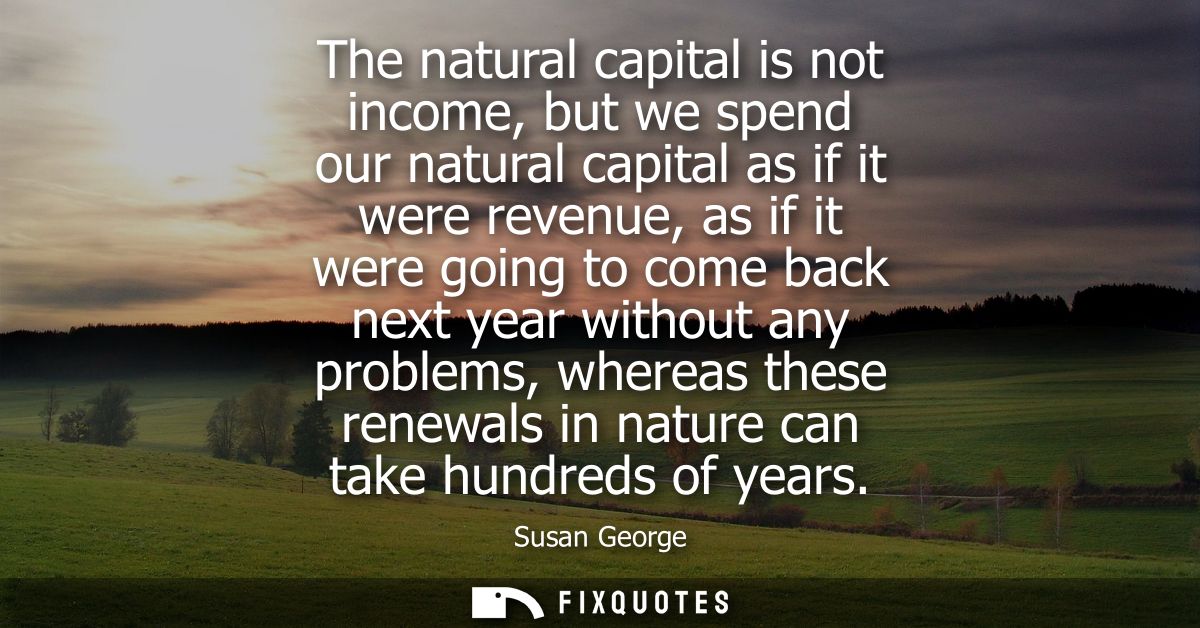
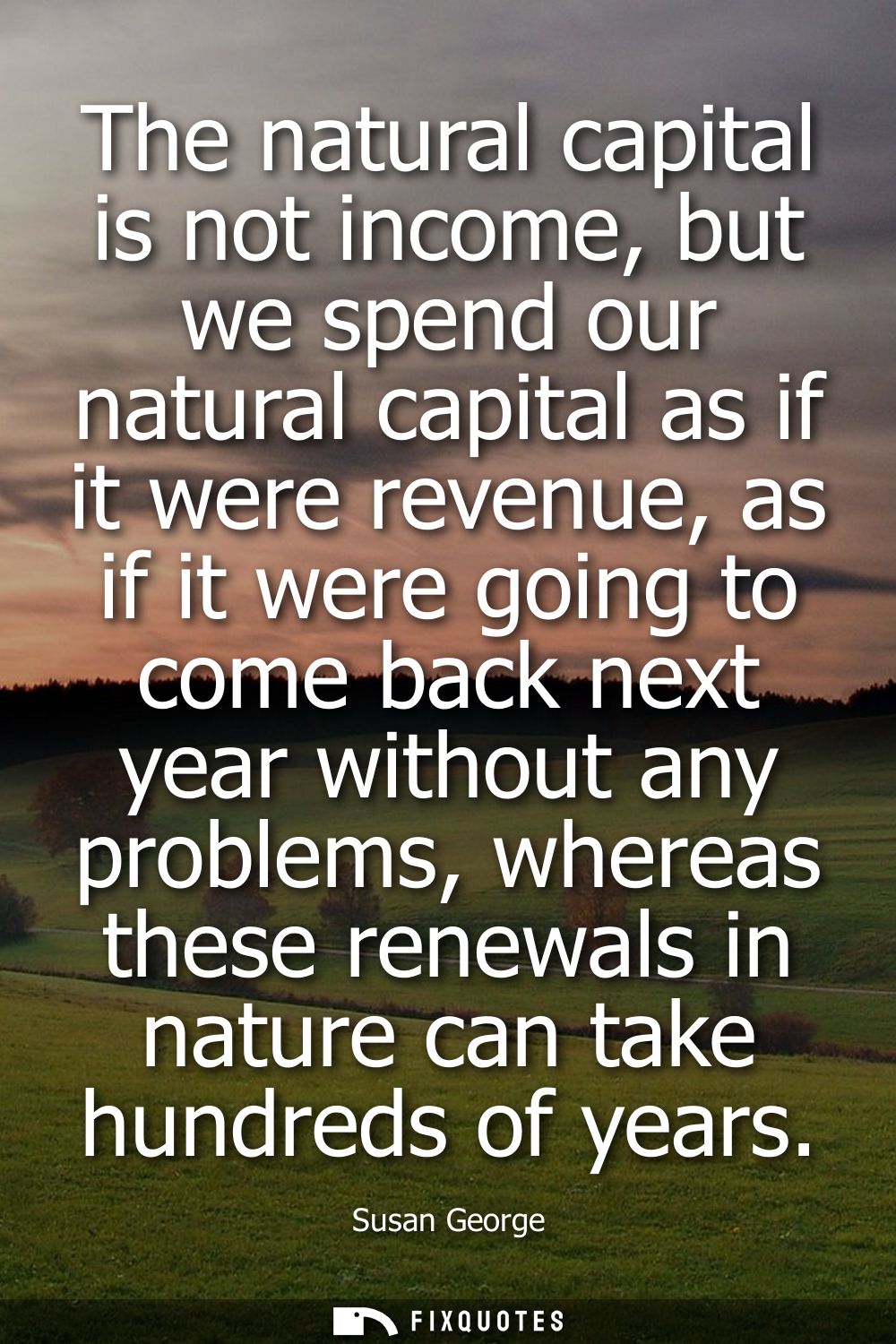
"The natural capital is not income, but we spend our natural capital as if it were revenue, as if it were going to come back next year without any problems, whereas these renewals in nature can take hundreds of years"
About this Quote
The bite is in the phrase "as if". George isn’t describing ignorance; she’s diagnosing a cultivated fantasy: that extraction is self-correcting, that forests, fisheries, soils, and aquifers behave like quarterly revenue streams. The subtext is moral as much as economic: modern growth depends on laundering depletion into prosperity, counting liquidation as profit. We don’t just overuse; we misclassify, which makes the overuse look rational.
Her final clause widens the time horizon into something almost accusatory. “Next year” is the tempo of politics and corporate reporting; “hundreds of years” is the tempo of repair. That mismatch is the real villain here, a structural incentive to borrow from deep time while paying nothing back. Coming from an activist steeped in development and globalization debates, the context is also distributive: the benefits of spending this “capital” concentrate quickly, while the costs land later, elsewhere, and on people with the least power to refuse the terms. George’s intent is to make environmental collapse legible as an accounting fraud we’re committing against the future.
Quote Details
| Topic | Nature |
|---|---|
| Source | Help us find the source |
| Cite |
Citation Formats
APA Style (7th ed.)
George, Susan. (2026, January 15). The natural capital is not income, but we spend our natural capital as if it were revenue, as if it were going to come back next year without any problems, whereas these renewals in nature can take hundreds of years. FixQuotes. https://fixquotes.com/quotes/the-natural-capital-is-not-income-but-we-spend-86405/
Chicago Style
George, Susan. "The natural capital is not income, but we spend our natural capital as if it were revenue, as if it were going to come back next year without any problems, whereas these renewals in nature can take hundreds of years." FixQuotes. January 15, 2026. https://fixquotes.com/quotes/the-natural-capital-is-not-income-but-we-spend-86405/.
MLA Style (9th ed.)
"The natural capital is not income, but we spend our natural capital as if it were revenue, as if it were going to come back next year without any problems, whereas these renewals in nature can take hundreds of years." FixQuotes, 15 Jan. 2026, https://fixquotes.com/quotes/the-natural-capital-is-not-income-but-we-spend-86405/. Accessed 5 Apr. 2026.