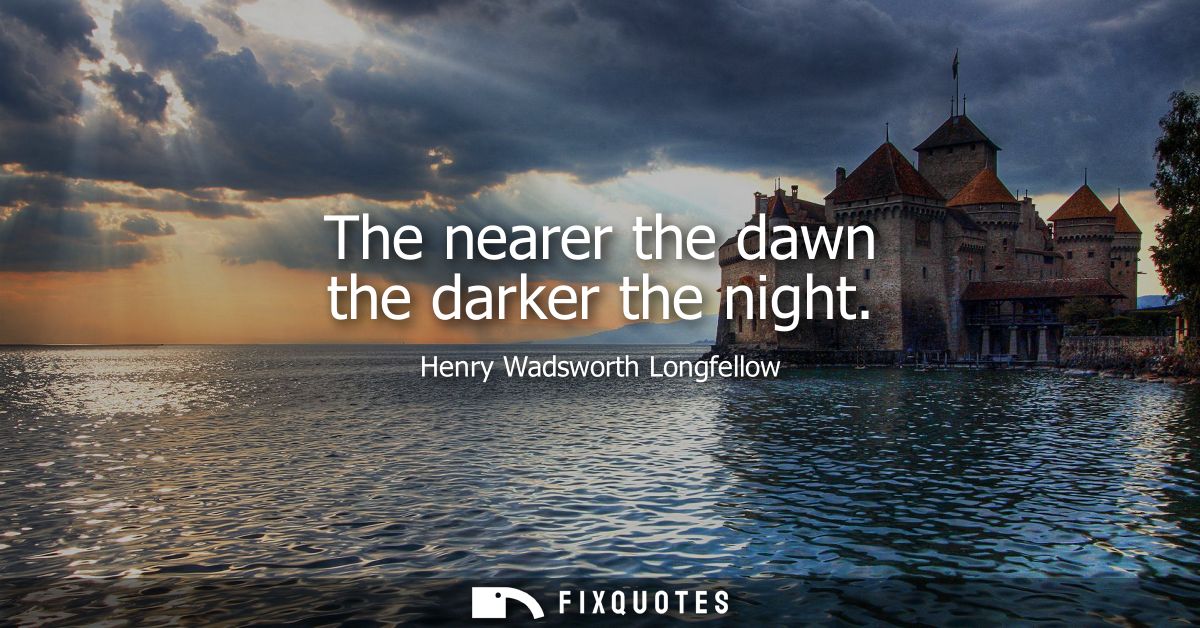
"The nearer the dawn, the darker the night"
About this Quote
Hope, in Longfellow's hands, is never the saccharine kind that arrives on schedule. "The nearer the dawn the darker the night" works because it flips the usual trajectory of optimism: instead of light steadily winning, the world seems to get worse right before it gets better. The line leans on a simple physical truth (eyes adjust; pre-dawn can feel pitch-black) to smuggle in a psychological one: when change is imminent, stress spikes. Anticipation sharpens fear. The mind, sensing an ending, panics and tries to prove the ending won't come.
Longfellow wrote as a poet of moral weather reports, often threading consolation through catastrophe. In 19th-century America, "dawn" was a loaded symbol - of national progress, religious renewal, abolitionist horizons, the promise of a more coherent republic. But Longfellow also lived amid grief and political fracture, and his poems frequently admit how stubborn suffering can be. The subtext is not "keep smiling"; it's "expect resistance". Darkness intensifies precisely when the old order feels threatened.
That's why the sentence endures as a piece of cultural self-talk in crises: reform movements, personal recoveries, even political cycles adopt it like a talisman. It gives people permission to interpret escalation not as failure but as a sign of proximity - a narrative hack that turns despair into a countdown. The cleverness is its double edge: it consoles, but it also warns that hope has a cost, and the bill often comes due right before morning.
Longfellow wrote as a poet of moral weather reports, often threading consolation through catastrophe. In 19th-century America, "dawn" was a loaded symbol - of national progress, religious renewal, abolitionist horizons, the promise of a more coherent republic. But Longfellow also lived amid grief and political fracture, and his poems frequently admit how stubborn suffering can be. The subtext is not "keep smiling"; it's "expect resistance". Darkness intensifies precisely when the old order feels threatened.
That's why the sentence endures as a piece of cultural self-talk in crises: reform movements, personal recoveries, even political cycles adopt it like a talisman. It gives people permission to interpret escalation not as failure but as a sign of proximity - a narrative hack that turns despair into a countdown. The cleverness is its double edge: it consoles, but it also warns that hope has a cost, and the bill often comes due right before morning.
Quote Details
| Topic | Hope |
|---|---|
| Source | Help us find the source |
| Cite |
Citation Formats
APA Style (7th ed.)
Longfellow, Henry Wadsworth. (2026, February 20). The nearer the dawn, the darker the night. FixQuotes. https://fixquotes.com/quotes/the-nearer-the-dawn-the-darker-the-night-19979/
Chicago Style
Longfellow, Henry Wadsworth. "The nearer the dawn, the darker the night." FixQuotes. February 20, 2026. https://fixquotes.com/quotes/the-nearer-the-dawn-the-darker-the-night-19979/.
MLA Style (9th ed.)
"The nearer the dawn, the darker the night." FixQuotes, 20 Feb. 2026, https://fixquotes.com/quotes/the-nearer-the-dawn-the-darker-the-night-19979/. Accessed 30 Mar. 2026.
More Quotes by Henry
Add to List