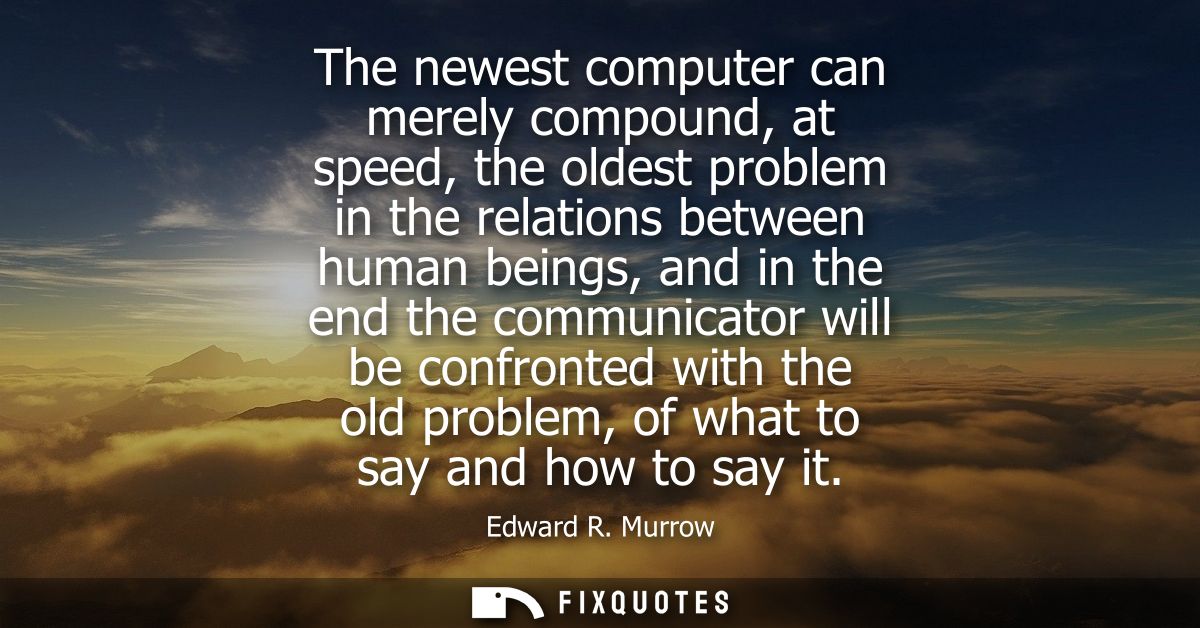
"The newest computer can merely compound, at speed, the oldest problem in the relations between human beings, and in the end the communicator will be confronted with the old problem, of what to say and how to say it"
About this Quote
The intent is not anti-technology so much as anti-hype. Murrow is stripping the machine of its magical aura and returning responsibility to the communicator. That final turn - “what to say and how to say it” - is deceptively plain, a craftsman’s credo disguised as common sense. He’s talking about ethics as much as style: accuracy, restraint, proportion, the discipline to choose signal over noise.
The subtext carries Murrow’s broader anxieties about mass media. In his era, television could bring the world into living rooms, but it could also turn public life into spectacle and sell certainty at a discount. Swap “computer” for “platform” and the quote becomes painfully current: technology scales our instincts faster than it improves our judgment. The hard part remains unchanged and unglamorous - having something worth saying, and saying it in a way that doesn’t betray the truth or the audience.
Quote Details
| Topic | Wisdom |
|---|---|
| Source | Help us find the source |
| Cite |
Citation Formats
APA Style (7th ed.)
Murrow, Edward R. (2026, January 17). The newest computer can merely compound, at speed, the oldest problem in the relations between human beings, and in the end the communicator will be confronted with the old problem, of what to say and how to say it. FixQuotes. https://fixquotes.com/quotes/the-newest-computer-can-merely-compound-at-speed-59043/
Chicago Style
Murrow, Edward R. "The newest computer can merely compound, at speed, the oldest problem in the relations between human beings, and in the end the communicator will be confronted with the old problem, of what to say and how to say it." FixQuotes. January 17, 2026. https://fixquotes.com/quotes/the-newest-computer-can-merely-compound-at-speed-59043/.
MLA Style (9th ed.)
"The newest computer can merely compound, at speed, the oldest problem in the relations between human beings, and in the end the communicator will be confronted with the old problem, of what to say and how to say it." FixQuotes, 17 Jan. 2026, https://fixquotes.com/quotes/the-newest-computer-can-merely-compound-at-speed-59043/. Accessed 12 Feb. 2026.