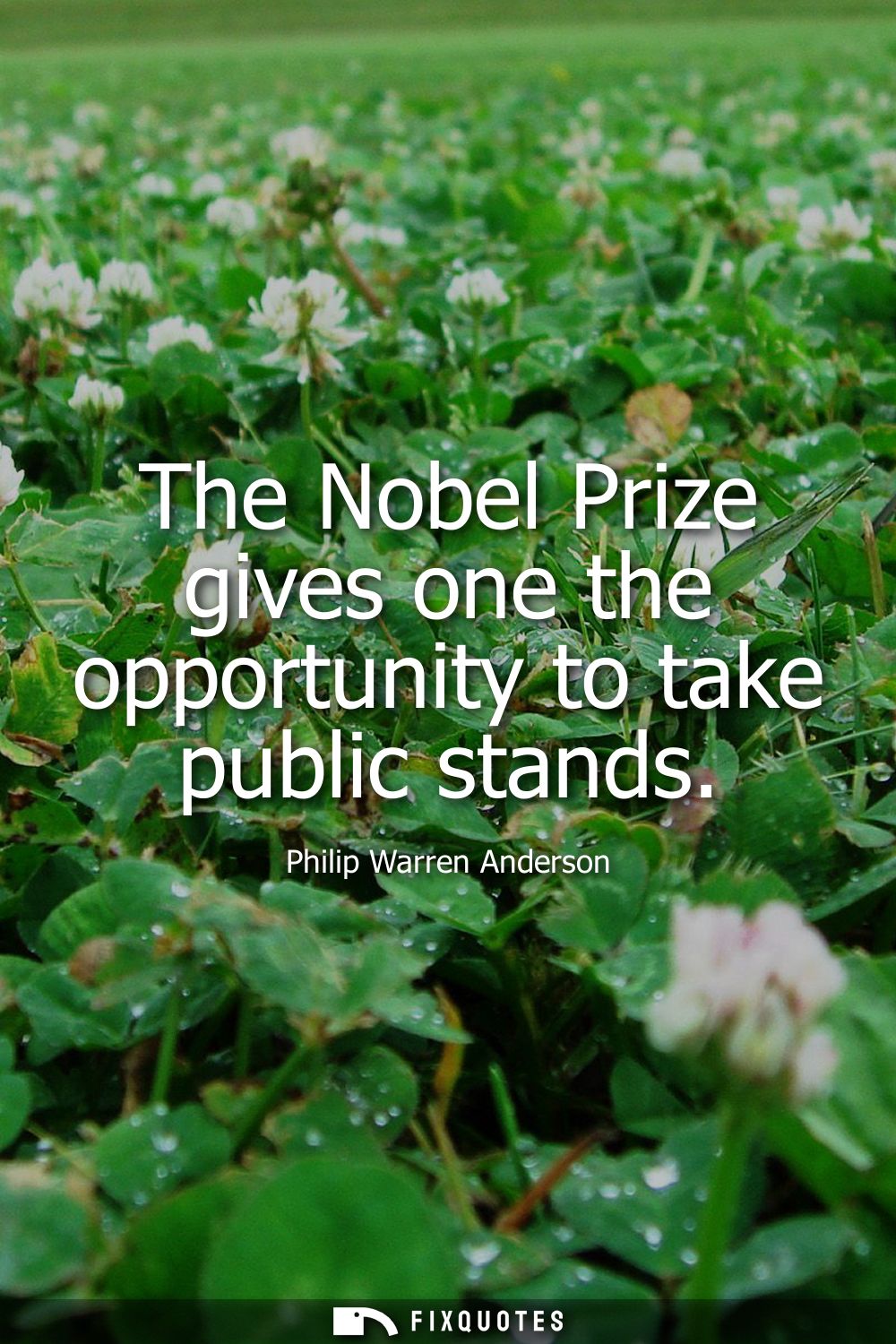
"The Nobel Prize gives one the opportunity to take public stands"
About this Quote
The subtext is both pragmatic and slightly wary. “Public stands” hints at controversy, at positions that will draw fire. Anderson isn’t romantic about the marketplace of ideas; he’s realistic about the marketplace of attention. A Nobel can convert a lab-bound career into a platform where one can challenge bad policy, defend basic research, or puncture fashionable overreach (including, in Anderson’s case, scientific overconfidence about reducing complex systems to simple laws). The line carries an ethical nudge: if you’re handed a rare instrument of influence, you’re not obliged to stay quiet.
Context sharpens the intent. Anderson lived through the century in which science became inseparable from state power, industry, and existential risk. In that world, neutrality can read as abdication. His quote is a minimalist theory of the public intellectual: you don’t earn a hearing by being right; you earn it, often unfairly, by being anointed. The real question he leaves hanging is what you do with that anointment: amplify evidence, or merely your ego.
Quote Details
| Topic | Leadership |
|---|---|
| Source | Help us find the source |
| Cite |
Citation Formats
APA Style (7th ed.)
Anderson, Philip Warren. (2026, January 16). The Nobel Prize gives one the opportunity to take public stands. FixQuotes. https://fixquotes.com/quotes/the-nobel-prize-gives-one-the-opportunity-to-take-109427/
Chicago Style
Anderson, Philip Warren. "The Nobel Prize gives one the opportunity to take public stands." FixQuotes. January 16, 2026. https://fixquotes.com/quotes/the-nobel-prize-gives-one-the-opportunity-to-take-109427/.
MLA Style (9th ed.)
"The Nobel Prize gives one the opportunity to take public stands." FixQuotes, 16 Jan. 2026, https://fixquotes.com/quotes/the-nobel-prize-gives-one-the-opportunity-to-take-109427/. Accessed 30 Mar. 2026.