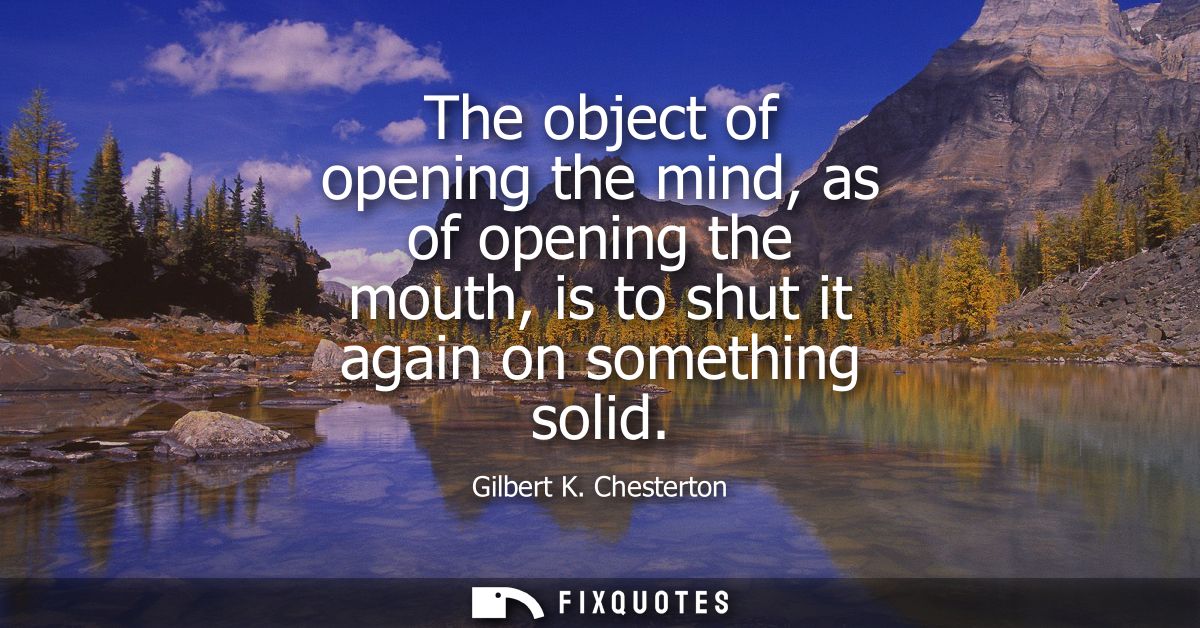
"The object of opening the mind, as of opening the mouth, is to shut it again on something solid"
About this Quote
The subtext is a jab at the early 20th-century fashion for intellectual drift - the polite skepticism that treats certainty as vulgar and commitment as naive. Chesterton, a Catholic convert and professional debunker of elite orthodoxies, is warning that endless questioning can become its own dogma. “Something solid” is pointedly material: not a vibe, not an impression, not a tasteful ambivalence, but an idea sturdy enough to bite down on, chew, and live by.
What makes the aphorism work is its refusal to let “open-minded” remain an unqualified virtue. It reframes the moral ideal from endless tolerance to disciplined judgment. Chesterton isn’t celebrating closed-mindedness; he’s attacking the limp, performative openness that confuses motion with progress. The closing action isn’t the end of thought but the proof that thought has happened - that inquiry has produced a conclusion with weight, even if provisional.
In a culture that rewards endless takes and punishes being wrong more than being empty, the quip still lands: an open mind, like an open mouth, looks impressive only until it starts to drool.
Quote Details
| Topic | Wisdom |
|---|---|
| Source | Unverified source: Tremendous Trifles (Gilbert K. Chesterton, 1909)
Evidence: For my friend said that he opened his intellect as the sun opens the fans of a palm tree, opening for opening's sake, opening infinitely for ever. But I said that I opened my intellect as I opened my mouth, in order to shut it again on something solid. (Page 24 (Wikisource scan: djvu/36); essay e... Other candidates (1) A Dictionary of Scientific Quotations (Alan L. Mackay, 1991) compilation95.0% Alan L. Mackay. 54 53 54 Gilbert Keith Chesterton A man must love a thing very much if he not only practices it ... T... |
| Cite |
Citation Formats
APA Style (7th ed.)
Chesterton, Gilbert K. (2026, February 15). The object of opening the mind, as of opening the mouth, is to shut it again on something solid. FixQuotes. https://fixquotes.com/quotes/the-object-of-opening-the-mind-as-of-opening-the-51952/
Chicago Style
Chesterton, Gilbert K. "The object of opening the mind, as of opening the mouth, is to shut it again on something solid." FixQuotes. February 15, 2026. https://fixquotes.com/quotes/the-object-of-opening-the-mind-as-of-opening-the-51952/.
MLA Style (9th ed.)
"The object of opening the mind, as of opening the mouth, is to shut it again on something solid." FixQuotes, 15 Feb. 2026, https://fixquotes.com/quotes/the-object-of-opening-the-mind-as-of-opening-the-51952/. Accessed 31 Mar. 2026.