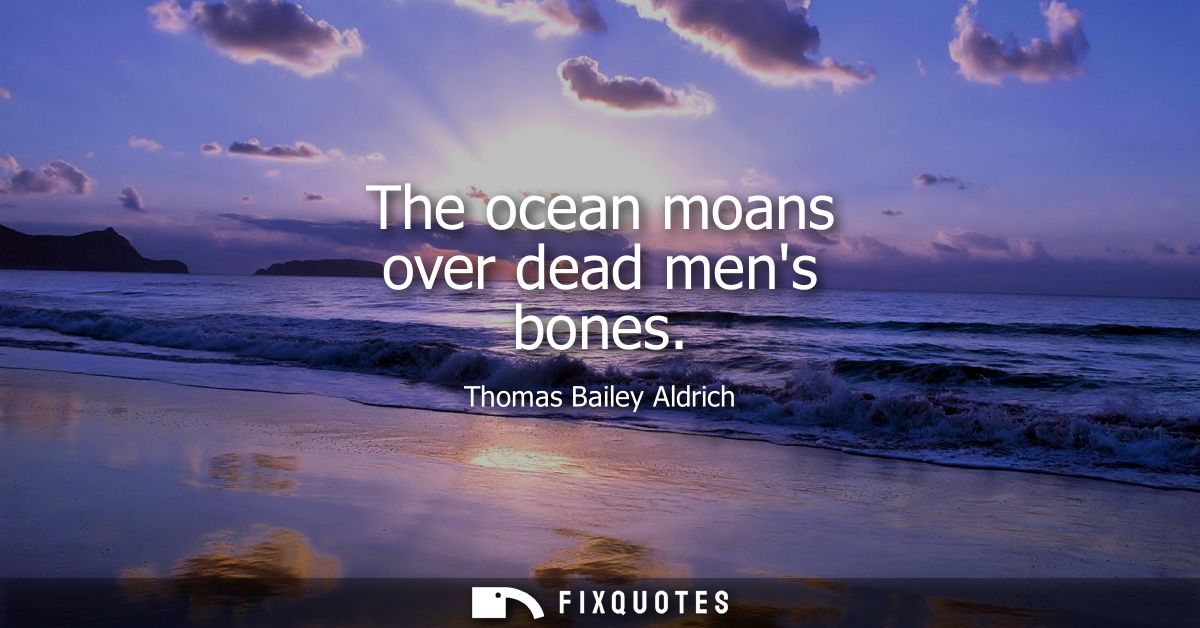
"The ocean moans over dead men's bones"
About this Quote
Sound does the heavy lifting here: the ocean "moans" like a living thing, and in that one verb Aldrich turns landscape into mourner, accomplice, and historian. This isn't the sea as postcard. It's the sea as a throat that can’t stop making noise, a perpetual grieving that never quite resolves into silence. The line’s blunt music - the long O in "ocean", "moans", "bones" - is almost funereal, a sonic undertow pulling you from wide horizon to a claustrophobic image of remains.
The specific intent is to compress maritime death into a single, repeatable sensation. Rather than narrate a shipwreck, Aldrich gives you its afterlife: bodies reduced to bones, then reduced further to a rumor carried in surf. The subtext is an argument about scale and erasure. Human lives end; the sea keeps going, and its continuing motion can feel like mourning but also like indifference dressed up as elegy. "Dead men's" also tips the line toward the gendered mythology of seafaring - the romantic and violent masculine theater of the 19th-century ocean, where work, empire, and disaster converged.
Context matters: Aldrich writes in a period fascinated by the sublime, by nature as both spiritual force and mechanical power. His move is to fuse gothic imagery with a near-journalistic spareness. No adjectives, no rescue, no moral. Just sound, bone, water - and the uneasy idea that what we call "nature's voice" may simply be the world grinding on over what it has taken.
The specific intent is to compress maritime death into a single, repeatable sensation. Rather than narrate a shipwreck, Aldrich gives you its afterlife: bodies reduced to bones, then reduced further to a rumor carried in surf. The subtext is an argument about scale and erasure. Human lives end; the sea keeps going, and its continuing motion can feel like mourning but also like indifference dressed up as elegy. "Dead men's" also tips the line toward the gendered mythology of seafaring - the romantic and violent masculine theater of the 19th-century ocean, where work, empire, and disaster converged.
Context matters: Aldrich writes in a period fascinated by the sublime, by nature as both spiritual force and mechanical power. His move is to fuse gothic imagery with a near-journalistic spareness. No adjectives, no rescue, no moral. Just sound, bone, water - and the uneasy idea that what we call "nature's voice" may simply be the world grinding on over what it has taken.
Quote Details
| Topic | Ocean & Sea |
|---|---|
| Source | Later attribution: English Quotations Complete Collection: Volume X (Daniel B. Smith, 2022) modern compilationID: QvghEQAAQBAJ
Evidence:
Daniel B. Smith. Quotations. by. Thomas. Bailey. Aldrich. (15). Thomas Bailey Aldrich was an American writer, poet, critic ... The ocean moans over dead men's bones.” 11.“The walking delegates of a higher civilization, who have nothing to ... |
| Cite |
Citation Formats
APA Style (7th ed.)
Aldrich, Thomas Bailey. (2026, March 23). The ocean moans over dead men's bones. FixQuotes. https://fixquotes.com/quotes/the-ocean-moans-over-dead-mens-bones-107412/
Chicago Style
Aldrich, Thomas Bailey. "The ocean moans over dead men's bones." FixQuotes. March 23, 2026. https://fixquotes.com/quotes/the-ocean-moans-over-dead-mens-bones-107412/.
MLA Style (9th ed.)
"The ocean moans over dead men's bones." FixQuotes, 23 Mar. 2026, https://fixquotes.com/quotes/the-ocean-moans-over-dead-mens-bones-107412/. Accessed 30 Mar. 2026.
More Quotes by Thomas
Add to List