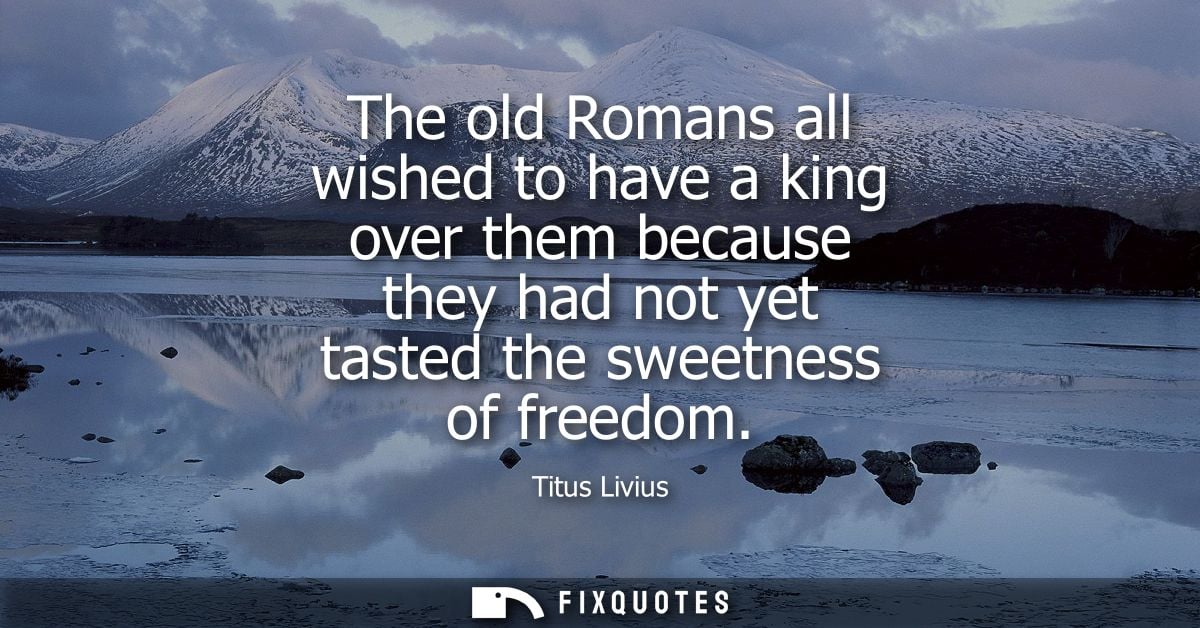
"The old Romans all wished to have a king over them because they had not yet tasted the sweetness of freedom"
About this Quote
The subtext is a warning shot aimed at Livy’s own age. Writing under Augustus, when Rome had effectively traded a republican façade for one-man stability, Livy could not openly sermonize about lost liberties without courting trouble. So he routes the argument through antiquity: early Romans want a king; later Romans learn to defend freedom. The implication is uncomfortable and contemporary: a people can be trained into liberty, but they can also be coaxed out of it by forgetting its taste.
It also flatters Roman exceptionalism. Livy implies Rome’s greatness required a moral evolution from dependence to self-rule, turning constitutional change into a coming-of-age story. The line works because it naturalizes political education while quietly indicting any audience ready to “wish” for a king again: wanting the strongman isn’t just fear, it’s ignorance dressed as nostalgia.
Quote Details
| Topic | Freedom |
|---|---|
| Source | Help us find the source |
| Cite |
Citation Formats
APA Style (7th ed.)
Livius, Titus. (2026, January 17). The old Romans all wished to have a king over them because they had not yet tasted the sweetness of freedom. FixQuotes. https://fixquotes.com/quotes/the-old-romans-all-wished-to-have-a-king-over-77826/
Chicago Style
Livius, Titus. "The old Romans all wished to have a king over them because they had not yet tasted the sweetness of freedom." FixQuotes. January 17, 2026. https://fixquotes.com/quotes/the-old-romans-all-wished-to-have-a-king-over-77826/.
MLA Style (9th ed.)
"The old Romans all wished to have a king over them because they had not yet tasted the sweetness of freedom." FixQuotes, 17 Jan. 2026, https://fixquotes.com/quotes/the-old-romans-all-wished-to-have-a-king-over-77826/. Accessed 2 Apr. 2026.