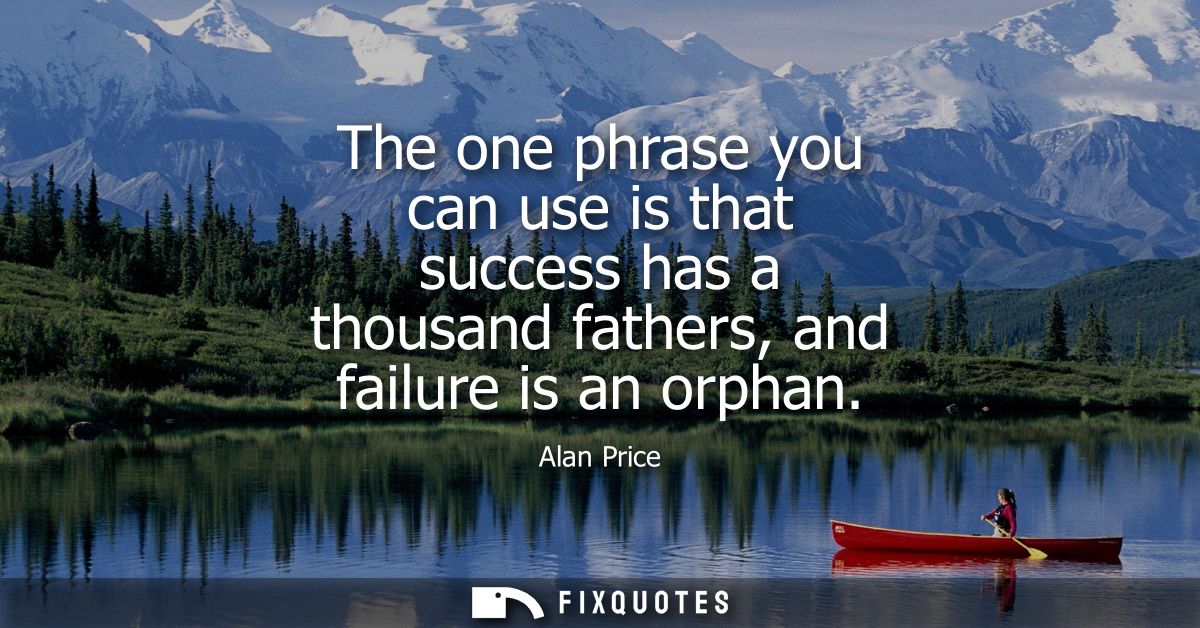
"The one phrase you can use is that success has a thousand fathers, and failure is an orphan"
About this Quote
The intent is less moral lesson than warning label. "A thousand fathers" makes success feel almost comically over-parented, smothered by people eager to attach their name to it. The image also carries a quiet accusation: paternity here isn't care, it's ownership. If you can claim authorship, you can claim credit, money, proximity to cool. "Failure is an orphan" flips the emotional register. Orphans don't just lack parents; they're socially unclaimed, made to bear their identity alone. Price is pointing at the way communities, teams, and scenes protect their reputations by disowning the flop.
Subtextually, it's about how narratives get rewritten after the fact. When something lands, the story becomes orderly: mentors appear, decisive meetings get retroactively emphasized, risks become "smart choices". When it doesn't, the messy reality returns and everyone vanishes. Coming from a working musician, the line reads like hard-won cynicism: don't confuse the applause with loyalty, and don't expect the same people who celebrate your rise to stand beside you when the numbers dip.
Quote Details
| Topic | Success |
|---|---|
| Source | Help us find the source |
| Cite |
Citation Formats
APA Style (7th ed.)
Price, Alan. (2026, January 16). The one phrase you can use is that success has a thousand fathers, and failure is an orphan. FixQuotes. https://fixquotes.com/quotes/the-one-phrase-you-can-use-is-that-success-has-a-125641/
Chicago Style
Price, Alan. "The one phrase you can use is that success has a thousand fathers, and failure is an orphan." FixQuotes. January 16, 2026. https://fixquotes.com/quotes/the-one-phrase-you-can-use-is-that-success-has-a-125641/.
MLA Style (9th ed.)
"The one phrase you can use is that success has a thousand fathers, and failure is an orphan." FixQuotes, 16 Jan. 2026, https://fixquotes.com/quotes/the-one-phrase-you-can-use-is-that-success-has-a-125641/. Accessed 31 Mar. 2026.