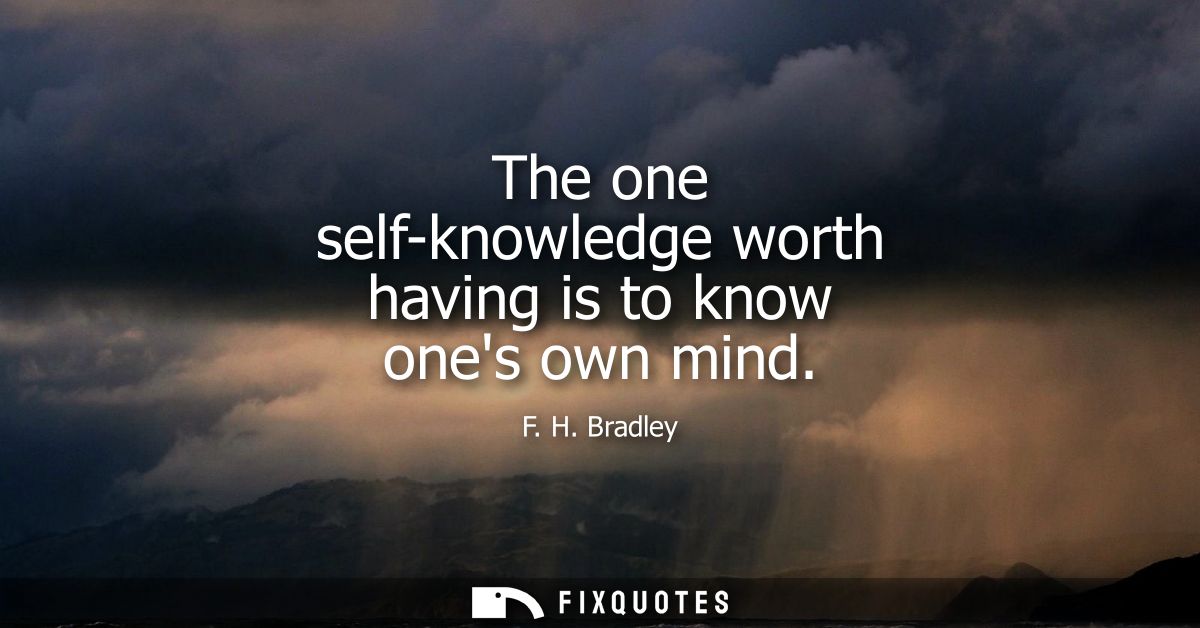
"The one self-knowledge worth having is to know one's own mind"
About this Quote
Bradley’s line is a neat piece of philosophical gatekeeping: he narrows the bloated modern project of “self-discovery” down to something tougher, less flattering, and more actionable. “Self-knowledge” is usually sold as a scavenger hunt through biography, trauma, personality tests, and aesthetic identity. Bradley cuts across that and insists the only kind that matters is epistemic: can you actually tell what you think?
The phrasing is deceptively plain. “Worth having” carries a cool, almost impatient utilitarianism: not all introspection deserves the name. “To know one’s own mind” sounds simple until you remember how slippery a mind is. We mistake moods for beliefs, borrowed opinions for convictions, and social instincts for reasons. Bradley’s intent is to relocate the self from a bundle of anecdotes to a disciplined awareness of judgment: what you assent to, what you reject, and why.
Context matters. As a leading British Idealist, Bradley was pushing back against a certain confidence in common-sense psychology and the idea that the mind is transparently available to itself. His subtext is that most people don’t possess their thinking; they are possessed by it. Knowing your mind isn’t navel-gazing, it’s a kind of philosophical hygiene: distinguishing impulse from principle, rhetoric from belief, and private rationalization from genuine commitment.
It also lands as a quiet ethical demand. If you can’t state your own mind clearly, you can’t be responsible for it. Bradley’s “self-knowledge” is less about finding yourself than about owning your thought.
The phrasing is deceptively plain. “Worth having” carries a cool, almost impatient utilitarianism: not all introspection deserves the name. “To know one’s own mind” sounds simple until you remember how slippery a mind is. We mistake moods for beliefs, borrowed opinions for convictions, and social instincts for reasons. Bradley’s intent is to relocate the self from a bundle of anecdotes to a disciplined awareness of judgment: what you assent to, what you reject, and why.
Context matters. As a leading British Idealist, Bradley was pushing back against a certain confidence in common-sense psychology and the idea that the mind is transparently available to itself. His subtext is that most people don’t possess their thinking; they are possessed by it. Knowing your mind isn’t navel-gazing, it’s a kind of philosophical hygiene: distinguishing impulse from principle, rhetoric from belief, and private rationalization from genuine commitment.
It also lands as a quiet ethical demand. If you can’t state your own mind clearly, you can’t be responsible for it. Bradley’s “self-knowledge” is less about finding yourself than about owning your thought.
Quote Details
| Topic | Wisdom |
|---|---|
| Source | Help us find the source |
| Cite |
Citation Formats
APA Style (7th ed.)
Bradley, F. H. (2026, January 18). The one self-knowledge worth having is to know one's own mind. FixQuotes. https://fixquotes.com/quotes/the-one-self-knowledge-worth-having-is-to-know-15341/
Chicago Style
Bradley, F. H. "The one self-knowledge worth having is to know one's own mind." FixQuotes. January 18, 2026. https://fixquotes.com/quotes/the-one-self-knowledge-worth-having-is-to-know-15341/.
MLA Style (9th ed.)
"The one self-knowledge worth having is to know one's own mind." FixQuotes, 18 Jan. 2026, https://fixquotes.com/quotes/the-one-self-knowledge-worth-having-is-to-know-15341/. Accessed 27 Mar. 2026.
More Quotes by H. Bradley
Add to List