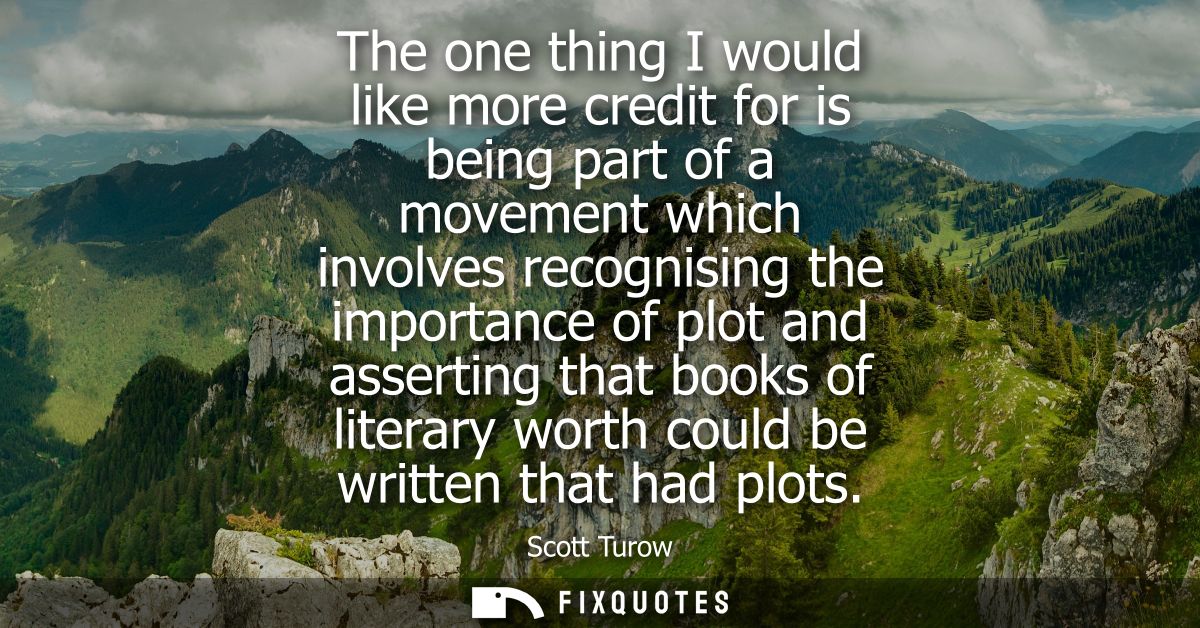
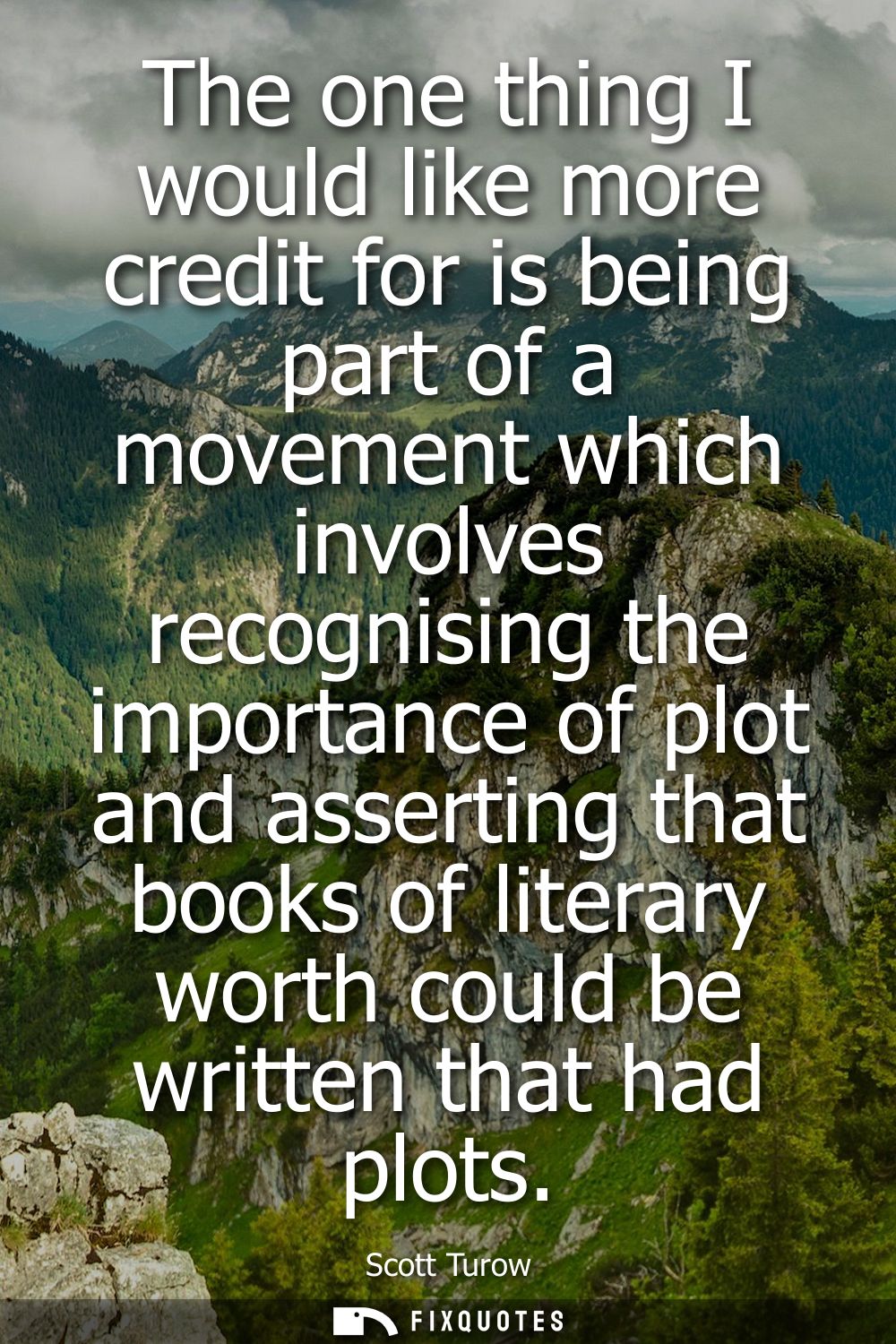
"The one thing I would like more credit for is being part of a movement which involves recognising the importance of plot and asserting that books of literary worth could be written that had plots"
About this Quote
The intent is revisionist. Turow is repositioning his own career inside a broader late-20th-century turn that blurred the boundary between genre and “literary” writing, insisting that narrative propulsion isn’t the enemy of style, psychology, or moral complexity. He’s not merely defending plot; he’s defending a reader. The subtext is that gatekeepers confused difficulty with depth, and that the prestige economy in publishing has sometimes rewarded books that perform seriousness by withholding the basic satisfactions of story.
Context matters: Turow arrives after postwar experimentation and at the crest of a commercial boom where the “serious” novelist could either disdain the marketplace or be suspected of pandering. By saying “movement,” he claims lineage and ideology, not just sales. The rhetoric works because it’s simultaneously modest and combative: he’s not claiming he reinvented literature, just that he helped normalize an unfashionable proposition - that craft can include suspense, pacing, and consequence without forfeiting artistic ambition. It’s a bid to collapse a false binary: plotless equals pure, plotted equals cheap.
Quote Details
| Topic | Writing |
|---|---|
| Source | Help us find the source |
| Cite |
Citation Formats
APA Style (7th ed.)
Turow, Scott. (2026, January 15). The one thing I would like more credit for is being part of a movement which involves recognising the importance of plot and asserting that books of literary worth could be written that had plots. FixQuotes. https://fixquotes.com/quotes/the-one-thing-i-would-like-more-credit-for-is-169705/
Chicago Style
Turow, Scott. "The one thing I would like more credit for is being part of a movement which involves recognising the importance of plot and asserting that books of literary worth could be written that had plots." FixQuotes. January 15, 2026. https://fixquotes.com/quotes/the-one-thing-i-would-like-more-credit-for-is-169705/.
MLA Style (9th ed.)
"The one thing I would like more credit for is being part of a movement which involves recognising the importance of plot and asserting that books of literary worth could be written that had plots." FixQuotes, 15 Jan. 2026, https://fixquotes.com/quotes/the-one-thing-i-would-like-more-credit-for-is-169705/. Accessed 31 Mar. 2026.