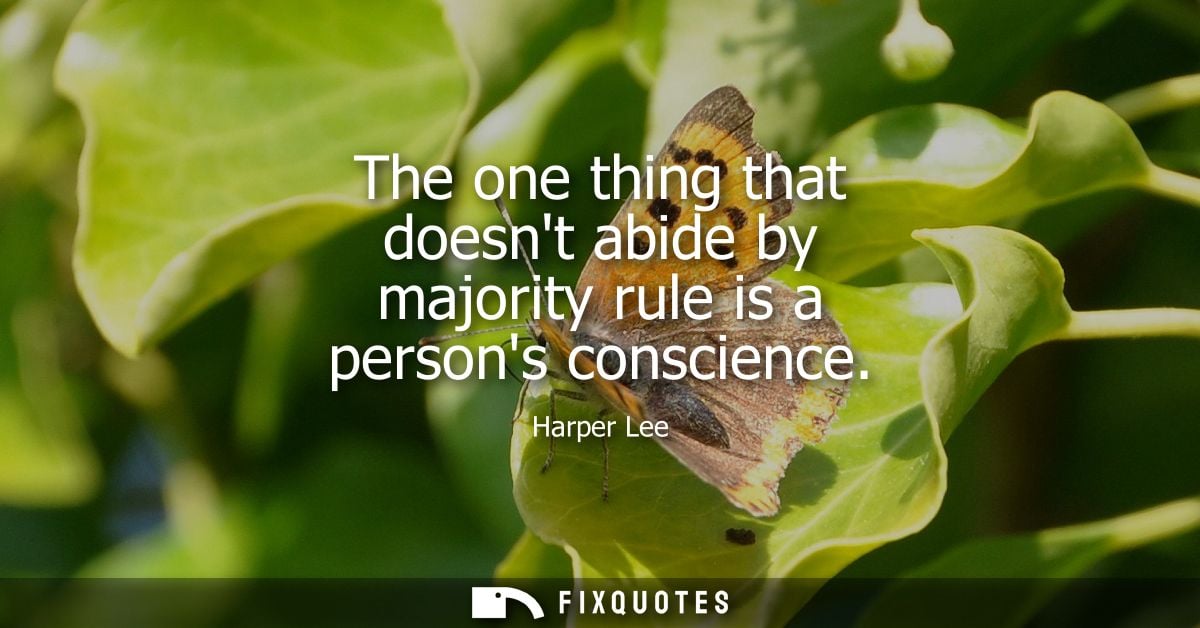
"The one thing that doesn't abide by majority rule is a person's conscience"
About this Quote
A neat, courtroom-ready line like this does two jobs at once: it flatters democracy while warning that democracy is not a moral solvent. In Harper Lee's world, the “majority” isn’t just a headcount; it’s a social machine, the kind that can vote itself into righteousness while preserving cruelty as custom. By putting “conscience” outside majority rule, Lee isolates the lone internal tribunal that can’t be whipped into line by applause, tradition, or fear of being talked about at the general store.
The subtext is sharper than it first appears. Conscience here isn’t a vibe or private preference; it’s a stubborn, potentially costly refusal to outsource right and wrong. The phrase “doesn’t abide” carries a quiet defiance, suggesting an active noncompliance rather than a passive difference of opinion. You can belong to the community, even love it, and still be obligated to resist it. That tension is the moral engine of To Kill a Mockingbird: the town’s consensus is polished, unanimous, and disastrously wrong, while integrity looks like one person standing alone, being called arrogant for having a spine.
Context matters: the line comes out of a mid-century Southern setting where law, religion, and etiquette often collaborate to launder prejudice into “the way things are.” Lee’s intent isn’t to romanticize individualism for its own sake; it’s to name the real enemy of justice: the comforting fiction that if enough people agree, the agreement becomes truth. Conscience, in her telling, is the last place a society’s lies can’t automatically win.
The subtext is sharper than it first appears. Conscience here isn’t a vibe or private preference; it’s a stubborn, potentially costly refusal to outsource right and wrong. The phrase “doesn’t abide” carries a quiet defiance, suggesting an active noncompliance rather than a passive difference of opinion. You can belong to the community, even love it, and still be obligated to resist it. That tension is the moral engine of To Kill a Mockingbird: the town’s consensus is polished, unanimous, and disastrously wrong, while integrity looks like one person standing alone, being called arrogant for having a spine.
Context matters: the line comes out of a mid-century Southern setting where law, religion, and etiquette often collaborate to launder prejudice into “the way things are.” Lee’s intent isn’t to romanticize individualism for its own sake; it’s to name the real enemy of justice: the comforting fiction that if enough people agree, the agreement becomes truth. Conscience, in her telling, is the last place a society’s lies can’t automatically win.
Quote Details
| Topic | Ethics & Morality |
|---|---|
| Source | To Kill a Mockingbird (1960) — Atticus Finch: "The one thing that doesn't abide by majority rule is a person's conscience." |
More Quotes by Harper
Add to List