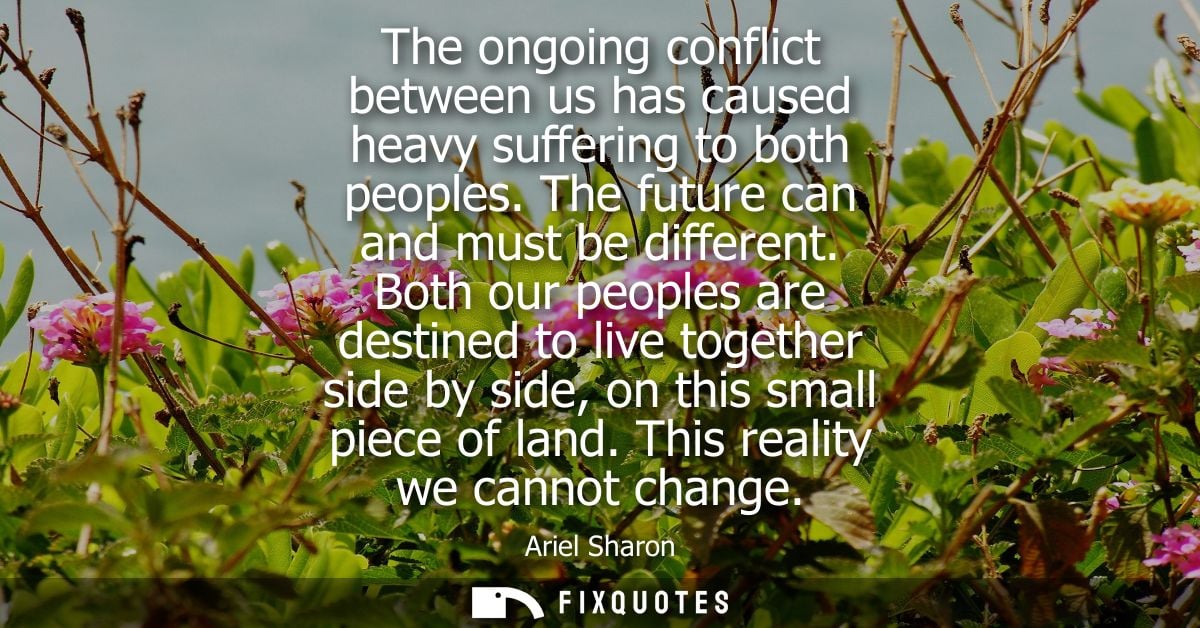
"The ongoing conflict between us has caused heavy suffering to both peoples. The future can and must be different. Both our peoples are destined to live together side by side, on this small piece of land. This reality we cannot change"
About this Quote
“The future can and must be different” couples hope with compulsion, a classic leader’s maneuver that turns contingency into duty. “Can” reassures the dreamers; “must” disciplines the skeptics. Sharon is sketching inevitability, not idealism. He’s telling his audience that separation or accommodation isn’t a concession to the other side; it’s the only sustainable posture for self-preservation. That’s reinforced by the phrase “destined to live together side by side,” which borrows the moral glow of coexistence while keeping the frame territorial and pragmatic: two peoples, one small land, no exit.
“This reality we cannot change” is the quote’s steel spine. It strips away fantasies - of total victory, of demographic escape, of permanent domination - and replaces them with geography. Subtext: you may dislike the neighbor, but you can’t evict history. In Sharon’s context, this reads less like reconciliation than a hard-nosed admission that the conflict is a treadmill: costly, endless, politically corrosive. The line aims to legitimize policy shifts (from containment to disengagement or negotiation) by presenting them as realism, not softness - a leader’s attempt to drag a fractious public toward the constraints they already live under.
Quote Details
| Topic | Peace |
|---|---|
| Source | Help us find the source |
| Cite |
Citation Formats
APA Style (7th ed.)
Sharon, Ariel. (2026, January 17). The ongoing conflict between us has caused heavy suffering to both peoples. The future can and must be different. Both our peoples are destined to live together side by side, on this small piece of land. This reality we cannot change. FixQuotes. https://fixquotes.com/quotes/the-ongoing-conflict-between-us-has-caused-heavy-38350/
Chicago Style
Sharon, Ariel. "The ongoing conflict between us has caused heavy suffering to both peoples. The future can and must be different. Both our peoples are destined to live together side by side, on this small piece of land. This reality we cannot change." FixQuotes. January 17, 2026. https://fixquotes.com/quotes/the-ongoing-conflict-between-us-has-caused-heavy-38350/.
MLA Style (9th ed.)
"The ongoing conflict between us has caused heavy suffering to both peoples. The future can and must be different. Both our peoples are destined to live together side by side, on this small piece of land. This reality we cannot change." FixQuotes, 17 Jan. 2026, https://fixquotes.com/quotes/the-ongoing-conflict-between-us-has-caused-heavy-38350/. Accessed 12 Feb. 2026.