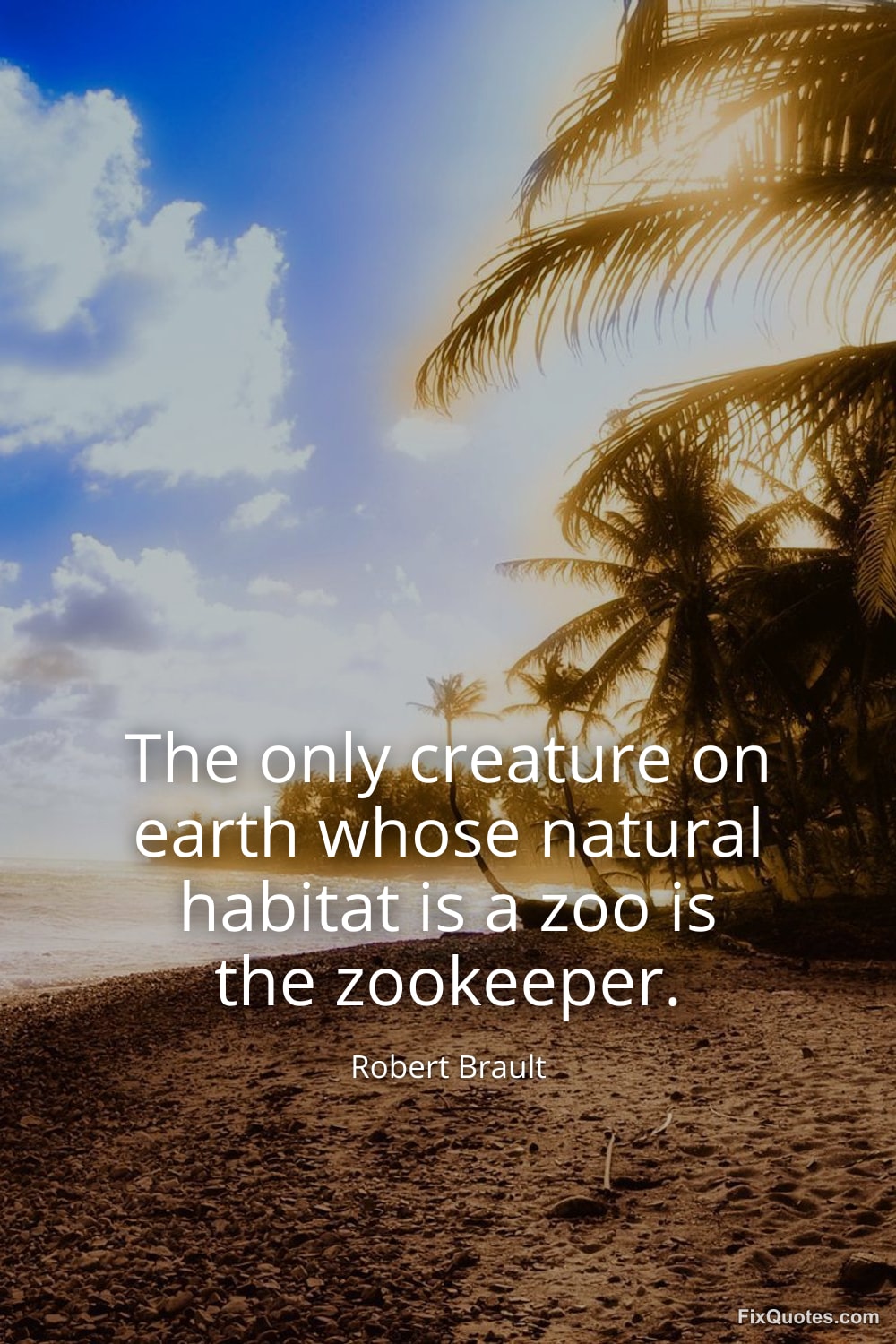
"The only creature on earth whose natural habitat is a zoo is the zookeeper"
About this Quote
A zoo is supposed to be a human invention that corrals the wild for our viewing pleasure; Brault flips that premise with a clean little trapdoor. If any being truly belongs in the zoo, he suggests, its the person who chose to live there. The line works because it punctures the moral alibi that zoos often borrow from conservation language. We tell ourselves the animals are safer, better fed, even happier. Brault sidesteps the animal-welfare debate and aims at the psychology of control: the urge not just to observe nature, but to curate it, label it, and make it perform its “nativeness” on schedule.
Calling the zookeepers habitat “natural” is the quiet barb. Zoos are the opposite of natural, so the word lands as irony: humans have become so adept at building artificial worlds that we can mistake them for an ecosystem we were meant to inhabit. The keeper is the only figure who freely opts into enclosure, routine, and surveillance. The animals are there by capture, breeding programs, or necessity; the keeper is there by preference, paycheck, and identity. That inversion turns the spectator into the exhibited.
The subtext isnt anti-zookeeper so much as anti-self-congratulation. Its a reminder that captivity is always a relationship: someone holds the keys, someone adapts, and everyone learns to call the arrangement normal. Read in a modern context of curated lives, from reality TV to social media feeds, the joke sharpens: the most “at home” in the cage may be the one who built it.
Calling the zookeepers habitat “natural” is the quiet barb. Zoos are the opposite of natural, so the word lands as irony: humans have become so adept at building artificial worlds that we can mistake them for an ecosystem we were meant to inhabit. The keeper is the only figure who freely opts into enclosure, routine, and surveillance. The animals are there by capture, breeding programs, or necessity; the keeper is there by preference, paycheck, and identity. That inversion turns the spectator into the exhibited.
The subtext isnt anti-zookeeper so much as anti-self-congratulation. Its a reminder that captivity is always a relationship: someone holds the keys, someone adapts, and everyone learns to call the arrangement normal. Read in a modern context of curated lives, from reality TV to social media feeds, the joke sharpens: the most “at home” in the cage may be the one who built it.
Quote Details
| Topic | Witty One-Liners |
|---|
More Quotes by Robert
Add to List