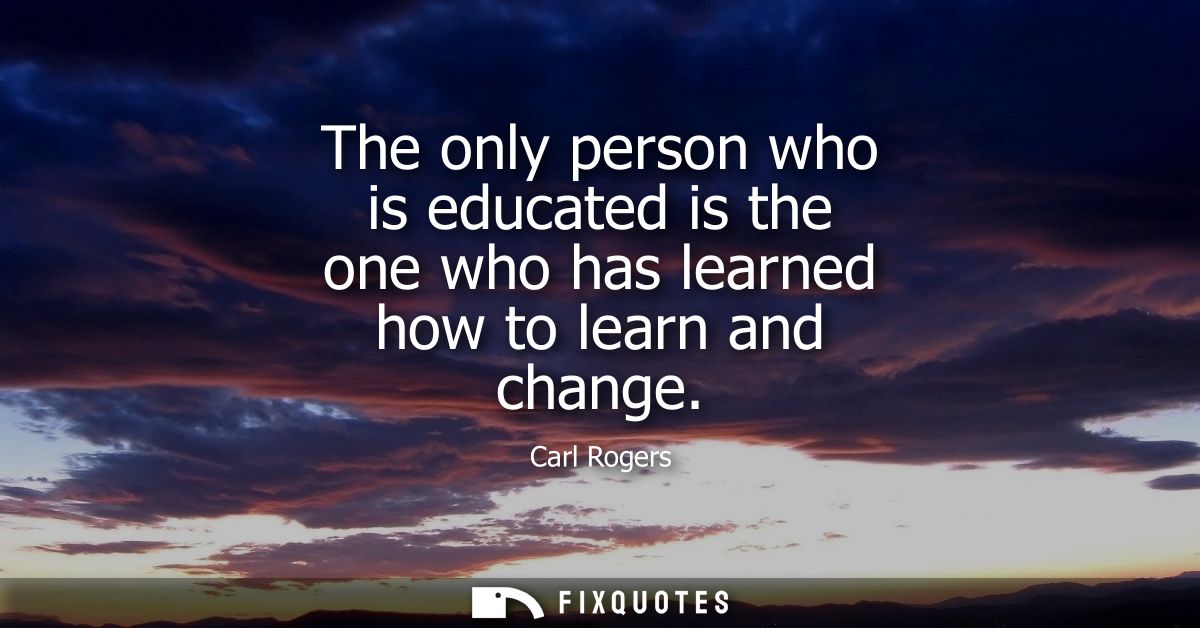
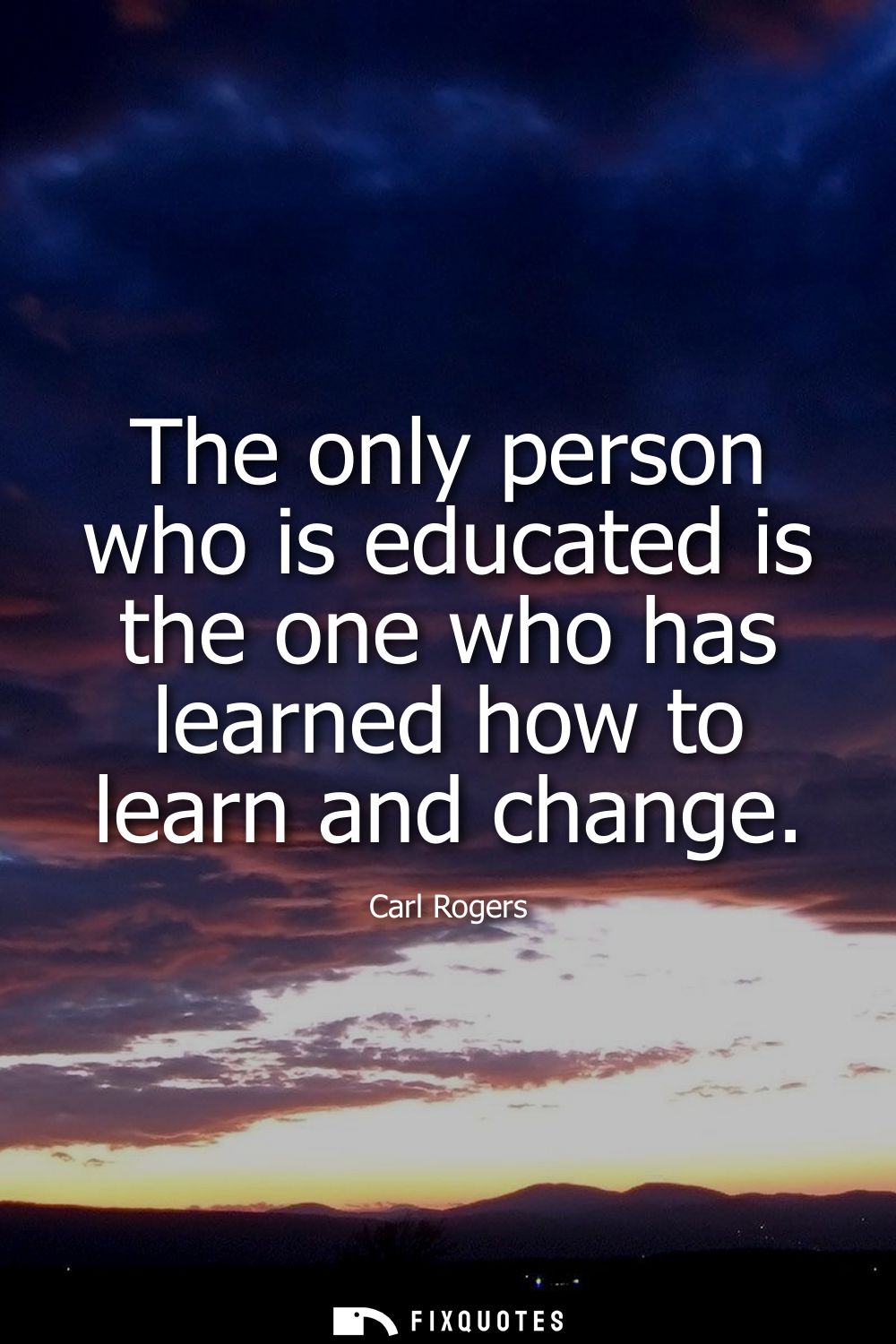
"The only person who is educated is the one who has learned how to learn and change"
About this Quote
The subtext is a rebuke to rigid expertise. Mid-century America loved systems: standardized testing, corporate hierarchies, behavioral models that treated people like predictable machines. Rogers pushed against that tide, insisting the self is not fixed and that change is not a failure state but a sign of health. Framing education as "learned how to learn and change" turns the classroom into a rehearsal for emotional and intellectual flexibility. It also smuggles in an ethical claim: if you can't revise your beliefs, you're not merely uninformed; you're unsafe with authority.
The sentence works because it's deceptively simple and slightly absolutist. "The only person" is a deliberate provocation, a narrowing that forces a choice: are you collecting knowledge like trophies, or building the capacity to update? In an era of rapidly shifting work, identity, and information ecosystems, Rogers's definition lands as both empowering and unsettling. It offers liberation from brittle status, while demanding the harder skill: being willing to become someone else.
Quote Details
| Topic | Learning |
|---|---|
| Source | Unverified source: Freedom to Learn: A View of What Education Might Become (Carl Rogers, 1969)
Evidence: Page 104. Primary-source match is in Carl R. Rogers’ own text. The wording commonly circulated online (“The only person who is educated is the one who has learned how to learn and change”) appears to be a shortened/modernized paraphrase of Rogers’ fuller sentence in Freedom to Learn (1969). Multi... Other candidates (2) Wisdom for the Soul (Larry Chang, 2006) compilation95.0% ... Carl Rogers , 1902-1987 ~ On Becoming a Person , 1961 The only person who is educated is the one who has learned ... Carl Rogers (Carl Rogers) compilation36.3% nce of the problems experienced by the group where they are clearly defined as issues allowance of the |
| Cite |
Citation Formats
APA Style (7th ed.)
Rogers, Carl. (2026, January 14). The only person who is educated is the one who has learned how to learn and change. FixQuotes. https://fixquotes.com/quotes/the-only-person-who-is-educated-is-the-one-who-2985/
Chicago Style
Rogers, Carl. "The only person who is educated is the one who has learned how to learn and change." FixQuotes. January 14, 2026. https://fixquotes.com/quotes/the-only-person-who-is-educated-is-the-one-who-2985/.
MLA Style (9th ed.)
"The only person who is educated is the one who has learned how to learn and change." FixQuotes, 14 Jan. 2026, https://fixquotes.com/quotes/the-only-person-who-is-educated-is-the-one-who-2985/. Accessed 1 Apr. 2026.