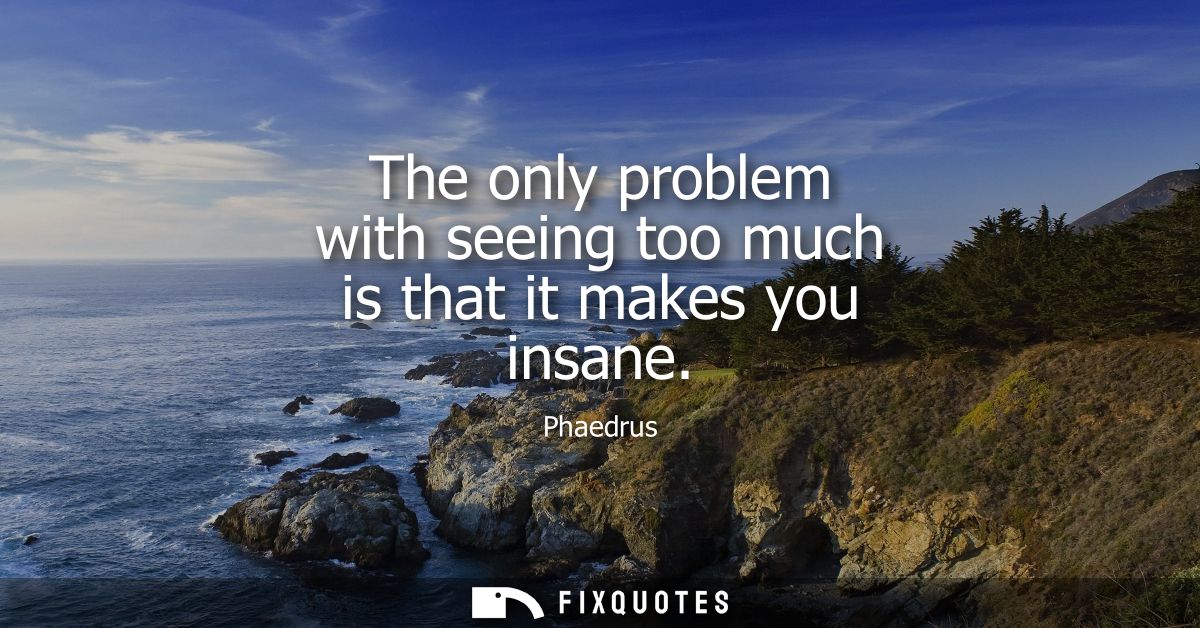
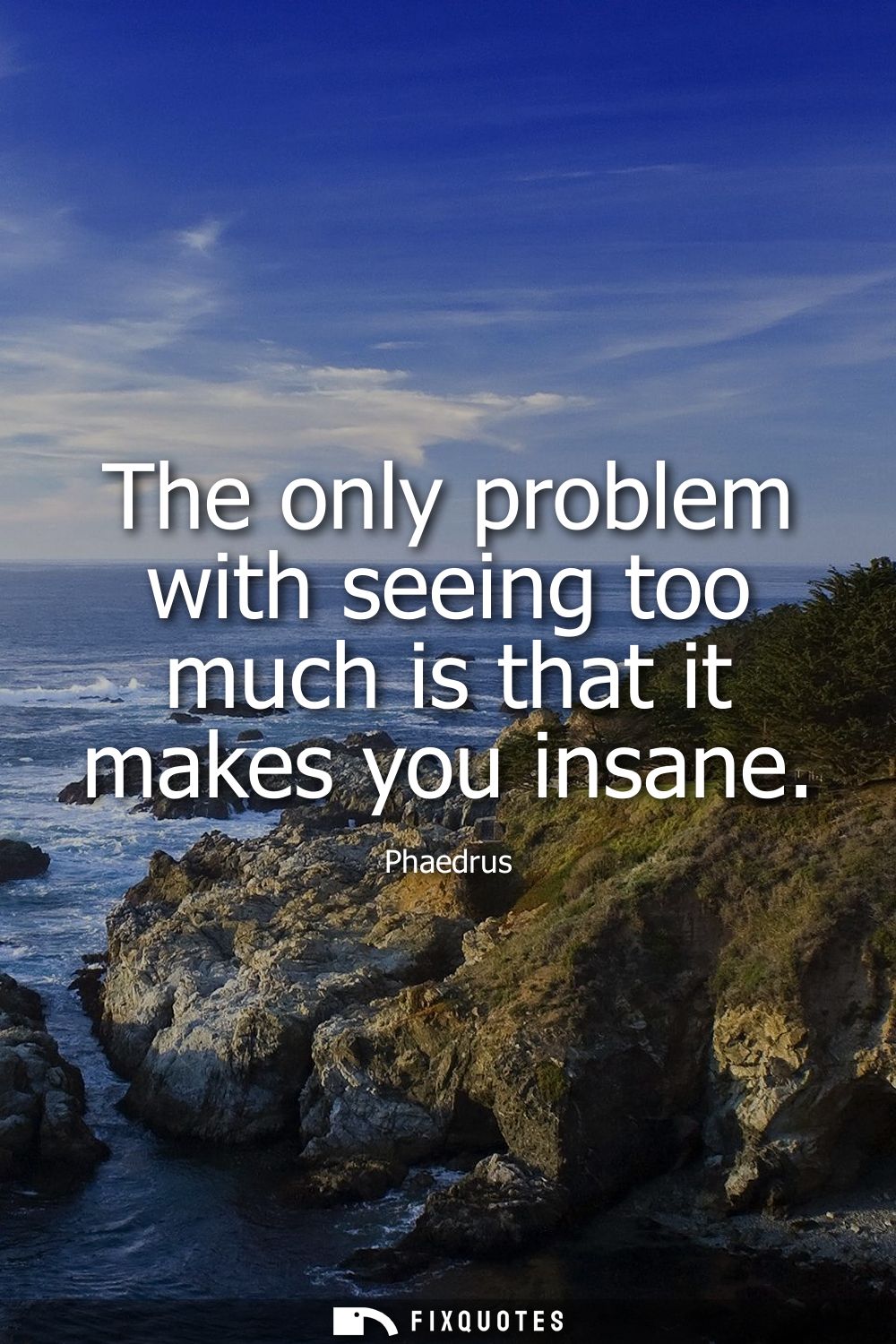
"The only problem with seeing too much is that it makes you insane"
About this Quote
Vision is usually sold as salvation; Phaedrus flips it into a diagnosis. "Seeing too much" isn’t about good eyesight or even curiosity. It’s about awareness that outpaces the psyche’s capacity to metabolize it. In one clean turn, the line yokes insight to breakdown, suggesting that sanity is less a moral achievement than a carefully maintained blindness.
As a poet writing in the late Republic, Phaedrus sits near a culture drunk on spectacle: political theater, shifting loyalties, public violence, the churn of empire. In that environment, perception becomes dangerous. To see "too much" is to notice the machinery behind the pageant, the hypocrisy under civic virtue, the fragility of order everyone pretends is permanent. The result isn’t enlightenment; it’s alienation. The insane person, in this formulation, is not the one who lacks reality but the one who can’t unsee it.
The sentence works because it’s built like a proverb but carries a threat. "Only problem" performs a wry minimization, as if madness were a minor side effect of clarity. That understatement is the blade: it mocks the romantic idea of the seer while admitting the cost of being one. There’s also an implicit warning to the reader. If you insist on total transparency - on knowing every motive, every lie, every hidden lever - you might win the argument and lose your life. The subtext is political and personal at once: regimes survive on managed sightlines, and individuals do too.
As a poet writing in the late Republic, Phaedrus sits near a culture drunk on spectacle: political theater, shifting loyalties, public violence, the churn of empire. In that environment, perception becomes dangerous. To see "too much" is to notice the machinery behind the pageant, the hypocrisy under civic virtue, the fragility of order everyone pretends is permanent. The result isn’t enlightenment; it’s alienation. The insane person, in this formulation, is not the one who lacks reality but the one who can’t unsee it.
The sentence works because it’s built like a proverb but carries a threat. "Only problem" performs a wry minimization, as if madness were a minor side effect of clarity. That understatement is the blade: it mocks the romantic idea of the seer while admitting the cost of being one. There’s also an implicit warning to the reader. If you insist on total transparency - on knowing every motive, every lie, every hidden lever - you might win the argument and lose your life. The subtext is political and personal at once: regimes survive on managed sightlines, and individuals do too.
Quote Details
| Topic | Wisdom |
|---|---|
| Source | Help us find the source |
| Cite |
Citation Formats
APA Style (7th ed.)
Phaedrus. (2026, January 18). The only problem with seeing too much is that it makes you insane. FixQuotes. https://fixquotes.com/quotes/the-only-problem-with-seeing-too-much-is-that-it-8696/
Chicago Style
Phaedrus. "The only problem with seeing too much is that it makes you insane." FixQuotes. January 18, 2026. https://fixquotes.com/quotes/the-only-problem-with-seeing-too-much-is-that-it-8696/.
MLA Style (9th ed.)
"The only problem with seeing too much is that it makes you insane." FixQuotes, 18 Jan. 2026, https://fixquotes.com/quotes/the-only-problem-with-seeing-too-much-is-that-it-8696/. Accessed 3 Apr. 2026.
More Quotes by Phaedrus
Add to List