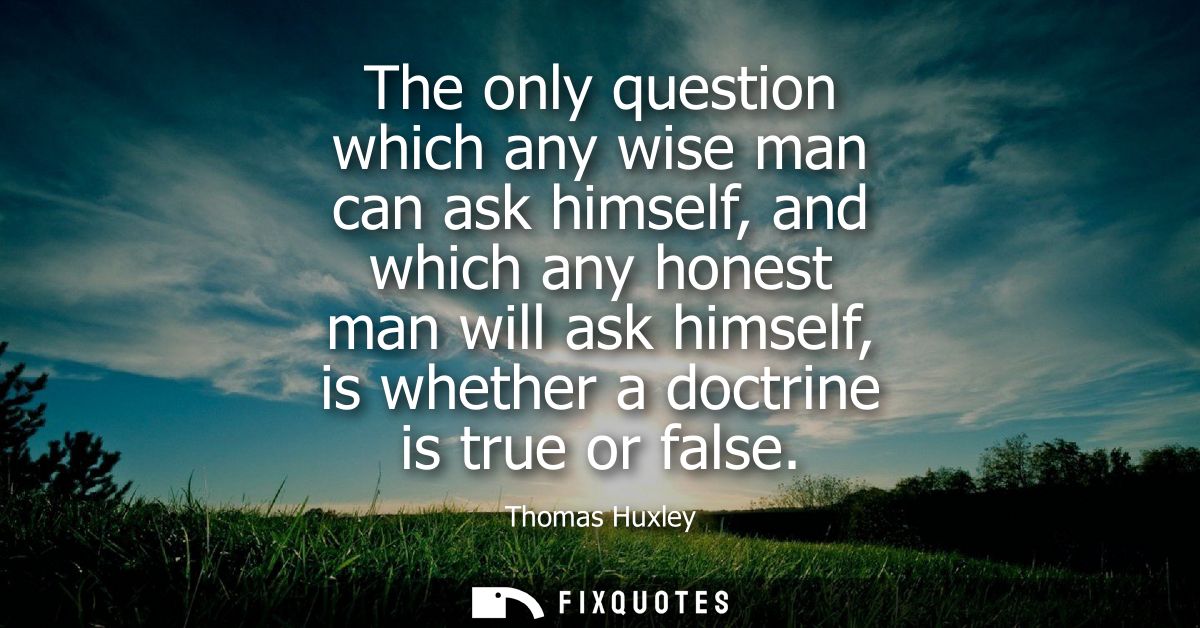
"The only question which any wise man can ask himself, and which any honest man will ask himself, is whether a doctrine is true or false"
About this Quote
That’s the subtext of a nineteenth-century scientist who spent his career fighting on two fronts: against religious authority that wanted doctrine insulated from empirical scrutiny, and against the genteel habit of treating belief as a social identity. Huxley, “Darwin’s bulldog,” knew that doctrines survive less because they’re accurate than because they’re socially reinforced. So he uses a kind of rhetorical gatekeeping: the “only question” move isn’t just emphasis, it’s exclusion. It narrows the field of legitimate conversation and makes evasions look like moral failures.
The phrasing also sneaks in a democratic provocation. He doesn’t say the question belongs to priests, philosophers, or institutions; it’s what any wise man can ask himself. Private judgment over inherited certainty. In an era of culture wars over evolution and biblical authority, that’s an implicit vote for evidence as the final referee - and for intellectual integrity as a public virtue, not a parlor pose.
Quote Details
| Topic | Truth |
|---|---|
| Source | Help us find the source |
| Cite |
Citation Formats
APA Style (7th ed.)
Huxley, Thomas. (2026, January 18). The only question which any wise man can ask himself, and which any honest man will ask himself, is whether a doctrine is true or false. FixQuotes. https://fixquotes.com/quotes/the-only-question-which-any-wise-man-can-ask-18026/
Chicago Style
Huxley, Thomas. "The only question which any wise man can ask himself, and which any honest man will ask himself, is whether a doctrine is true or false." FixQuotes. January 18, 2026. https://fixquotes.com/quotes/the-only-question-which-any-wise-man-can-ask-18026/.
MLA Style (9th ed.)
"The only question which any wise man can ask himself, and which any honest man will ask himself, is whether a doctrine is true or false." FixQuotes, 18 Jan. 2026, https://fixquotes.com/quotes/the-only-question-which-any-wise-man-can-ask-18026/. Accessed 24 Mar. 2026.