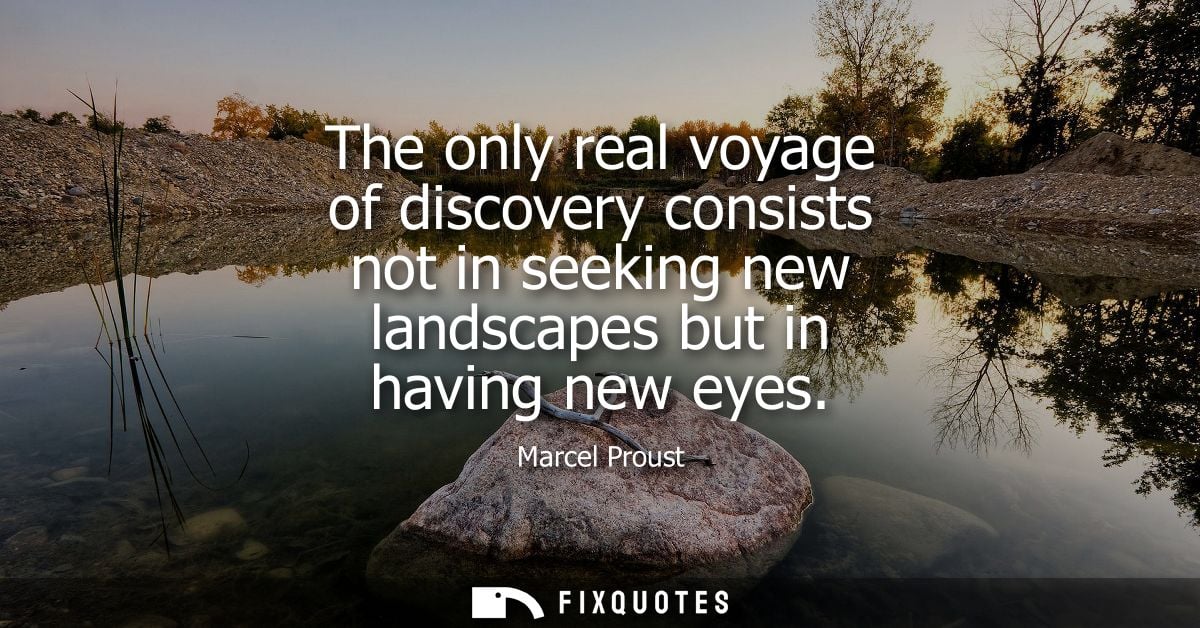
"The only real voyage of discovery consists not in seeking new landscapes but in having new eyes"
About this Quote
The subtext is classic Proust: the richest territories are internal, but they’re accessible only through disciplined attention. “New eyes” isn’t optimism; it’s craft. It implies time, repetition, and the willingness to notice what you’ve trained yourself to ignore. That’s the deeper provocation inside the elegant phrasing: discovery isn’t a matter of access, it’s a matter of sensibility. The same room, the same relationship, the same self can be remapped if your perceptual habits change.
Context matters. Proust is writing out of the modernist crisis where old certainties - social class, progress, even memory - are being re-litigated. His project in In Search of Lost Time is a sustained demonstration that consciousness edits reality, and that memory, desire, and attention are the engines of meaning. The quote works because it’s both aspirational and slightly cruel: if you’re bored, it may not be the landscape that’s exhausted - it may be your eyesight.
Quote Details
| Topic | Wisdom |
|---|---|
| Source | Help us find the source |
| Cite | Cite this Quote |
Citation Formats
APA Style (7th ed.)
Proust, Marcel. (n.d.). The only real voyage of discovery consists not in seeking new landscapes but in having new eyes. FixQuotes. https://fixquotes.com/quotes/the-only-real-voyage-of-discovery-consists-not-in-32621/
Chicago Style
Proust, Marcel. "The only real voyage of discovery consists not in seeking new landscapes but in having new eyes." FixQuotes. Accessed February 3, 2026. https://fixquotes.com/quotes/the-only-real-voyage-of-discovery-consists-not-in-32621/.
MLA Style (9th ed.)
"The only real voyage of discovery consists not in seeking new landscapes but in having new eyes." FixQuotes, https://fixquotes.com/quotes/the-only-real-voyage-of-discovery-consists-not-in-32621/. Accessed 3 Feb. 2026.