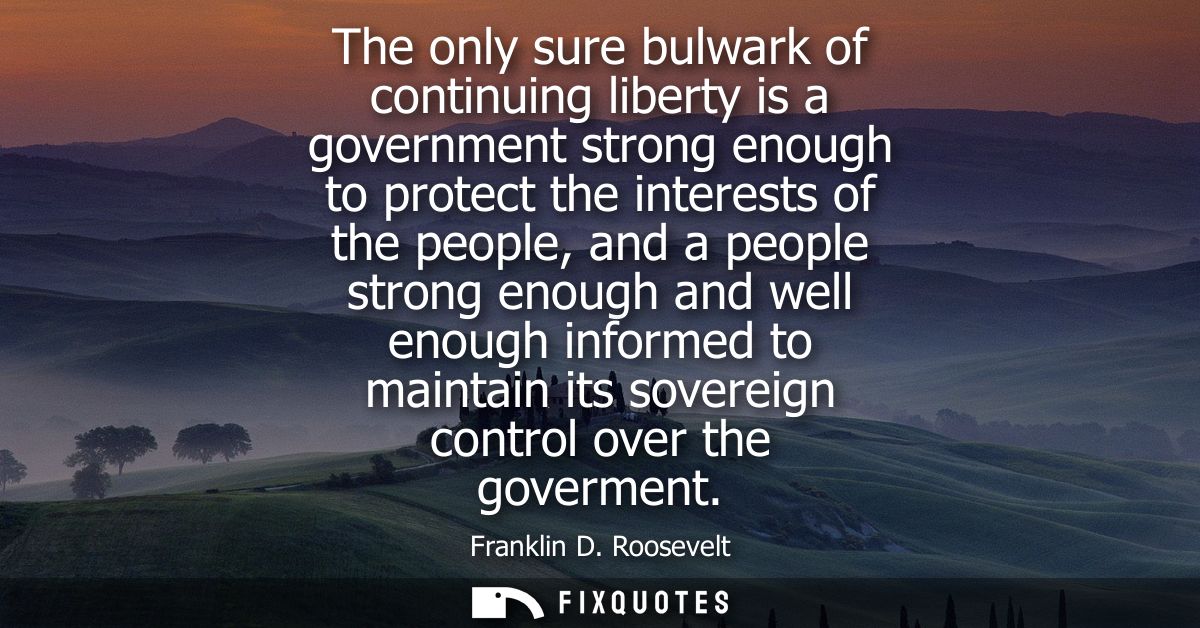
"The only sure bulwark of continuing liberty is a government strong enough to protect the interests of the people, and a people strong enough and well enough informed to maintain its sovereign control over the goverment"
About this Quote
The intent is unmistakably New Deal. In a country burned by depression and jolted by the rise of authoritarianism abroad, Roosevelt reframes strength as a democratic necessity rather than a militaristic temptation. He’s arguing against the idea that minimal government automatically equals maximal freedom. A weak state, for FDR, doesn’t liberate citizens; it abandons them to whoever can fill the vacuum. The "interests of the people" is also carefully chosen: it implies that policy should counterbalance concentrated wealth and organized influence, not simply referee them.
The subtext is a warning shot at both extremes. It cautions anti-government libertarianism (because power doesn’t vanish; it relocates) and also preemptively disciplines Roosevelt’s own expanding executive ambitions: legitimacy depends on an electorate that can audit, dissent, vote, and organize. "Well enough informed" makes the democratic project contingent on education and media health, implying that ignorance is not just a personal failing but a structural threat. Liberty, in Roosevelt’s telling, is less a right you possess than a relationship you maintain.
Quote Details
| Topic | Freedom |
|---|---|
| Source | Help us find the source |
| Cite |
Citation Formats
APA Style (7th ed.)
Roosevelt, Franklin D. (2026, January 17). The only sure bulwark of continuing liberty is a government strong enough to protect the interests of the people, and a people strong enough and well enough informed to maintain its sovereign control over the goverment. FixQuotes. https://fixquotes.com/quotes/the-only-sure-bulwark-of-continuing-liberty-is-a-35201/
Chicago Style
Roosevelt, Franklin D. "The only sure bulwark of continuing liberty is a government strong enough to protect the interests of the people, and a people strong enough and well enough informed to maintain its sovereign control over the goverment." FixQuotes. January 17, 2026. https://fixquotes.com/quotes/the-only-sure-bulwark-of-continuing-liberty-is-a-35201/.
MLA Style (9th ed.)
"The only sure bulwark of continuing liberty is a government strong enough to protect the interests of the people, and a people strong enough and well enough informed to maintain its sovereign control over the goverment." FixQuotes, 17 Jan. 2026, https://fixquotes.com/quotes/the-only-sure-bulwark-of-continuing-liberty-is-a-35201/. Accessed 30 Mar. 2026.