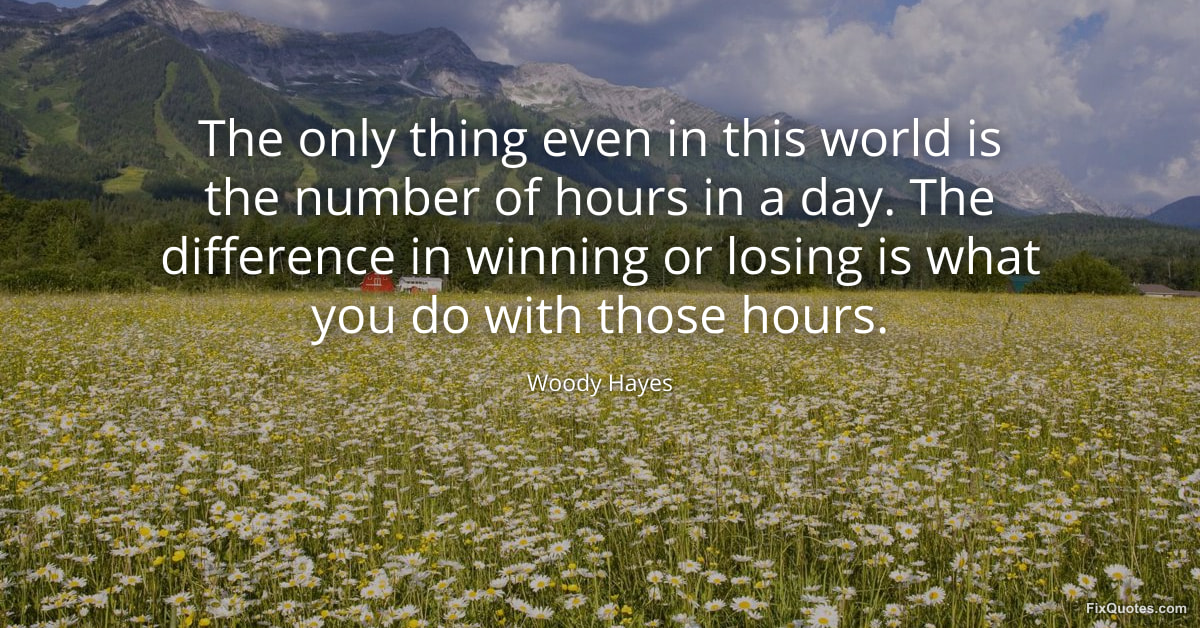
"The only thing even in this world is the number of hours in a day. The difference in winning or losing is what you do with those hours"
About this Quote
The line works because it sounds democratic while smuggling in a harsher message. “Even” doesn’t mean generous; it means indifferent. Time is distributed equally, then immediately weaponized by preparation. Hayes frames winning and losing not as a dramatic, last-second event but as an accumulated moral record of choices. The game is the receipt, not the transaction.
Context matters: Hayes coached in an era when college football was becoming a mass spectacle and a recruiting arms race, but it still sold itself as character-building. His Ohio State persona was famously hard-edged, allergic to excuses, and built on repetition and control. So this isn’t a gentle self-help poster; it’s a coaching philosophy that justifies intensity. If everyone gets the same hours, then the coach can demand that you account for them. It also subtly protects the system: inequality in outcomes becomes proof of effort rather than evidence of structural advantage.
Subtext: the scoreboard is an ethical verdict. If you lose, it’s not bad breaks; it’s how you lived your week. That’s galvanizing, and also unforgiving - exactly the kind of rhetoric that turns athletes into believers.
Quote Details
| Topic | Time |
|---|---|
| Source | Help us find the source |
| Cite |
Citation Formats
APA Style (7th ed.)
Hayes, Woody. (2026, January 15). The only thing even in this world is the number of hours in a day. The difference in winning or losing is what you do with those hours. FixQuotes. https://fixquotes.com/quotes/the-only-thing-even-in-this-world-is-the-number-173594/
Chicago Style
Hayes, Woody. "The only thing even in this world is the number of hours in a day. The difference in winning or losing is what you do with those hours." FixQuotes. January 15, 2026. https://fixquotes.com/quotes/the-only-thing-even-in-this-world-is-the-number-173594/.
MLA Style (9th ed.)
"The only thing even in this world is the number of hours in a day. The difference in winning or losing is what you do with those hours." FixQuotes, 15 Jan. 2026, https://fixquotes.com/quotes/the-only-thing-even-in-this-world-is-the-number-173594/. Accessed 7 Mar. 2026.