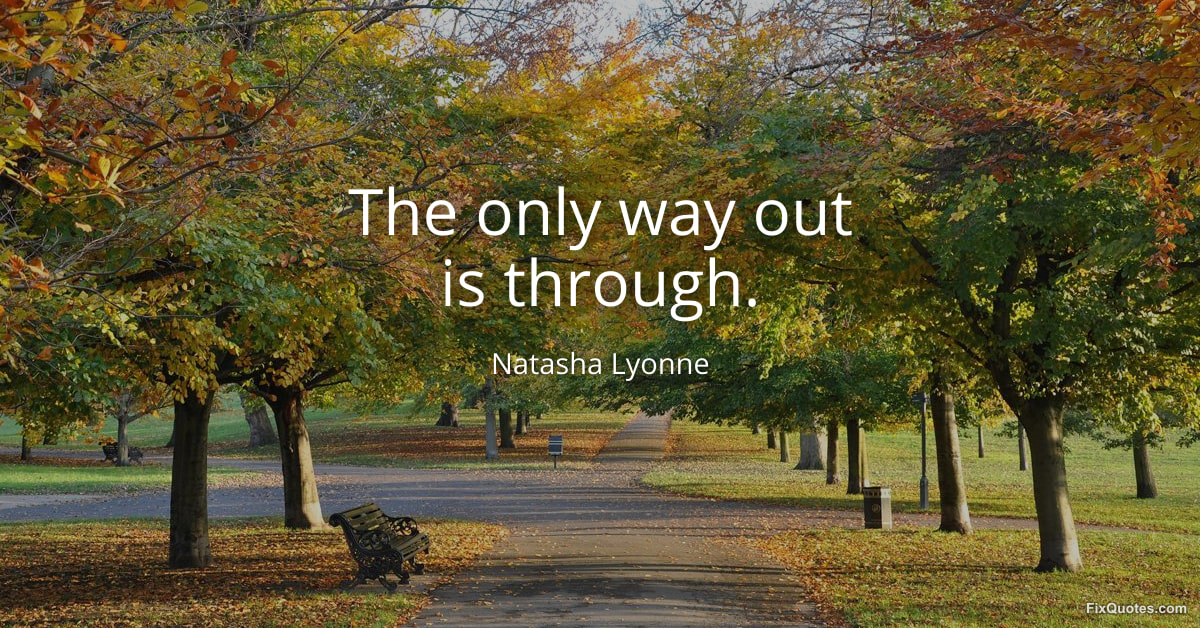
"The only way out is through"
About this Quote
A blunt little mantra like "The only way out is through" lands because it refuses the fantasy of a side door. Coming from Natasha Lyonne, it reads less like self-help packaging and more like a survivor's shorthand: the hard-earned knowledge that the discomfort you’re trying to outrun is usually the very terrain you have to cross.
The line works on two levels. On its face, it’s practical advice about endurance. Underneath, it’s a quiet rebuke of avoidance culture: the urge to rebrand pain as a “pivot,” to numb it, to optimize around it, to post through it without actually living it. "Out" suggests escape, relief, maybe reinvention. "Through" is the opposite: time, mess, repetition, relapse, grief that doesn’t resolve on a schedule. The sentence is almost aggressively linear. No plot twist, no hack.
Lyonne’s public persona sharpens the intent. Her career has been a long argument against neat narratives: early success, very public turbulence, recovery, then a late-career resurgence built on playing characters who are funny because they’re bruised and lucid at the same time. In projects like Russian Doll, the premise is literally "through" as destiny: you don’t solve the loop by finding an exit; you solve it by staying with the pattern until it reveals what you’ve been refusing to face.
Culturally, the quote hits because it’s anti-performative. It doesn’t promise transformation. It promises contact. It asks for stamina, not inspiration.
The line works on two levels. On its face, it’s practical advice about endurance. Underneath, it’s a quiet rebuke of avoidance culture: the urge to rebrand pain as a “pivot,” to numb it, to optimize around it, to post through it without actually living it. "Out" suggests escape, relief, maybe reinvention. "Through" is the opposite: time, mess, repetition, relapse, grief that doesn’t resolve on a schedule. The sentence is almost aggressively linear. No plot twist, no hack.
Lyonne’s public persona sharpens the intent. Her career has been a long argument against neat narratives: early success, very public turbulence, recovery, then a late-career resurgence built on playing characters who are funny because they’re bruised and lucid at the same time. In projects like Russian Doll, the premise is literally "through" as destiny: you don’t solve the loop by finding an exit; you solve it by staying with the pattern until it reveals what you’ve been refusing to face.
Culturally, the quote hits because it’s anti-performative. It doesn’t promise transformation. It promises contact. It asks for stamina, not inspiration.
Quote Details
| Topic | Overcoming Obstacles |
|---|---|
| Source | Russian Doll (Netflix series), Season 1 (2019) , line spoken in the show |
| Cite |
Citation Formats
APA Style (7th ed.)
Lyonne, Natasha. (2026, January 25). The only way out is through. FixQuotes. https://fixquotes.com/quotes/the-only-way-out-is-through-184309/
Chicago Style
Lyonne, Natasha. "The only way out is through." FixQuotes. January 25, 2026. https://fixquotes.com/quotes/the-only-way-out-is-through-184309/.
MLA Style (9th ed.)
"The only way out is through." FixQuotes, 25 Jan. 2026, https://fixquotes.com/quotes/the-only-way-out-is-through-184309/. Accessed 22 Mar. 2026.
More Quotes by Natasha
Add to List