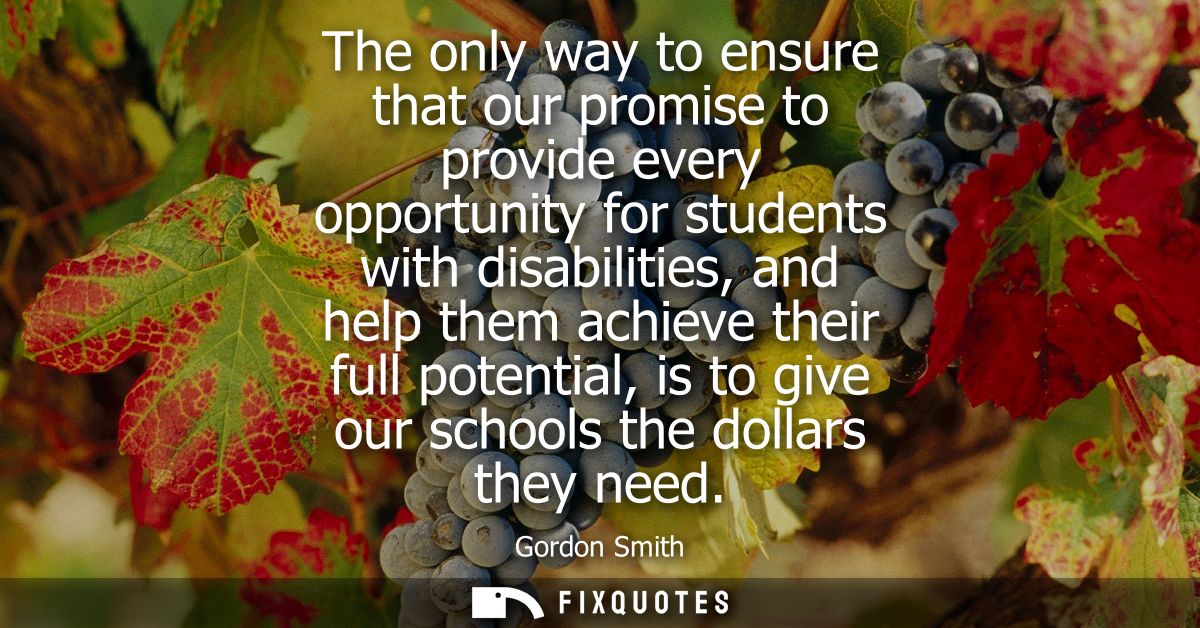
"The only way to ensure that our promise to provide every opportunity for students with disabilities, and help them achieve their full potential, is to give our schools the dollars they need"
About this Quote
The key move is the phrase “the only way to ensure.” That’s not persuasion; it’s foreclosing debate. If you accept the premise that schools are responsible for enabling disabled students to thrive, you’re pushed toward Smith’s conclusion that resources are the non-negotiable mechanism. It’s a rhetorical shortcut that turns an argument about priorities into an argument about credibility: oppose the money, and you’re not merely “fiscally cautious,” you’re undermining a public promise.
The subtext is also about shifting the frame from abstract policy to practical capacity. Special education is legally mandated and notoriously expensive; “opportunity” depends on staffing ratios, aides, accessible materials, therapists, transportation, and compliant facilities. Smith’s wording implies that without adequate funding, inclusion becomes performative - rights on paper, scarcity in practice. In a political context where school budgets are perpetual battlegrounds, he’s recruiting disability justice as the unimpeachable rationale for broader school funding, daring opponents to explain why they’d shortchange the students least able to absorb the cuts.
Quote Details
| Topic | Student |
|---|---|
| Source | Help us find the source |
| Cite |
Citation Formats
APA Style (7th ed.)
Smith, Gordon. (2026, January 16). The only way to ensure that our promise to provide every opportunity for students with disabilities, and help them achieve their full potential, is to give our schools the dollars they need. FixQuotes. https://fixquotes.com/quotes/the-only-way-to-ensure-that-our-promise-to-91697/
Chicago Style
Smith, Gordon. "The only way to ensure that our promise to provide every opportunity for students with disabilities, and help them achieve their full potential, is to give our schools the dollars they need." FixQuotes. January 16, 2026. https://fixquotes.com/quotes/the-only-way-to-ensure-that-our-promise-to-91697/.
MLA Style (9th ed.)
"The only way to ensure that our promise to provide every opportunity for students with disabilities, and help them achieve their full potential, is to give our schools the dollars they need." FixQuotes, 16 Jan. 2026, https://fixquotes.com/quotes/the-only-way-to-ensure-that-our-promise-to-91697/. Accessed 18 Feb. 2026.