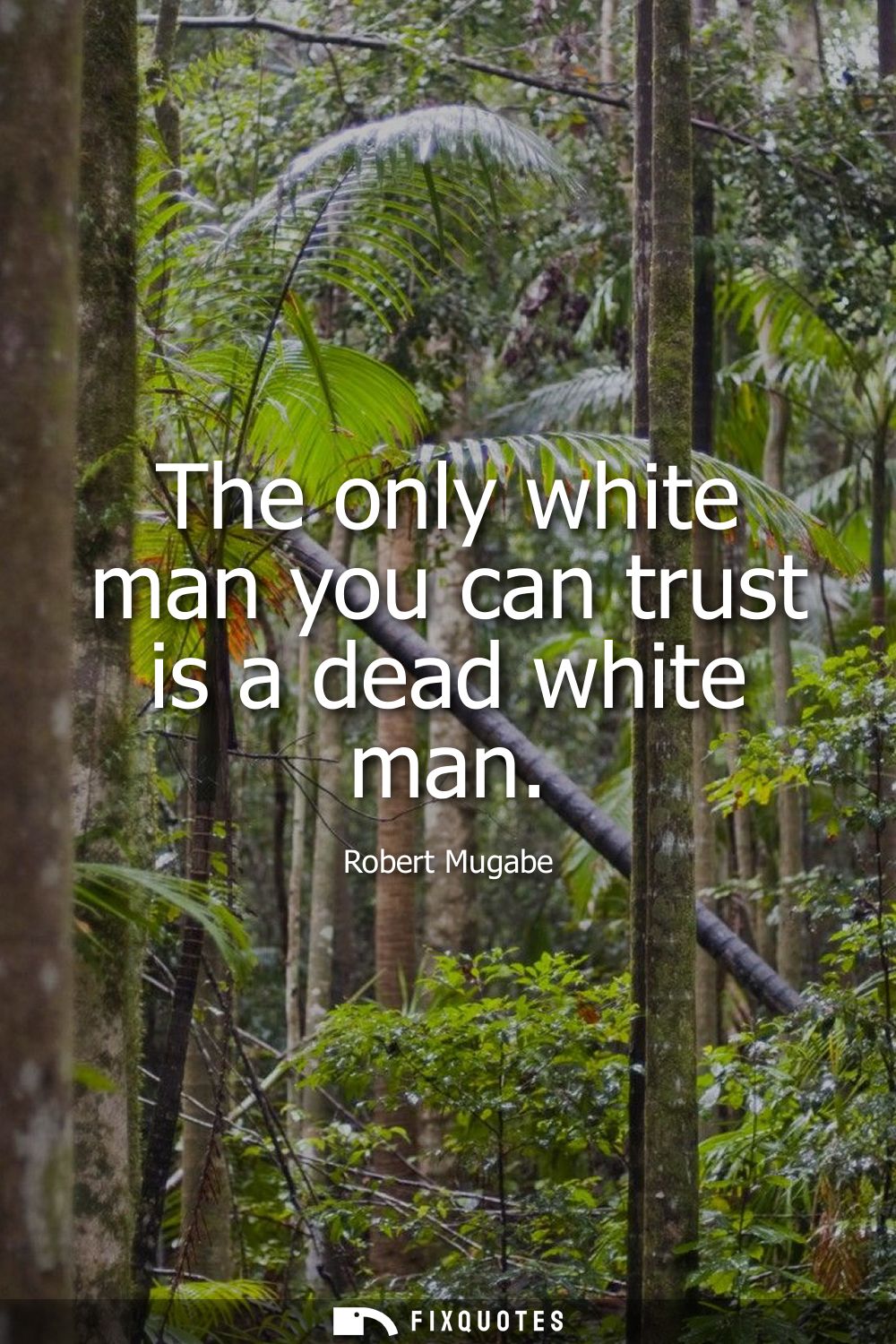
"The only white man you can trust is a dead white man"
About this Quote
It lands like a slogan because it is one: a sentence engineered to turn grievance into policy, and fear into permission. Mugabe’s line is not merely racist invective; it’s a political technology, compressing Zimbabwe’s colonial trauma into a binary moral universe where “white” equals enemy and “dead” equals safety. The rhetorical move is absolute trust is impossible, coexistence is naive, restraint is betrayal. In one stroke, it delegitimizes dissent, negotiation, and even ordinary human contact as forms of collaboration.
The intent is to recast a complicated postcolonial reality as an emergency. By the time Mugabe’s rule hardened into repression, the liberation narrative needed maintenance. Naming a permanent villain kept the revolutionary story alive long after independence, when corruption, economic collapse, and state violence demanded a new explanation. “White man” becomes a synecdoche for land dispossession, Rhodesian brutality, sanctions, and the lingering visibility of wealth. The dead-white-man punchline adds a chilling layer: it doesn’t just accuse; it gestures toward elimination as the only “solution,” laundering extremity through the language of common sense.
Context matters: Zimbabwe inherited real, brutal inequities from settler rule, and land redistribution was a live moral question. Mugabe weaponized that history to immunize himself from accountability. The subtext is less about whites per se than about power: if the nation is always under siege, then the strongman is always necessary. It’s the logic of authoritarianism in a liberation mask, turning historical justice into an excuse for perpetual cruelty.
The intent is to recast a complicated postcolonial reality as an emergency. By the time Mugabe’s rule hardened into repression, the liberation narrative needed maintenance. Naming a permanent villain kept the revolutionary story alive long after independence, when corruption, economic collapse, and state violence demanded a new explanation. “White man” becomes a synecdoche for land dispossession, Rhodesian brutality, sanctions, and the lingering visibility of wealth. The dead-white-man punchline adds a chilling layer: it doesn’t just accuse; it gestures toward elimination as the only “solution,” laundering extremity through the language of common sense.
Context matters: Zimbabwe inherited real, brutal inequities from settler rule, and land redistribution was a live moral question. Mugabe weaponized that history to immunize himself from accountability. The subtext is less about whites per se than about power: if the nation is always under siege, then the strongman is always necessary. It’s the logic of authoritarianism in a liberation mask, turning historical justice into an excuse for perpetual cruelty.
Quote Details
| Topic | Equality |
|---|---|
| Source | Help us find the source |
| Cite |
Citation Formats
APA Style (7th ed.)
Mugabe, Robert. (2026, January 18). The only white man you can trust is a dead white man. FixQuotes. https://fixquotes.com/quotes/the-only-white-man-you-can-trust-is-a-dead-white-1541/
Chicago Style
Mugabe, Robert. "The only white man you can trust is a dead white man." FixQuotes. January 18, 2026. https://fixquotes.com/quotes/the-only-white-man-you-can-trust-is-a-dead-white-1541/.
MLA Style (9th ed.)
"The only white man you can trust is a dead white man." FixQuotes, 18 Jan. 2026, https://fixquotes.com/quotes/the-only-white-man-you-can-trust-is-a-dead-white-1541/. Accessed 1 Apr. 2026.
More Quotes by Robert
Add to List