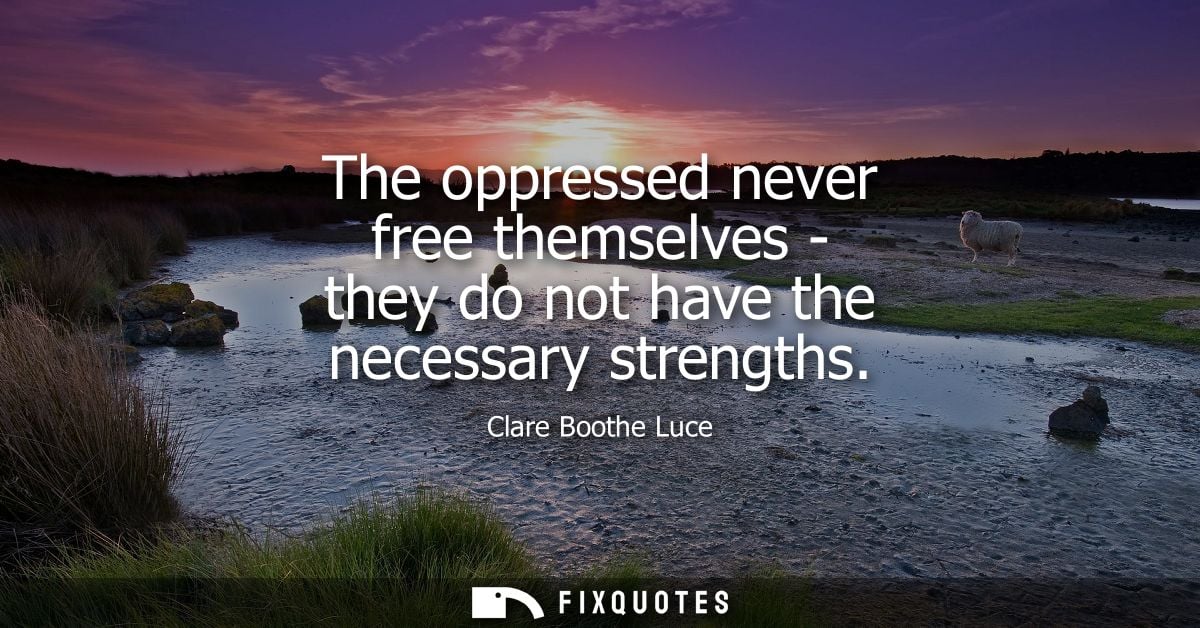
"The oppressed never free themselves - they do not have the necessary strengths"
About this Quote
The subtext is theatrical in the darker sense: a line built to provoke, not persuade. As a dramatist, Luce understood how to harden an audience’s mood with a single sentence. This one weaponizes fatalism. It flatters readers who identify with the powerful (we have the “strengths”) and scolds those who want history to bend toward justice (stop expecting miracles from the weak). The construction also preemptively discredits collective action: if the oppressed “never” free themselves, then revolts, labor victories, anti-colonial movements, civil rights campaigns become exceptions so rare they don’t count - or stories that must be credited to rescuers.
Context matters: Luce moved easily in elite political and media circles in mid-century America, a world suspicious of mass movements and comfortable with “realist” talk that often doubled as moral cover. Read that way, the line isn’t a diagnosis; it’s a permission slip for paternalism. If the oppressed can’t do it, someone else must decide what freedom looks like, when it’s granted, and at what price.
Quote Details
| Topic | Freedom |
|---|---|
| Source | Help us find the source |
| Cite |
Citation Formats
APA Style (7th ed.)
Luce, Clare Boothe. (2026, January 18). The oppressed never free themselves - they do not have the necessary strengths. FixQuotes. https://fixquotes.com/quotes/the-oppressed-never-free-themselves-they-do-not-13195/
Chicago Style
Luce, Clare Boothe. "The oppressed never free themselves - they do not have the necessary strengths." FixQuotes. January 18, 2026. https://fixquotes.com/quotes/the-oppressed-never-free-themselves-they-do-not-13195/.
MLA Style (9th ed.)
"The oppressed never free themselves - they do not have the necessary strengths." FixQuotes, 18 Jan. 2026, https://fixquotes.com/quotes/the-oppressed-never-free-themselves-they-do-not-13195/. Accessed 27 Mar. 2026.