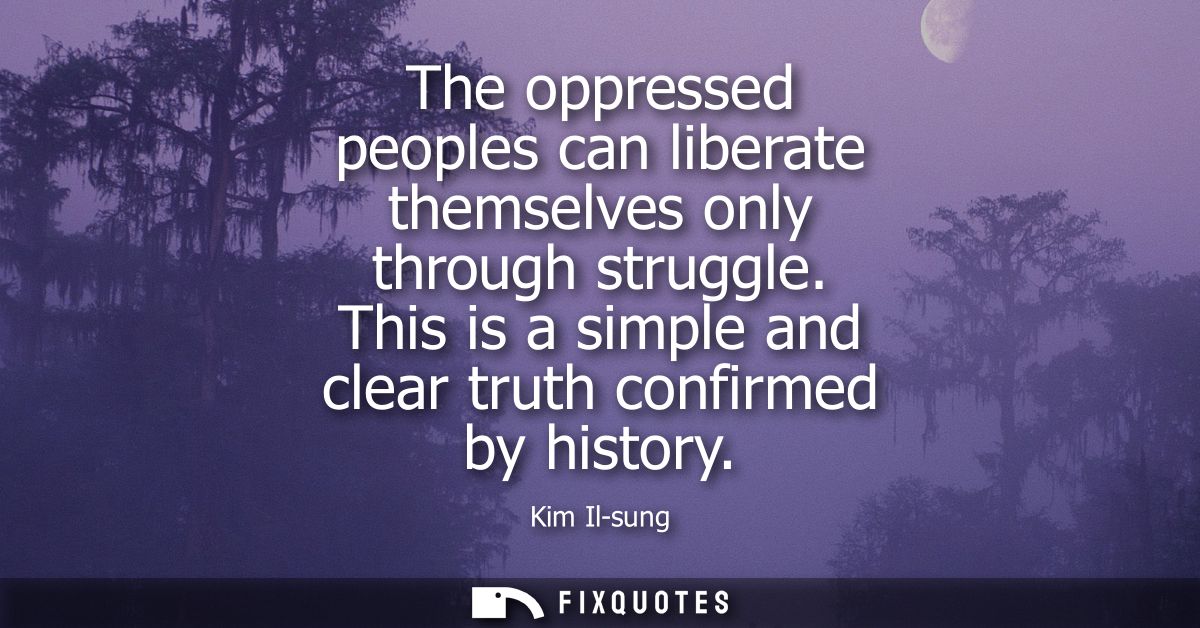
"The oppressed peoples can liberate themselves only through struggle. This is a simple and clear truth confirmed by history"
About this Quote
“Simple and clear” is doing heavy lifting here. Kim Il-sung frames liberation not as a political choice but as a law of nature, “confirmed by history,” the kind of phrase that tries to end arguments before they start. It’s a leader’s move: turn a contested strategy into inevitability, and you turn dissent into either naivete or betrayal.
The intent is double-edged. On one level, it’s a rallying line aimed at colonized or subordinated people, lending moral urgency to resistance and refusing the fantasy that freedom is granted by benevolent rulers. On another, it’s a permission slip for permanent mobilization. If struggle is the only path, then the state can demand sacrifice indefinitely, brand compromise as cowardice, and justify coercion as historical necessity. “Oppressed peoples” sounds collective and egalitarian, but it also erases internal pluralism: who gets to define oppression, who speaks for “the people,” and what forms “struggle” must take.
Context matters. Kim’s legitimacy was forged in anti-Japanese guerrilla mythology and consolidated in the post-1945 struggle over the Korean peninsula, then hardened by the Korean War. That history makes the line emotionally persuasive: struggle did shape the nation’s founding narrative. But it also explains the subtext: a revolutionary origin story converted into a governing doctrine, where the revolutionary party becomes the sole custodian of liberation and the perpetual author of “history” itself. The quote’s clarity is its tactic; the ambiguity is its power.
The intent is double-edged. On one level, it’s a rallying line aimed at colonized or subordinated people, lending moral urgency to resistance and refusing the fantasy that freedom is granted by benevolent rulers. On another, it’s a permission slip for permanent mobilization. If struggle is the only path, then the state can demand sacrifice indefinitely, brand compromise as cowardice, and justify coercion as historical necessity. “Oppressed peoples” sounds collective and egalitarian, but it also erases internal pluralism: who gets to define oppression, who speaks for “the people,” and what forms “struggle” must take.
Context matters. Kim’s legitimacy was forged in anti-Japanese guerrilla mythology and consolidated in the post-1945 struggle over the Korean peninsula, then hardened by the Korean War. That history makes the line emotionally persuasive: struggle did shape the nation’s founding narrative. But it also explains the subtext: a revolutionary origin story converted into a governing doctrine, where the revolutionary party becomes the sole custodian of liberation and the perpetual author of “history” itself. The quote’s clarity is its tactic; the ambiguity is its power.
Quote Details
| Topic | Freedom |
|---|---|
| Source | Help us find the source |
More Quotes by Kim
Add to List