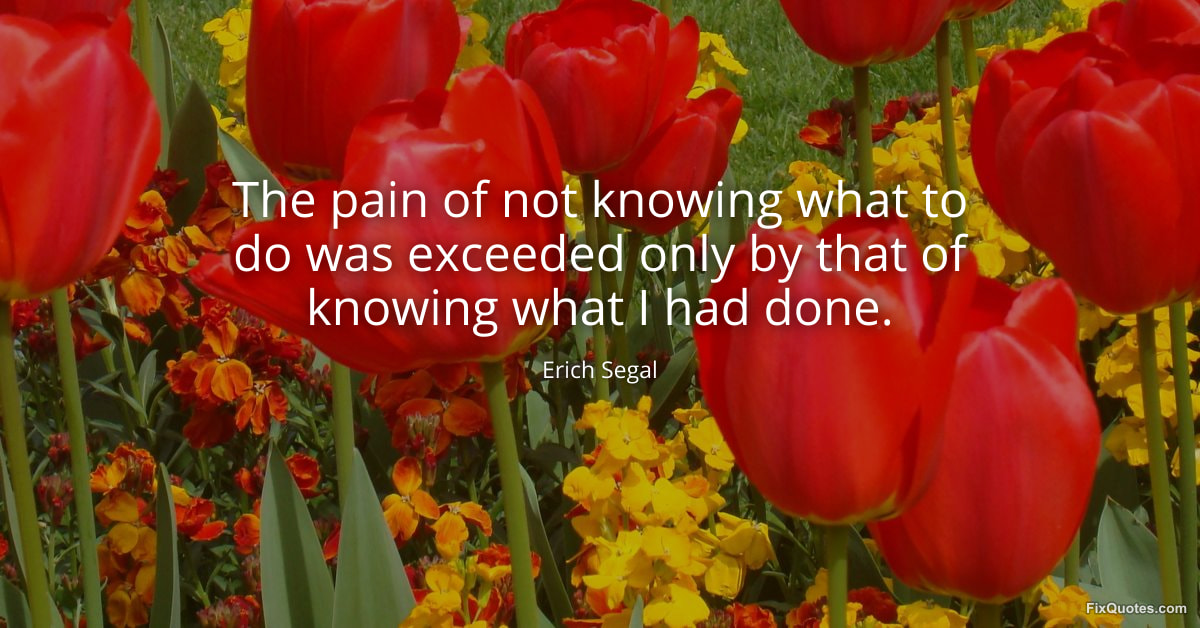
"The pain of not knowing what to do was exceeded only by that of knowing what I had done"
About this Quote
The sentence is engineered like a trapdoor. It starts in the abstract, almost philosophical, then pivots to confession. The second clause doesn’t specify the deed, which is precisely why it works: the reader supplies their own. Segal is writing for the interior courtroom where memory prosecutes without needing details. The comparative structure (“exceeded only by...”) also implies a grim ranking system, as if the narrator has taken inventory of pains and found the worst one is the one that comes with evidence.
Contextually, Segal’s fiction often treats romance and loss as moral weather systems: choices feel small when made, catastrophic when remembered. This line captures that delayed thunder. It also gestures toward a modern kind of guilt - not the fear of being caught, but the intolerable lucidity of self-knowledge. Uncertainty can be anesthetized by hope. Certainty about what you’ve done offers no such refuge.
Quote Details
| Topic | Learning from Mistakes |
|---|---|
| Source | Help us find the source |
| Cite |
Citation Formats
APA Style (7th ed.)
Segal, Erich. (2026, January 15). The pain of not knowing what to do was exceeded only by that of knowing what I had done. FixQuotes. https://fixquotes.com/quotes/the-pain-of-not-knowing-what-to-do-was-exceeded-173442/
Chicago Style
Segal, Erich. "The pain of not knowing what to do was exceeded only by that of knowing what I had done." FixQuotes. January 15, 2026. https://fixquotes.com/quotes/the-pain-of-not-knowing-what-to-do-was-exceeded-173442/.
MLA Style (9th ed.)
"The pain of not knowing what to do was exceeded only by that of knowing what I had done." FixQuotes, 15 Jan. 2026, https://fixquotes.com/quotes/the-pain-of-not-knowing-what-to-do-was-exceeded-173442/. Accessed 24 Mar. 2026.