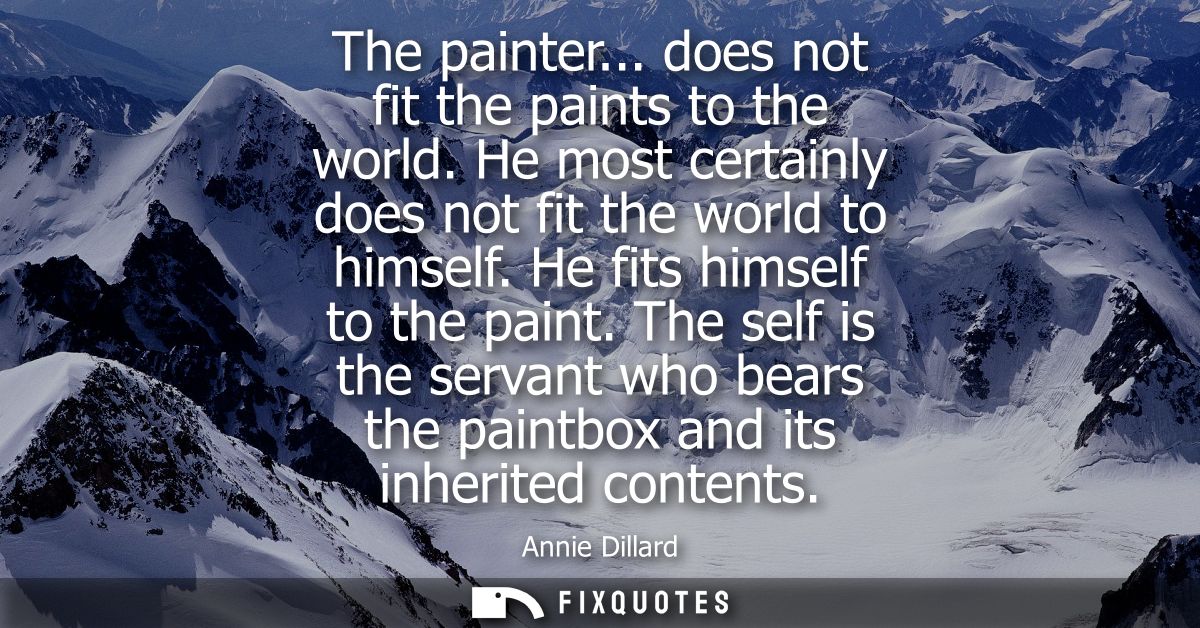
"The painter... does not fit the paints to the world. He most certainly does not fit the world to himself. He fits himself to the paint. The self is the servant who bears the paintbox and its inherited contents"
About this Quote
The intent is quietly disciplinary. Dillard is arguing for craft as an ethics: you don’t earn expression by declaring a personality; you earn it by apprenticing yourself to materials and to lineage. “Inherited” matters here. Paint isn’t just pigment; it’s centuries of techniques, expectations, and solved problems baked into a palette. To pick up a brush is to enter an argument already in progress. The subtext nudges against romantic individualism - the myth that originality comes from pure interiority. Dillard suggests the opposite: the fastest way to make dishonest work is to treat the medium like a neutral delivery system for your feelings.
Contextually, this is Dillard’s larger project as a writer who watches attention itself - how it’s trained, narrowed, and sharpened. She’s writing from a tradition that mistrusts ego and prizes reverence for the real, whether nature or craft. The sentence lands because it flatters the reader’s ambition while refusing their vanity: you can make something, but only if you agree to be changed by what you’re using.
Quote Details
| Topic | Art |
|---|---|
| Source | Help us find the source |
| Cite |
Citation Formats
APA Style (7th ed.)
Dillard, Annie. (2026, January 17). The painter... does not fit the paints to the world. He most certainly does not fit the world to himself. He fits himself to the paint. The self is the servant who bears the paintbox and its inherited contents. FixQuotes. https://fixquotes.com/quotes/the-painter-does-not-fit-the-paints-to-the-world-44265/
Chicago Style
Dillard, Annie. "The painter... does not fit the paints to the world. He most certainly does not fit the world to himself. He fits himself to the paint. The self is the servant who bears the paintbox and its inherited contents." FixQuotes. January 17, 2026. https://fixquotes.com/quotes/the-painter-does-not-fit-the-paints-to-the-world-44265/.
MLA Style (9th ed.)
"The painter... does not fit the paints to the world. He most certainly does not fit the world to himself. He fits himself to the paint. The self is the servant who bears the paintbox and its inherited contents." FixQuotes, 17 Jan. 2026, https://fixquotes.com/quotes/the-painter-does-not-fit-the-paints-to-the-world-44265/. Accessed 15 Mar. 2026.