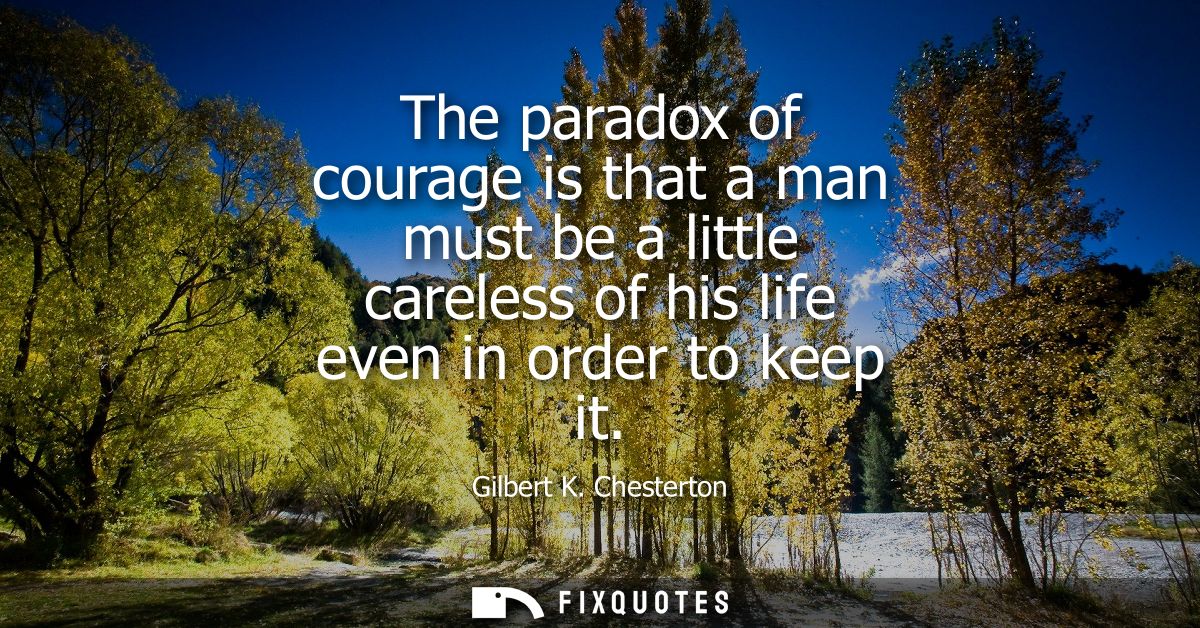
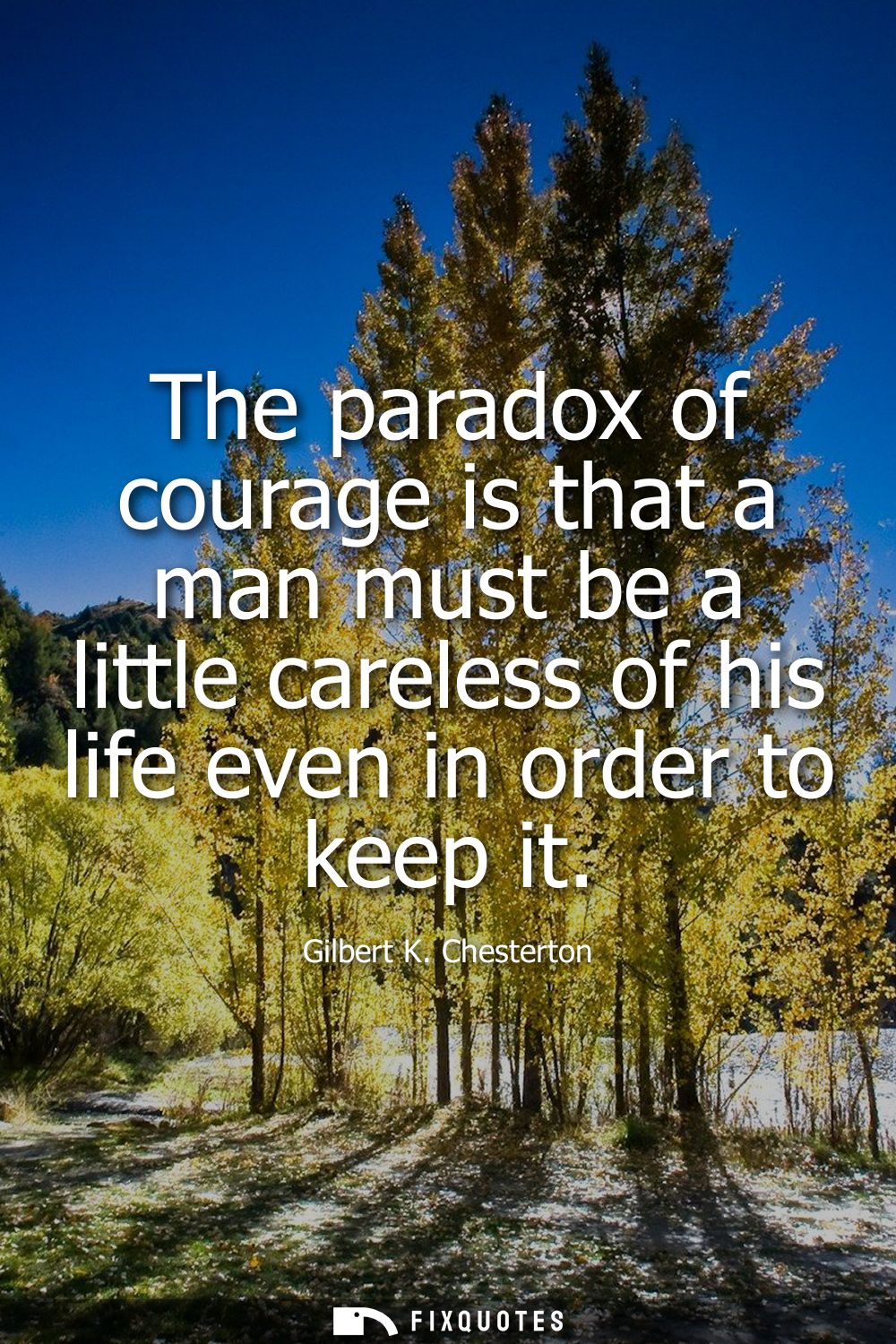
"The paradox of courage is that a man must be a little careless of his life even in order to keep it"
About this Quote
Chesterton builds courage out of a trap door: the moment you cling too tightly to survival, you start making choices that shrink your life until it’s barely worth keeping. The line turns on “a little careless,” a deliberately modest phrase that smuggles in a radical demand. He isn’t praising recklessness; he’s insisting that self-preservation, taken as a highest good, becomes self-defeating. You can’t protect a life you refuse to risk, because the world eventually calls your bluff - through injustice, duty, love, war, illness, or simply the daily need to step into uncertainty.
The subtext is Chesterton’s quarrel with modern timidity and moral bookkeeping. In his era, the early 20th century’s anxieties - industrial danger, imperial politics, shifting faith - encouraged a kind of managerial mindset: calculate risks, avoid scandal, don’t make enemies. Chesterton, a Catholic apologist with a taste for paradox, punctures that posture with a Christian-tinged ethic: life is not an idol. Courage becomes the act of placing something above your immediate safety, whether that’s truth, neighbor, honor, or God.
Rhetorically, the quote works because it names a contradiction people already feel but rarely articulate. We admire the firefighter and the whistleblower because they refuse the small, sensible bargain: live longer by living smaller. Chesterton sharpens that admiration into a principle, then dares the reader to notice how often “prudence” is just fear wearing a respectable hat.
The subtext is Chesterton’s quarrel with modern timidity and moral bookkeeping. In his era, the early 20th century’s anxieties - industrial danger, imperial politics, shifting faith - encouraged a kind of managerial mindset: calculate risks, avoid scandal, don’t make enemies. Chesterton, a Catholic apologist with a taste for paradox, punctures that posture with a Christian-tinged ethic: life is not an idol. Courage becomes the act of placing something above your immediate safety, whether that’s truth, neighbor, honor, or God.
Rhetorically, the quote works because it names a contradiction people already feel but rarely articulate. We admire the firefighter and the whistleblower because they refuse the small, sensible bargain: live longer by living smaller. Chesterton sharpens that admiration into a principle, then dares the reader to notice how often “prudence” is just fear wearing a respectable hat.
Quote Details
| Topic | Wisdom |
|---|---|
| Source | Help us find the source |
More Quotes by Gilbert
Add to List