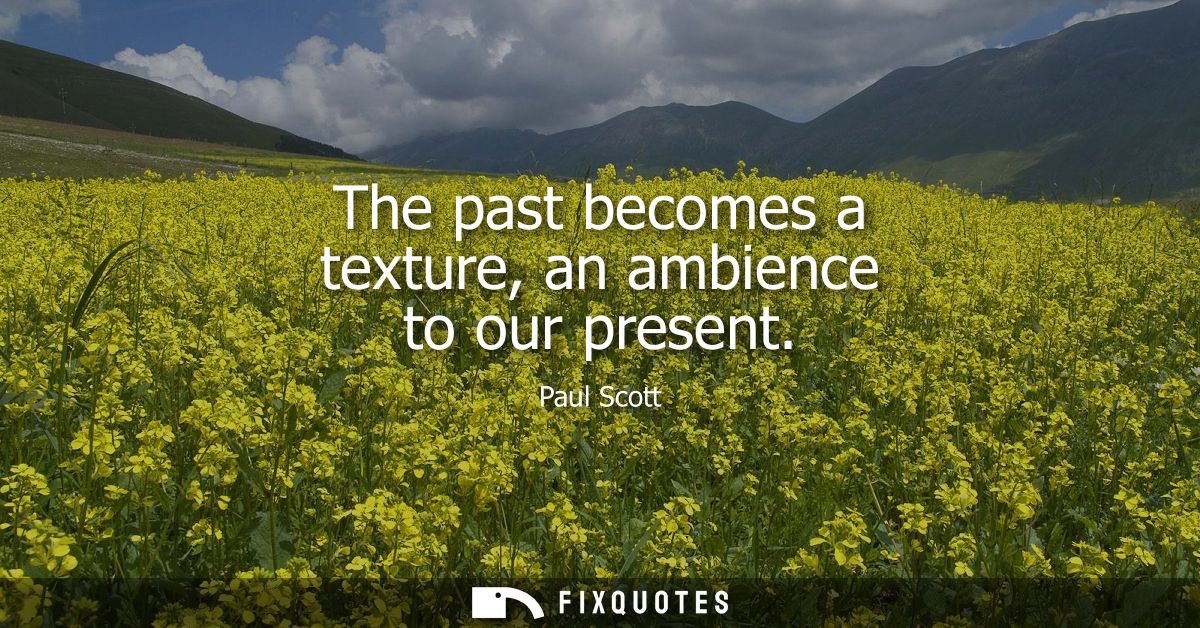
"The past becomes a texture, an ambience to our present"
About this Quote
“The past becomes a texture” is a novelist’s way of demoting history from courtroom evidence to interior design. Paul Scott isn’t arguing that the past disappears; he’s arguing it changes state. “Texture” and “ambience” are sensory words: what you feel on your skin, what you breathe without noticing. That’s the quiet menace of the line. The past doesn’t need to be consciously remembered to run the room. It can sit in the wallpaper of your habits, your language, your taste for certain stories about yourself.
Scott’s work, steeped in the afterlives of empire, understands how power survives its official endings. When empires fall or families fracture, people still live among the residues: inherited codes of class, racial hierarchies made “natural,” nostalgia that flatters the victors and sedates the guilty. Calling the past an “ambience” exposes how easily it becomes mood lighting: a soft focus that makes yesterday feel inevitable, even comforting, while blurring responsibility. It’s the difference between knowing and knowing you know.
The sentence also slips in a warning about the present. If the past is merely “texture,” we may treat it as aesthetic rather than ethical - something to curate, not confront. Scott’s intent is less to romanticize memory than to show its stealth. History doesn’t always return as a headline; it returns as atmosphere, shaping what feels normal, what feels possible, what feels like “just the way things are.”
Scott’s work, steeped in the afterlives of empire, understands how power survives its official endings. When empires fall or families fracture, people still live among the residues: inherited codes of class, racial hierarchies made “natural,” nostalgia that flatters the victors and sedates the guilty. Calling the past an “ambience” exposes how easily it becomes mood lighting: a soft focus that makes yesterday feel inevitable, even comforting, while blurring responsibility. It’s the difference between knowing and knowing you know.
The sentence also slips in a warning about the present. If the past is merely “texture,” we may treat it as aesthetic rather than ethical - something to curate, not confront. Scott’s intent is less to romanticize memory than to show its stealth. History doesn’t always return as a headline; it returns as atmosphere, shaping what feels normal, what feels possible, what feels like “just the way things are.”
Quote Details
| Topic | Nostalgia |
|---|---|
| Source | Help us find the source |
| Cite |
Citation Formats
APA Style (7th ed.)
Scott, Paul. (2026, January 15). The past becomes a texture, an ambience to our present. FixQuotes. https://fixquotes.com/quotes/the-past-becomes-a-texture-an-ambience-to-our-89070/
Chicago Style
Scott, Paul. "The past becomes a texture, an ambience to our present." FixQuotes. January 15, 2026. https://fixquotes.com/quotes/the-past-becomes-a-texture-an-ambience-to-our-89070/.
MLA Style (9th ed.)
"The past becomes a texture, an ambience to our present." FixQuotes, 15 Jan. 2026, https://fixquotes.com/quotes/the-past-becomes-a-texture-an-ambience-to-our-89070/. Accessed 25 Mar. 2026.
More Quotes by Paul
Add to List