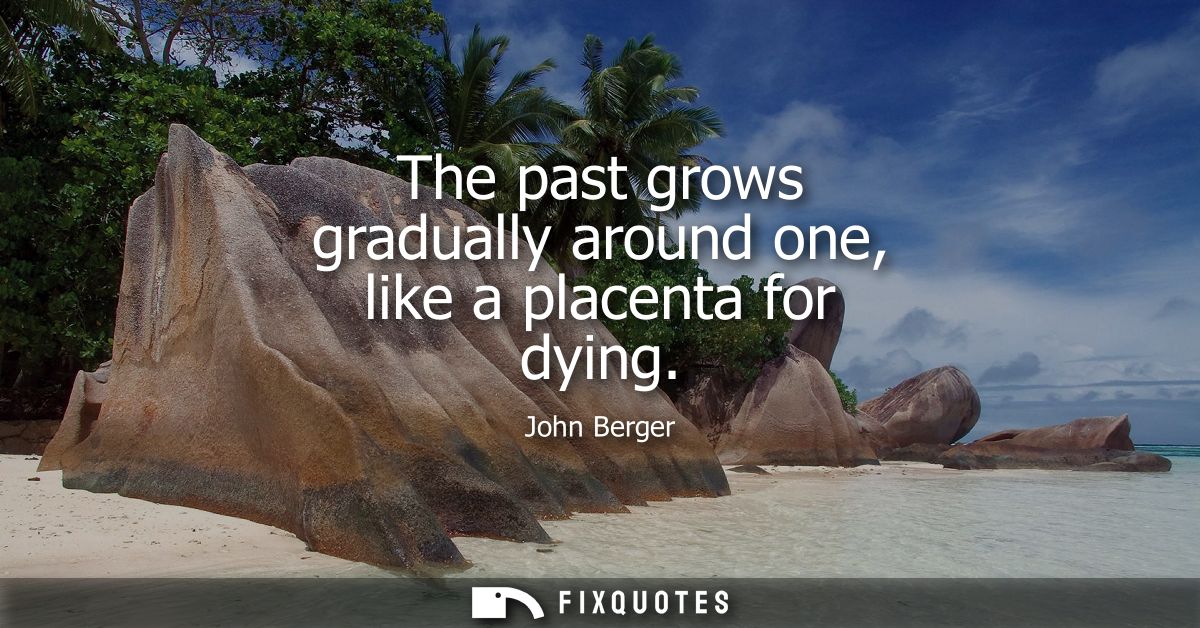
"The past grows gradually around one, like a placenta for dying"
About this Quote
Memory isn’t a scrapbook here; it’s an organ. Berger’s image is grotesquely precise: the past “grows” the way living tissue grows, slow and involuntary, until it wraps you in something meant to sustain life but repurposed as a shroud. A placenta is intimate, protective, and temporary. By yoking it to “dying,” Berger flips the nurture script into something suffocating, suggesting that what once fed us - origins, formative stories, inherited identities - can become a dependency that keeps us from moving, changing, or even noticing we’re being enclosed.
The line works because it refuses nostalgia’s soft-focus. It’s not that the past is heavy; it’s biological. You don’t simply remember; you are incubated by what you’ve already lived. There’s an implied accusation, too: the culture that romanticizes history, tradition, and “roots” may be fetishizing an amniotic comfort that’s indistinguishable from decline. The past isn’t a teacher in this sentence. It’s a life-support system with an expiration date.
Context matters: Berger spent his career interrogating how we see - art, labor, politics, the ways power frames reality. This metaphor is a piece of that project. It warns that experience can become a closed circuit, a private womb of meaning that insulates you from the present’s demands. The subtext is existential but also political: when the past becomes the only habitat you recognize, you stop imagining futures, and someone else gets to write them for you.
The line works because it refuses nostalgia’s soft-focus. It’s not that the past is heavy; it’s biological. You don’t simply remember; you are incubated by what you’ve already lived. There’s an implied accusation, too: the culture that romanticizes history, tradition, and “roots” may be fetishizing an amniotic comfort that’s indistinguishable from decline. The past isn’t a teacher in this sentence. It’s a life-support system with an expiration date.
Context matters: Berger spent his career interrogating how we see - art, labor, politics, the ways power frames reality. This metaphor is a piece of that project. It warns that experience can become a closed circuit, a private womb of meaning that insulates you from the present’s demands. The subtext is existential but also political: when the past becomes the only habitat you recognize, you stop imagining futures, and someone else gets to write them for you.
Quote Details
| Topic | Mortality |
|---|---|
| Source | Evidence: What I did not know when I was very young was that nothing can take the past away: the past grows gradually around one, like a placenta for dying. (Page number not securely verified from a primary scan; exact section/page remains unconfirmed). The strongest evidence points to John Berger's 1984 book And Our Faces, My Heart, Brief as Photos as the original primary source. Multiple secondary sources attribute the line to that book, and the fuller wording begins with 'What I did not know when I was very young...,' suggesting the commonly circulated version is a truncated excerpt. I was able to verify the book title and year, but I could not securely confirm the exact page number from a reliable primary page image in the available search results. The quote appears to have been first published in this book, not in a speech or interview. Other candidates (1) Forbes Book of Quotations (Ted Goodman, 2016) compilation95.0% ... The past grows gradually around one, like a placenta for dying. John Berger Many are always praising the bygone t... |
| Cite |
Citation Formats
APA Style (7th ed.)
Berger, John. (2026, March 10). The past grows gradually around one, like a placenta for dying. FixQuotes. https://fixquotes.com/quotes/the-past-grows-gradually-around-one-like-a-147145/
Chicago Style
Berger, John. "The past grows gradually around one, like a placenta for dying." FixQuotes. March 10, 2026. https://fixquotes.com/quotes/the-past-grows-gradually-around-one-like-a-147145/.
MLA Style (9th ed.)
"The past grows gradually around one, like a placenta for dying." FixQuotes, 10 Mar. 2026, https://fixquotes.com/quotes/the-past-grows-gradually-around-one-like-a-147145/. Accessed 24 Mar. 2026.
More Quotes by John
Add to List