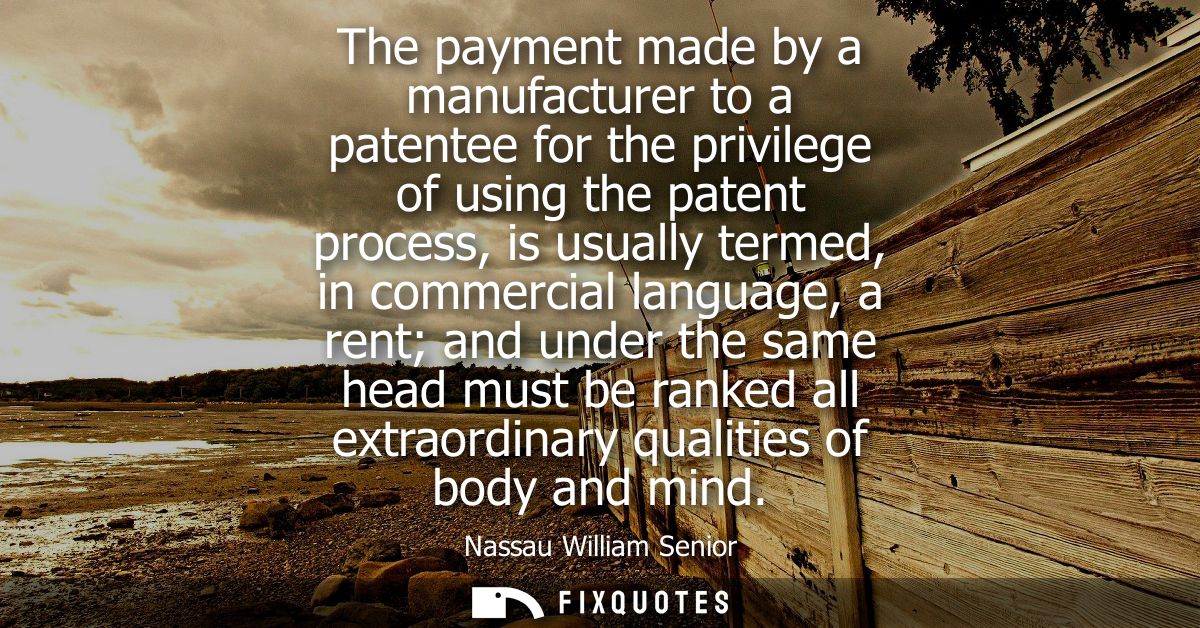
"The payment made by a manufacturer to a patentee for the privilege of using the patent process, is usually termed, in commercial language, a rent; and under the same head must be ranked all extraordinary qualities of body and mind"
About this Quote
In context, this sits inside the 19th-century economist's obsession with classification: wages, profits, rents, each with its own justifying story. Senior is interested in how income attaches to scarcity. A patent is artificial scarcity enforced by law; extraordinary ability is natural scarcity enforced by biology and social valuation. By grouping them, he quietly challenges the comforting idea that markets simply reward effort. Some rewards come from gatekeeping (legal monopoly), others from luck (endowment), but both look, economically, like unearned advantage converted into cash.
The subtext lands uncomfortably in today's debates about IP, superstar economies, and meritocracy. If genius produces "rent", then the heroic narrative of "deserving" starts to wobble: we can admire skill while still admitting that its outsized payoff resembles monopoly pricing. Senior isn't condemning talent; he's stripping it of its halo. The sentence reads clinical, even bloodless, which is part of its power: it treats human brilliance the way a ledger treats a plot of land. That chill is the point.
Quote Details
| Topic | Business |
|---|---|
| Source | Help us find the source |
| Cite |
Citation Formats
APA Style (7th ed.)
Senior, Nassau William. (2026, January 18). The payment made by a manufacturer to a patentee for the privilege of using the patent process, is usually termed, in commercial language, a rent; and under the same head must be ranked all extraordinary qualities of body and mind. FixQuotes. https://fixquotes.com/quotes/the-payment-made-by-a-manufacturer-to-a-patentee-8152/
Chicago Style
Senior, Nassau William. "The payment made by a manufacturer to a patentee for the privilege of using the patent process, is usually termed, in commercial language, a rent; and under the same head must be ranked all extraordinary qualities of body and mind." FixQuotes. January 18, 2026. https://fixquotes.com/quotes/the-payment-made-by-a-manufacturer-to-a-patentee-8152/.
MLA Style (9th ed.)
"The payment made by a manufacturer to a patentee for the privilege of using the patent process, is usually termed, in commercial language, a rent; and under the same head must be ranked all extraordinary qualities of body and mind." FixQuotes, 18 Jan. 2026, https://fixquotes.com/quotes/the-payment-made-by-a-manufacturer-to-a-patentee-8152/. Accessed 12 Feb. 2026.