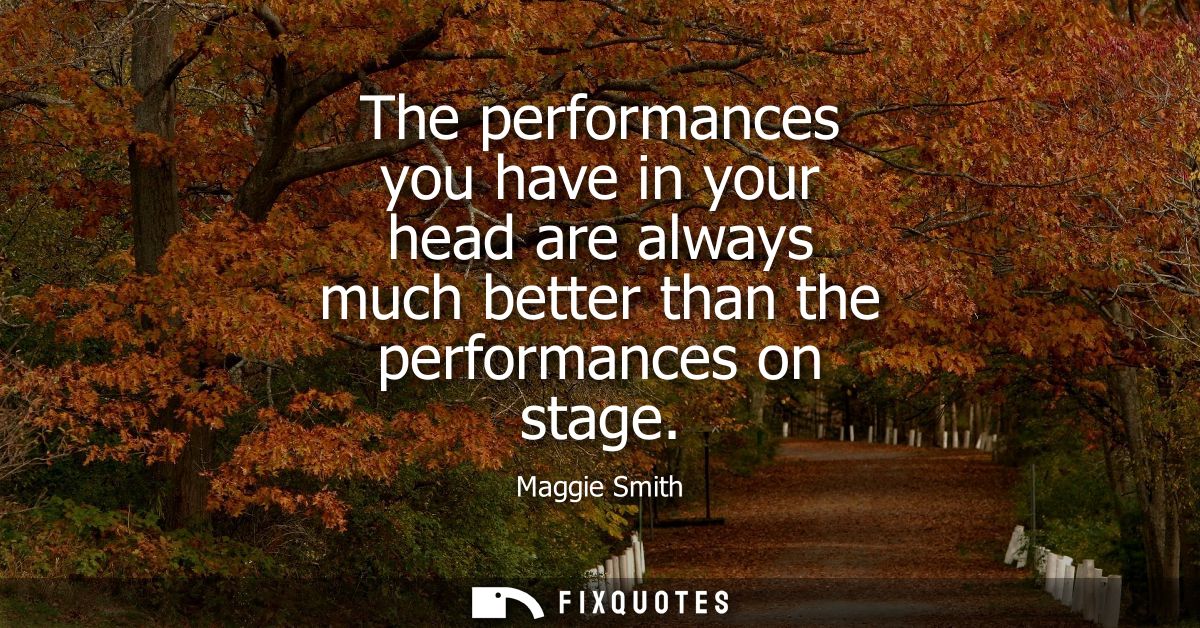
"The performances you have in your head are always much better than the performances on stage"
About this Quote
The intent isn’t to lower standards so much as to puncture a fantasy that quietly poisons creative work: the belief that there exists a version of your performance that is pure, total, and fully translatable. In your head, timing is immaculate, emotion arrives on cue, every pause means exactly what you want it to mean. On stage, you contend with breath, nerves, a missed mark, a prop that won’t cooperate, a scene partner’s micro-shift, an audience that laughs half a beat late. Real performance is negotiated in public.
Smith’s subtext is also about professionalism. The gap between imagined brilliance and actual execution doesn’t close through more yearning; it closes through repetition, craft, and tolerance for imperfection. The line quietly argues for humility without self-pity: accept the downgrade, then work anyway.
Context matters: theater culture fetishizes the “dream version” of a role, the private ideal actors chase in rehearsal rooms and dressing rooms. Smith reframes that ideal as a mirage. Not because the stage can’t be great, but because live art is great precisely when it’s human, contingent, and slightly out of your control.
Quote Details
| Topic | Art |
|---|---|
| Source | Help us find the source |
| Cite |
Citation Formats
APA Style (7th ed.)
Smith, Maggie. (2026, January 15). The performances you have in your head are always much better than the performances on stage. FixQuotes. https://fixquotes.com/quotes/the-performances-you-have-in-your-head-are-always-152160/
Chicago Style
Smith, Maggie. "The performances you have in your head are always much better than the performances on stage." FixQuotes. January 15, 2026. https://fixquotes.com/quotes/the-performances-you-have-in-your-head-are-always-152160/.
MLA Style (9th ed.)
"The performances you have in your head are always much better than the performances on stage." FixQuotes, 15 Jan. 2026, https://fixquotes.com/quotes/the-performances-you-have-in-your-head-are-always-152160/. Accessed 29 Mar. 2026.