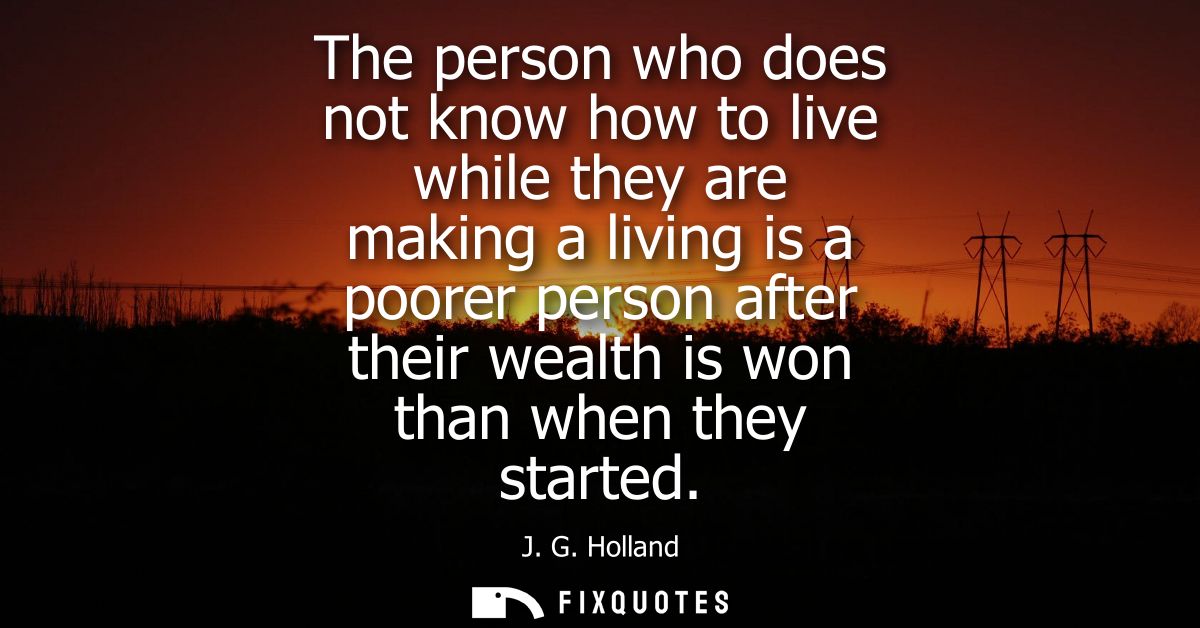
"The person who does not know how to live while they are making a living is a poorer person after their wealth is won than when they started"
About this Quote
A Victorian-era admonition dressed up as a balance sheet, Holland’s line turns prosperity into an audit of the soul. The sting is in the reversal: wealth, the supposed proof of success, can actually certify a quieter kind of failure. He’s not arguing against ambition so much as against the habit of postponement - the modern superstition that life begins once the invoices are paid, the farm is bought, the novel is finished, the promotion is secured. By then, he suggests, you may have trained yourself out of living.
The intent is moral but not prudish. Holland aims at a particular American (and distinctly 19th-century) faith: the self-made life where character is forged through work and thrift. In that world, “making a living” isn’t just employment; it’s a civic religion. Holland’s subtext is that this religion can hollow out the worshipper. If you don’t practice joy, attention, friendship, rest - if you treat them as luxuries to be purchased later - you won’t suddenly acquire the muscles for them when the money arrives. You’ll have assets and no appetite.
The phrase “poorer person” lands hardest because it reframes poverty as existential, not financial. Holland implies wealth can come with an opportunity cost that compounds: narrowed imagination, dulled curiosity, relationships maintained like obligations. The context is a century obsessed with upward mobility; the warning still reads like a critique of hustle culture before hustle culture had a name.
The intent is moral but not prudish. Holland aims at a particular American (and distinctly 19th-century) faith: the self-made life where character is forged through work and thrift. In that world, “making a living” isn’t just employment; it’s a civic religion. Holland’s subtext is that this religion can hollow out the worshipper. If you don’t practice joy, attention, friendship, rest - if you treat them as luxuries to be purchased later - you won’t suddenly acquire the muscles for them when the money arrives. You’ll have assets and no appetite.
The phrase “poorer person” lands hardest because it reframes poverty as existential, not financial. Holland implies wealth can come with an opportunity cost that compounds: narrowed imagination, dulled curiosity, relationships maintained like obligations. The context is a century obsessed with upward mobility; the warning still reads like a critique of hustle culture before hustle culture had a name.
Quote Details
| Topic | Work-Life Balance |
|---|
More Quotes by G. Holland
Add to List