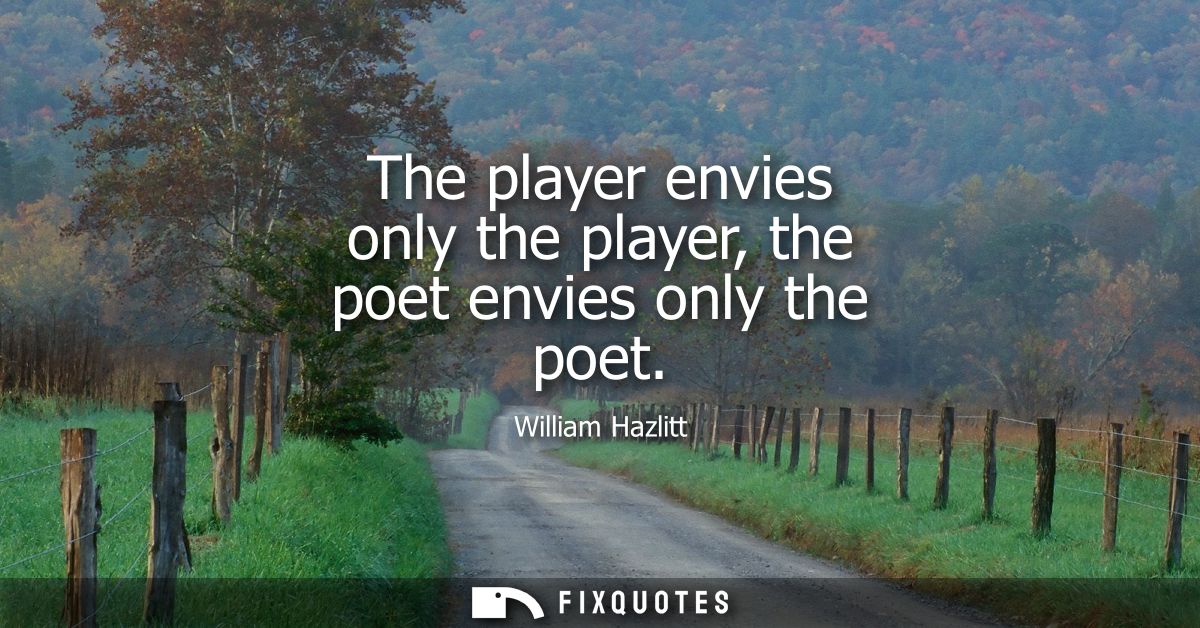
"The player envies only the player, the poet envies only the poet"
About this Quote
Envy, Hazlitt implies, is a specialist emotion: it doesn’t roam freely across the social map, it hunts in your own lane. The player envies only the player, the poet only the poet, because what stings isn’t someone else’s success in the abstract; it’s the unbearable closeness of a rival who proves your private standards are publicly contestable. A banker’s fortune can be dismissed as vulgar luck. Another poet’s clean, lethal line can’t. It lands as evidence.
That’s the intent: to demystify jealousy as petty character flaw and reframe it as professional clairvoyance twisted into resentment. The subtext is darker. Hazlitt is saying you can only be truly threatened by someone who shares your measures of excellence - who speaks the same craft dialect, who competes for the same scarce rewards: attention, praise, immortality. Envy becomes a backhanded form of recognition, an admission that the other person is playing the game correctly. It’s also a quiet critique of audiences who assume talent wars are egotistical. Hazlitt suggests the ego is secondary; the real fight is over standards.
Context matters because Hazlitt lived inside the early 19th-century literary scrum: reviews as blood sport, reputations made and shattered in print, the Romantic era crowded with geniuses who read one another closely and took it personally. As a critic, he knew the intimate cruelty of comparison. The line has the crispness of an aphorism, but it’s really a field report: competition is fiercest where understanding is deepest, and admiration and bitterness are often separated by a hairline.
That’s the intent: to demystify jealousy as petty character flaw and reframe it as professional clairvoyance twisted into resentment. The subtext is darker. Hazlitt is saying you can only be truly threatened by someone who shares your measures of excellence - who speaks the same craft dialect, who competes for the same scarce rewards: attention, praise, immortality. Envy becomes a backhanded form of recognition, an admission that the other person is playing the game correctly. It’s also a quiet critique of audiences who assume talent wars are egotistical. Hazlitt suggests the ego is secondary; the real fight is over standards.
Context matters because Hazlitt lived inside the early 19th-century literary scrum: reviews as blood sport, reputations made and shattered in print, the Romantic era crowded with geniuses who read one another closely and took it personally. As a critic, he knew the intimate cruelty of comparison. The line has the crispness of an aphorism, but it’s really a field report: competition is fiercest where understanding is deepest, and admiration and bitterness are often separated by a hairline.
Quote Details
| Topic | Wisdom |
|---|---|
| Source | Help us find the source |
| Cite |
Citation Formats
APA Style (7th ed.)
Hazlitt, William. (2026, January 15). The player envies only the player, the poet envies only the poet. FixQuotes. https://fixquotes.com/quotes/the-player-envies-only-the-player-the-poet-envies-74669/
Chicago Style
Hazlitt, William. "The player envies only the player, the poet envies only the poet." FixQuotes. January 15, 2026. https://fixquotes.com/quotes/the-player-envies-only-the-player-the-poet-envies-74669/.
MLA Style (9th ed.)
"The player envies only the player, the poet envies only the poet." FixQuotes, 15 Jan. 2026, https://fixquotes.com/quotes/the-player-envies-only-the-player-the-poet-envies-74669/. Accessed 22 Mar. 2026.
More Quotes by William
Add to List