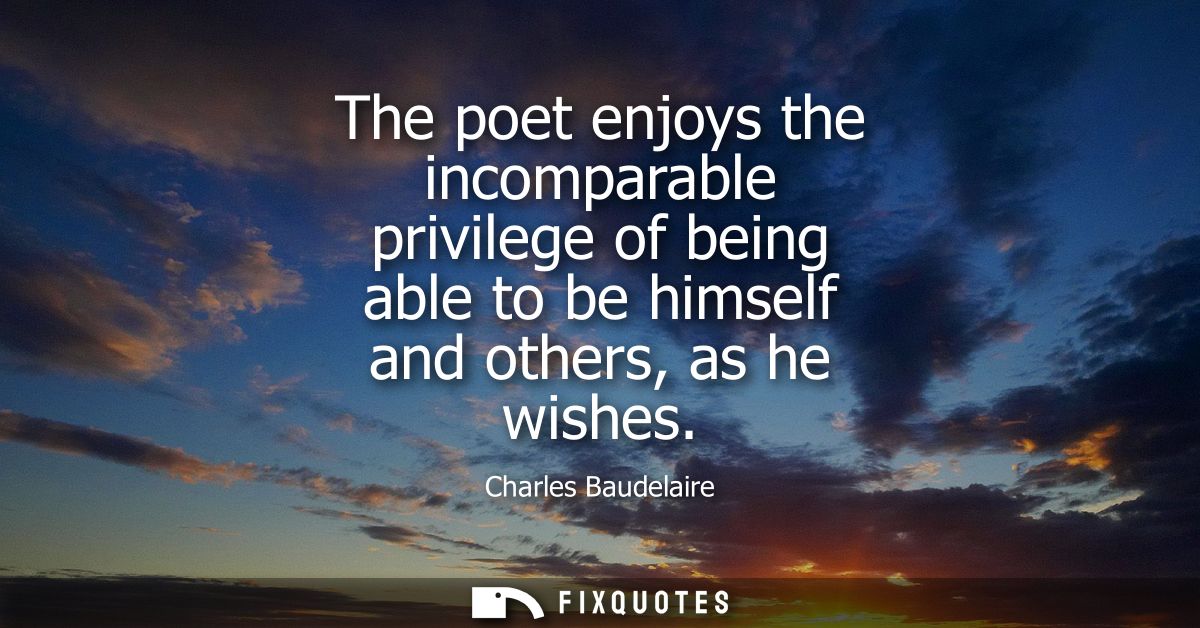
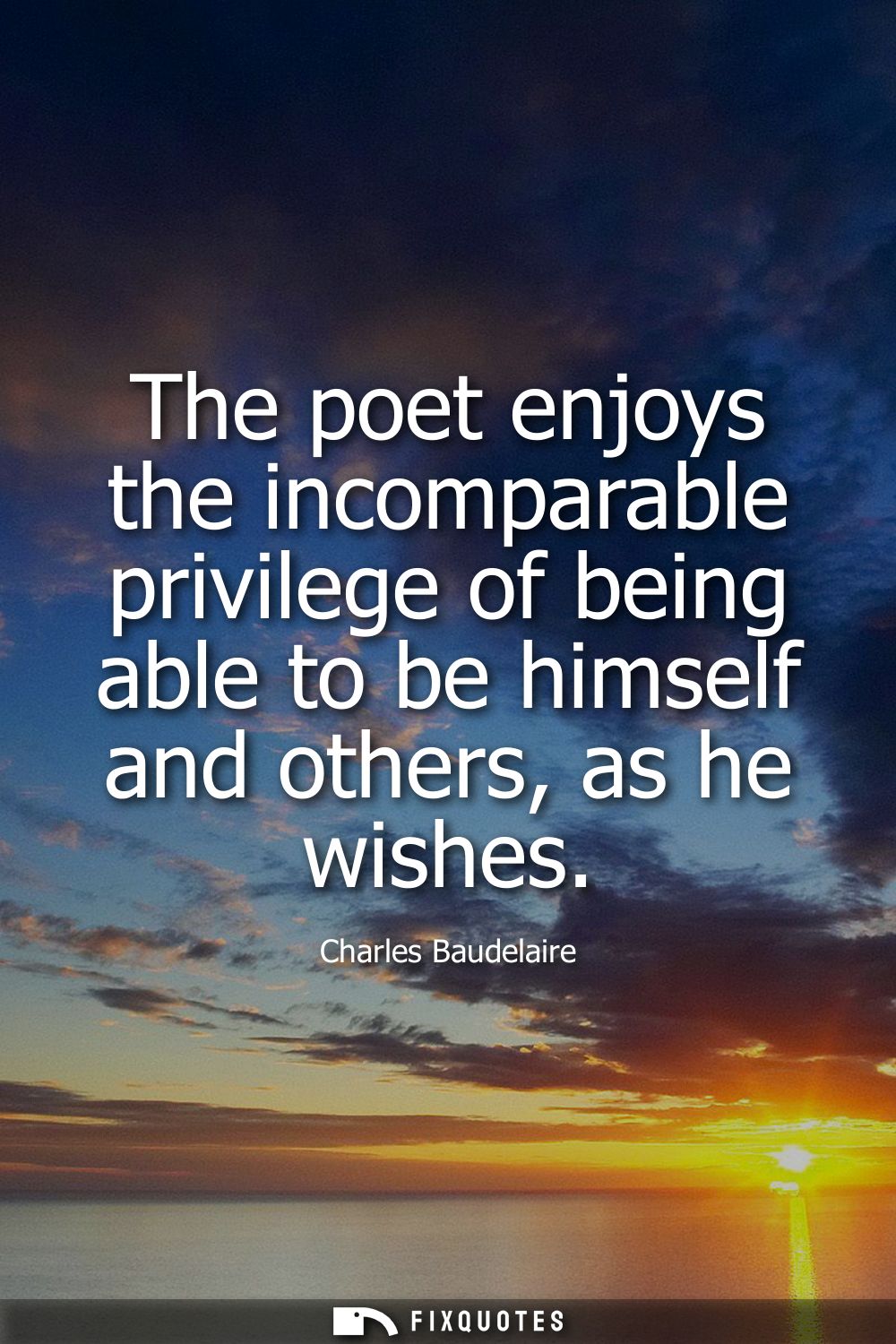
"The poet enjoys the incomparable privilege of being able to be himself and others, as he wishes"
About this Quote
The subtext is defensive and a little defiant. Baudelaire was famously prosecuted for Les Fleurs du mal, accused of corrupting public morals. So “being himself and others” doubles as a strategy: if a poem voices desire, cruelty, boredom, or blasphemy, it can be confession and mask at once. The poet can claim truth and disavowal in the same breath. That ambiguity is the point, not a bug. It’s how art tells on society while retaining plausible deniability.
There’s also a modern psychology embedded in the line. Baudelaire treats identity as plural, curated, performable - less a solid core than a repertoire. The poet becomes an early specialist in what we’d now call code-switching, except his arena is the inner life. His “privilege” is to turn that instability into form, to make a virtue out of the fractured self that modernity keeps producing.
Quote Details
| Topic | Poetry |
|---|---|
| Source | Help us find the source |
| Cite |
Citation Formats
APA Style (7th ed.)
Baudelaire, Charles. (2026, January 15). The poet enjoys the incomparable privilege of being able to be himself and others, as he wishes. FixQuotes. https://fixquotes.com/quotes/the-poet-enjoys-the-incomparable-privilege-of-142089/
Chicago Style
Baudelaire, Charles. "The poet enjoys the incomparable privilege of being able to be himself and others, as he wishes." FixQuotes. January 15, 2026. https://fixquotes.com/quotes/the-poet-enjoys-the-incomparable-privilege-of-142089/.
MLA Style (9th ed.)
"The poet enjoys the incomparable privilege of being able to be himself and others, as he wishes." FixQuotes, 15 Jan. 2026, https://fixquotes.com/quotes/the-poet-enjoys-the-incomparable-privilege-of-142089/. Accessed 12 Feb. 2026.