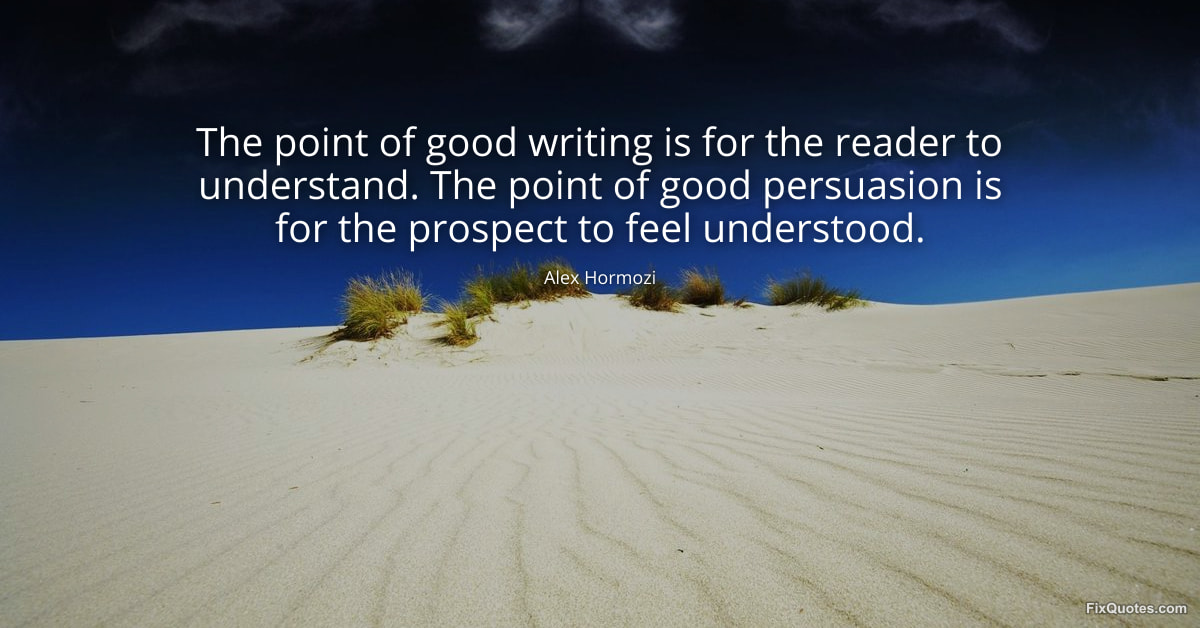
"The point of good writing is for the reader to understand. The point of good persuasion is for the prospect to feel understood"
About this Quote
The subtext is a quiet indictment of the standard entrepreneur playbook. Most pitches fail not because the offer is incoherent, but because the prospect feels handled. Hormozi’s line reframes persuasion as a kind of emotional UI/UX: reduce friction by naming the prospect’s anxieties before they have to. “Feel understood” is also a protective spell against the modern consumer’s defenses. People are trained to spot manipulation; mirroring their internal narrative lowers the drawbridge.
Context matters: Hormozi’s audience lives in DMs, landing pages, cold emails, and short-form content where attention is rented by the second. In that environment, “understanding” is table stakes; everyone can write clearer copy with enough templates. What differentiates a message is whether it reflects back a person’s private language: the fear of wasting money, the embarrassment of not following through, the exhaustion of trying everything.
There’s a sharp edge here, too. Empathy can be a bridge or a crowbar. By making “feeling understood” the goal, Hormozi hints at persuasion’s ethical fork: are you recognizing someone’s reality to help them, or to steer them?
Quote Details
| Topic | Sales |
|---|---|
| Source | Verified source: $100M Offers: How to Make Offers So Good People Feel Stup... (Alex Hormozi, 2021)ISBN: 9781737475705 · ID: 26LWEAAAQBAJ
Evidence:
Alex Hormozi. When picking markets, I look for four indicators: 1). Massive. Pain. They must not want, but ... The point of good writing is for the reader to understand. The point of good persuasion is for the prospect to feel understood ... |
| Cite |
Citation Formats
APA Style (7th ed.)
Hormozi, Alex. (2026, March 27). The point of good writing is for the reader to understand. The point of good persuasion is for the prospect to feel understood. FixQuotes. https://fixquotes.com/quotes/the-point-of-good-writing-is-for-the-reader-to-183998/
Chicago Style
Hormozi, Alex. "The point of good writing is for the reader to understand. The point of good persuasion is for the prospect to feel understood." FixQuotes. March 27, 2026. https://fixquotes.com/quotes/the-point-of-good-writing-is-for-the-reader-to-183998/.
MLA Style (9th ed.)
"The point of good writing is for the reader to understand. The point of good persuasion is for the prospect to feel understood." FixQuotes, 27 Mar. 2026, https://fixquotes.com/quotes/the-point-of-good-writing-is-for-the-reader-to-183998/. Accessed 3 Apr. 2026.