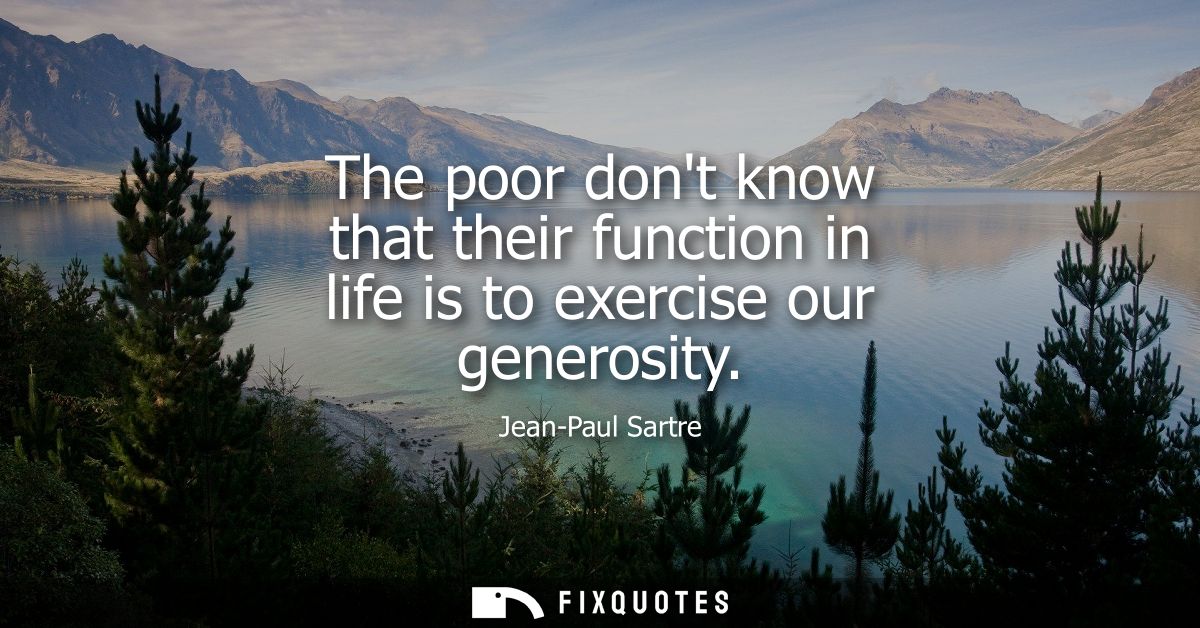
"The poor don't know that their function in life is to exercise our generosity"
About this Quote
The intent isn’t to sneer at the poor; it’s to indict a social arrangement where compassion becomes a performance and inequality becomes useful. Sartre is exposing how philanthropy can operate as social deodorant: it masks the stench of structural exploitation while allowing the comfortable to keep their comfort. The poor, in this worldview, are not citizens with claims but props in a morality play that flatters the benefactor.
The subtext is pure Sartrean existentialism filtered through postwar politics: if human beings are supposed to be free, then turning anyone into a means for someone else’s self-image is an ethical scandal. The line also echoes his broader critique of “bad faith,” the habit of hiding from responsibility by playing a role. Here, the role is the generous savior, which quietly depends on keeping the saved in their place.
Context matters: mid-century France, the rise of consumer prosperity alongside decolonization and class conflict, and a left intellectual scene suspicious of liberal humanitarianism that stops at handouts. Sartre isn’t rejecting generosity; he’s demanding we notice when it’s cheaper than justice.
Quote Details
| Topic | Equality |
|---|---|
| Source | Help us find the source |
| Cite |
Citation Formats
APA Style (7th ed.)
Sartre, Jean-Paul. (2026, January 17). The poor don't know that their function in life is to exercise our generosity. FixQuotes. https://fixquotes.com/quotes/the-poor-dont-know-that-their-function-in-life-is-35817/
Chicago Style
Sartre, Jean-Paul. "The poor don't know that their function in life is to exercise our generosity." FixQuotes. January 17, 2026. https://fixquotes.com/quotes/the-poor-dont-know-that-their-function-in-life-is-35817/.
MLA Style (9th ed.)
"The poor don't know that their function in life is to exercise our generosity." FixQuotes, 17 Jan. 2026, https://fixquotes.com/quotes/the-poor-dont-know-that-their-function-in-life-is-35817/. Accessed 12 Feb. 2026.