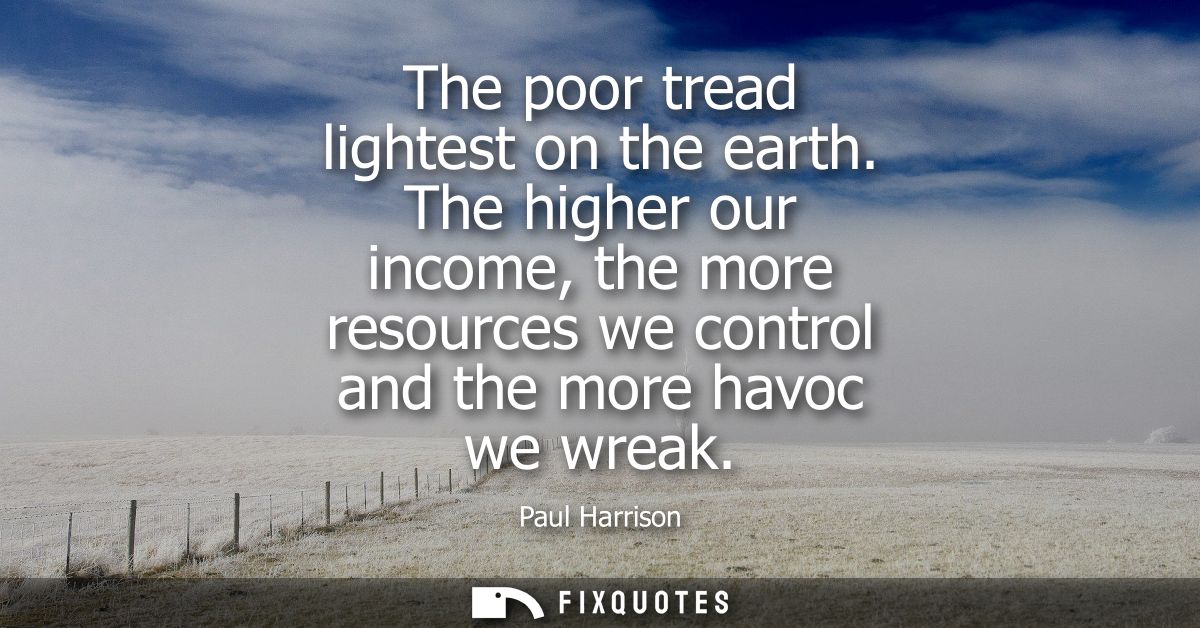
"The poor tread lightest on the earth. The higher our income, the more resources we control and the more havoc we wreak"
About this Quote
The second sentence sharpens the knife. “Higher our income” isn’t framed as success or aspiration but as a lever of control. Harrison shifts the unit of analysis from individuals to power: wealth isn’t merely private comfort, it’s command over land, energy, supply chains, and the right to externalize costs. “Resources we control” implies a system that grants some people legal and economic permission to consume on behalf of others, then call it “the market.”
“Havoc” is doing heavy work. It’s not neutral “impact” or “use”; it’s damage with victims. The subtext is climate justice before the term became mainstream: emissions and extraction track with affluence, while the worst consequences land disproportionately on those with the fewest buffers. In that context, the quote challenges the comforting fantasy that environmental collapse is a shared guilt requiring only shared sacrifice. Harrison points instead to an unequal bargain: the poor subsidize the lifestyles of the rich with their air, water, and future, and are then asked to tighten belts they never loosened.
Quote Details
| Topic | Equality |
|---|---|
| Source | Help us find the source |
| Cite |
Citation Formats
APA Style (7th ed.)
Harrison, Paul. (2026, January 16). The poor tread lightest on the earth. The higher our income, the more resources we control and the more havoc we wreak. FixQuotes. https://fixquotes.com/quotes/the-poor-tread-lightest-on-the-earth-the-higher-119370/
Chicago Style
Harrison, Paul. "The poor tread lightest on the earth. The higher our income, the more resources we control and the more havoc we wreak." FixQuotes. January 16, 2026. https://fixquotes.com/quotes/the-poor-tread-lightest-on-the-earth-the-higher-119370/.
MLA Style (9th ed.)
"The poor tread lightest on the earth. The higher our income, the more resources we control and the more havoc we wreak." FixQuotes, 16 Jan. 2026, https://fixquotes.com/quotes/the-poor-tread-lightest-on-the-earth-the-higher-119370/. Accessed 5 Apr. 2026.