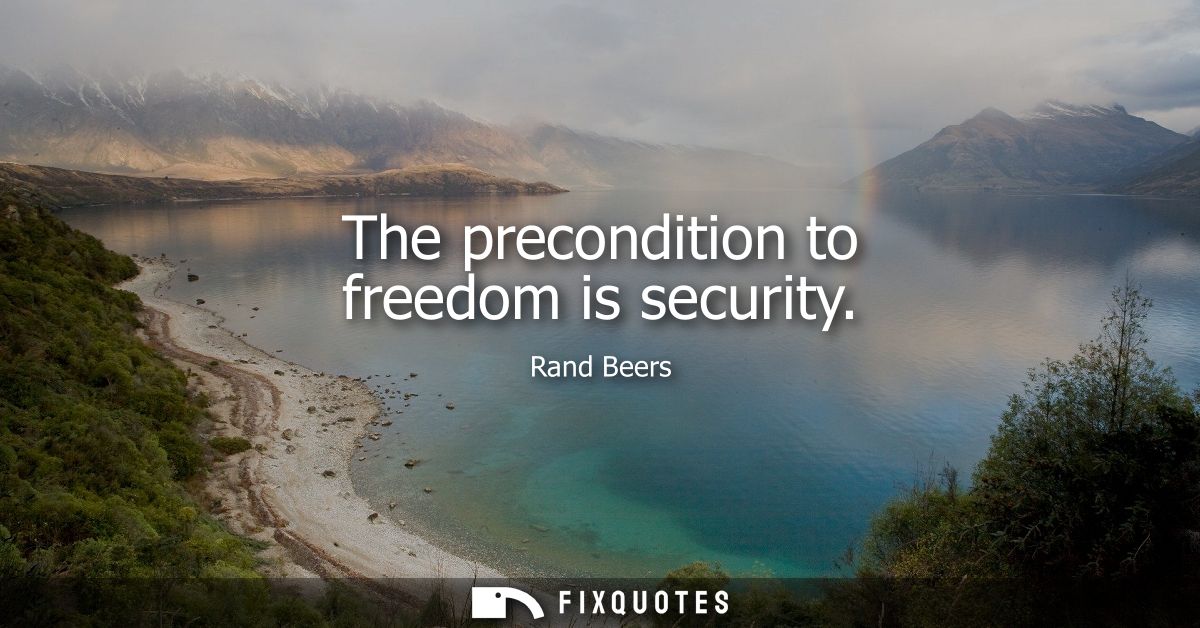
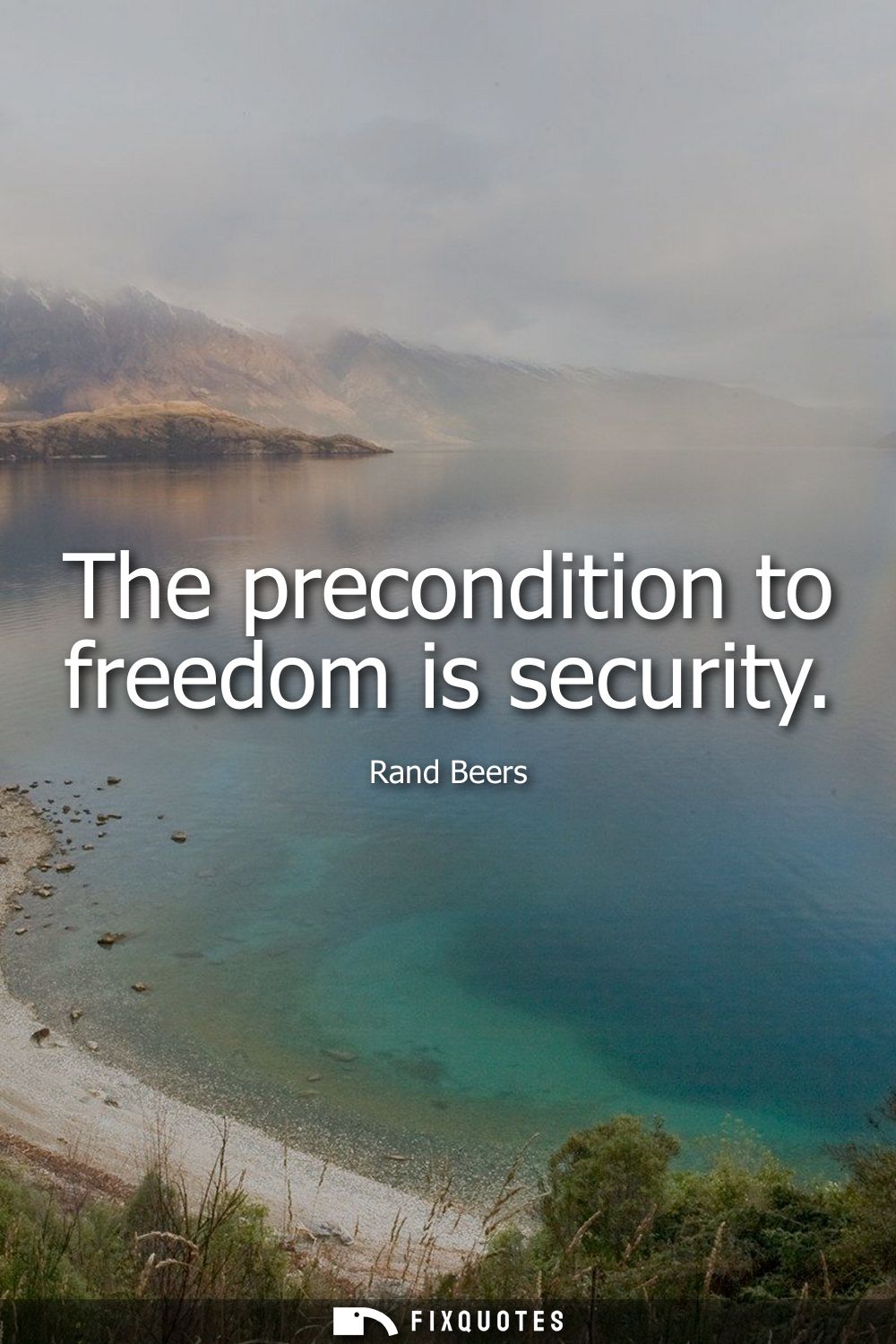
"The precondition to freedom is security"
About this Quote
Freedom rarely comes with a clean, heroic soundtrack; it arrives stapled to logistics, patrol routes, and the unglamorous work of keeping people alive. Rand Beers's line, "The precondition to freedom is security", is the kind of sentence that sounds self-evident until you notice its quiet rearranging of political priorities. It doesn't frame security as freedom's rival (the classic civil liberties panic), but as freedom's prerequisite: the floor you stand on before you can argue, vote, protest, or simply walk home.
Coming from a soldier, the intent is practical and directional. It's not a philosophy seminar; it's a briefing-room worldview. Security here isn't abstract comfort. It's the absence of immediate coercion, the reduction of chaos, the minimum stability that lets institutions function and civilians take risks that aren't suicidal. The subtext is also a warning to idealists: exporting "freedom" without establishing safety first is theater. Ballots don't mean much when the polling station is a target.
But the sentence carries a second, more controversial implication: whoever defines "security" gets to define the timetable of freedom. In modern counterinsurgency and post-9/11 governance, that ambiguity matters. Security can mean protecting a neighborhood from militias. It can also mean surveillance, checkpoints, and emergency powers that outlive the emergency. The line works because it's both a commonsense truth and a political lever. It legitimizes patience and force in the name of liberty, while daring the listener to ask the uncomfortable follow-up: security for whom, imposed by whom, and at what cost.
Coming from a soldier, the intent is practical and directional. It's not a philosophy seminar; it's a briefing-room worldview. Security here isn't abstract comfort. It's the absence of immediate coercion, the reduction of chaos, the minimum stability that lets institutions function and civilians take risks that aren't suicidal. The subtext is also a warning to idealists: exporting "freedom" without establishing safety first is theater. Ballots don't mean much when the polling station is a target.
But the sentence carries a second, more controversial implication: whoever defines "security" gets to define the timetable of freedom. In modern counterinsurgency and post-9/11 governance, that ambiguity matters. Security can mean protecting a neighborhood from militias. It can also mean surveillance, checkpoints, and emergency powers that outlive the emergency. The line works because it's both a commonsense truth and a political lever. It legitimizes patience and force in the name of liberty, while daring the listener to ask the uncomfortable follow-up: security for whom, imposed by whom, and at what cost.
Quote Details
| Topic | Freedom |
|---|---|
| Source | Help us find the source |
| Cite |
Citation Formats
APA Style (7th ed.)
Beers, Rand. (2026, January 16). The precondition to freedom is security. FixQuotes. https://fixquotes.com/quotes/the-precondition-to-freedom-is-security-93198/
Chicago Style
Beers, Rand. "The precondition to freedom is security." FixQuotes. January 16, 2026. https://fixquotes.com/quotes/the-precondition-to-freedom-is-security-93198/.
MLA Style (9th ed.)
"The precondition to freedom is security." FixQuotes, 16 Jan. 2026, https://fixquotes.com/quotes/the-precondition-to-freedom-is-security-93198/. Accessed 25 Mar. 2026.
More Quotes by Rand
Add to List