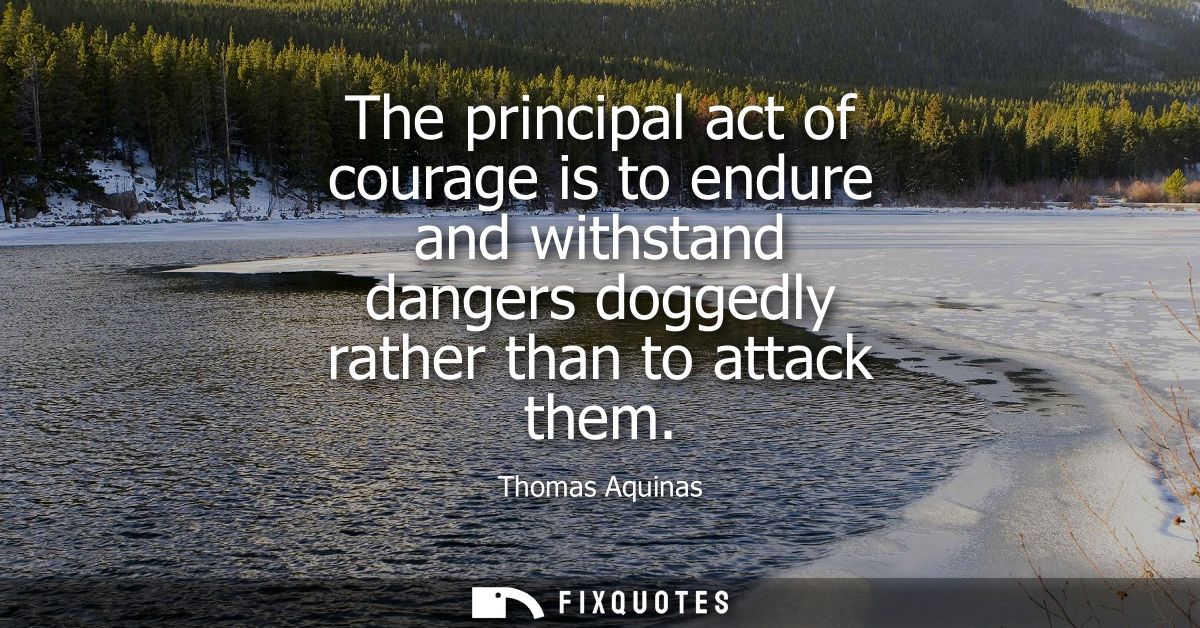
"The principal act of courage is to endure and withstand dangers doggedly rather than to attack them"
About this Quote
The intent is corrective. Aquinas is writing inside a medieval virtue tradition that treats fortitude as a habit aimed at the good, not a personality trait or a battlefield vibe. Attacking danger can be driven by anger, pride, or the thrill of action; endurance is harder to counterfeit. It forces the will to stay aligned with reason when the body and imagination are screaming to flee. In scholastic terms, it’s a way of ranking moral acts by how fully they submit the passions to judgment.
The subtext is quietly political and pastoral. In a world where warfare, plague, and public punishment were ordinary, most people weren’t choosing heroic offensives; they were surviving. Aquinas dignifies that reality, implying that the truer test of character is often passive in appearance but active in the soul. Endurance is also social: it keeps communities intact when panic would atomize them.
Contextually, this sits in his treatment of fortitude as chiefly about “standing firm” (especially in the face of death) rather than aggression. It’s a theology of courage that prizes steadiness over spectacle, because salvation is usually won in the grind, not the lunge.
Quote Details
| Topic | Perseverance |
|---|---|
| Source | Unverified source: Summa Theologiae (Secunda Secundae, Q. 123, Art. 6) (Thomas Aquinas, 1270)
Evidence: Therefore the principal act of fortitude is endurance, that is to stand immovable in the midst of dangers rather than to attack them. (II-II, Question 123 (Fortitude), Article 6). Your wording appears to be a modern paraphrase/variant of Aquinas’ point in *Summa Theologiae* II-II, Q.123, Art.6 ("... Other candidates (1) 1001 Pearls of Bible Wisdom (Malcolm Day, 2008) compilation95.0% ... St. Thomas Aquinas ( 1225-1274 ) declared that " The principal act of courage is to endure and withstand dangers ... |
| Cite |
Citation Formats
APA Style (7th ed.)
Aquinas, Thomas. (2026, March 1). The principal act of courage is to endure and withstand dangers doggedly rather than to attack them. FixQuotes. https://fixquotes.com/quotes/the-principal-act-of-courage-is-to-endure-and-10293/
Chicago Style
Aquinas, Thomas. "The principal act of courage is to endure and withstand dangers doggedly rather than to attack them." FixQuotes. March 1, 2026. https://fixquotes.com/quotes/the-principal-act-of-courage-is-to-endure-and-10293/.
MLA Style (9th ed.)
"The principal act of courage is to endure and withstand dangers doggedly rather than to attack them." FixQuotes, 1 Mar. 2026, https://fixquotes.com/quotes/the-principal-act-of-courage-is-to-endure-and-10293/. Accessed 6 Apr. 2026.