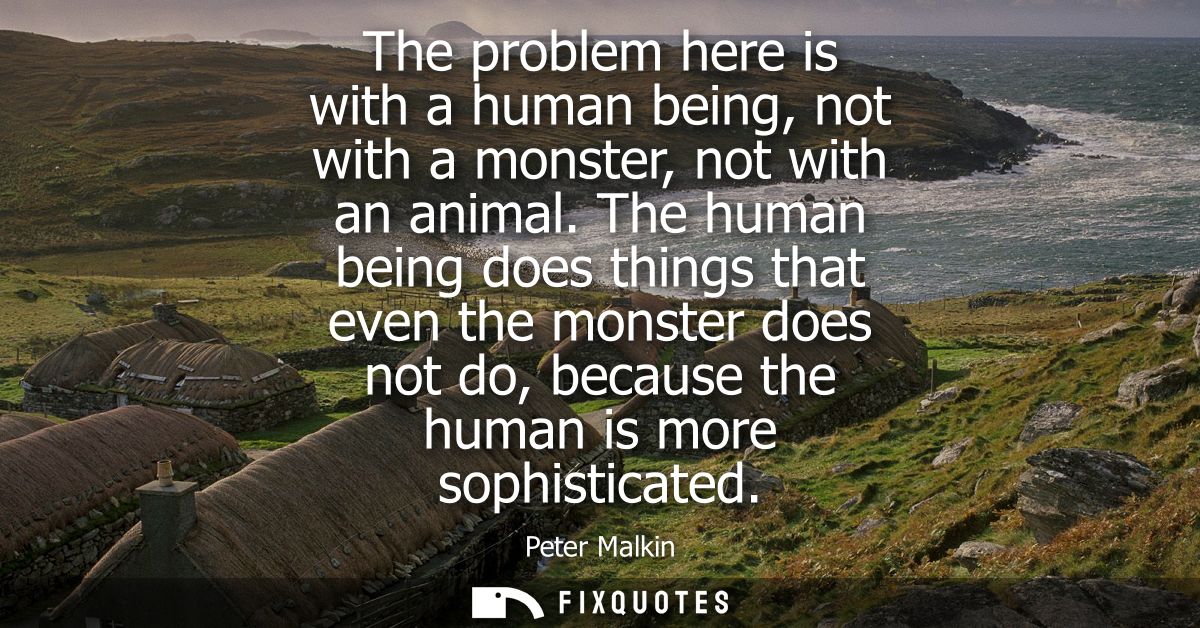
"The problem here is with a human being, not with a monster, not with an animal. The human being does things that even the monster does not do, because the human is more sophisticated"
About this Quote
The insistence on "a human being, not a monster, not an animal" is doing two things at once. It rejects dehumanizing language as ethically lazy, and it indicts the very capacity we usually celebrate as progress: sophistication. Malkin’s sting is that brutality isn’t a collapse into instinct; it can be an achievement of planning, bureaucracy, and imagination. Animals kill to eat, defend, survive. Humans can design suffering for its own strategic, ideological, or administrative ends, then file it under procedure.
That’s the subtext: modern evil often arrives wearing credentials, speaking politely, following protocols. "More sophisticated" is not praise; it’s a warning about how education, institutions, and technology can expand the repertoire of harm when paired with obedience or certainty. Coming from a public servant, the statement reads as a critique of systems as much as individuals: the desk, the memo, the chain of command can become instruments of cruelty precisely because they feel normal.
Malkin’s intent is accountability. If the perpetrator is human, then the conditions that produced him are human too - cultural, political, organizational. You don’t get to outsource blame to the supernatural. You have to look in the mirror, then look at the machinery.
Quote Details
| Topic | Ethics & Morality |
|---|---|
| Source | Help us find the source |
| Cite |
Citation Formats
APA Style (7th ed.)
Malkin, Peter. (2026, January 16). The problem here is with a human being, not with a monster, not with an animal. The human being does things that even the monster does not do, because the human is more sophisticated. FixQuotes. https://fixquotes.com/quotes/the-problem-here-is-with-a-human-being-not-with-a-126884/
Chicago Style
Malkin, Peter. "The problem here is with a human being, not with a monster, not with an animal. The human being does things that even the monster does not do, because the human is more sophisticated." FixQuotes. January 16, 2026. https://fixquotes.com/quotes/the-problem-here-is-with-a-human-being-not-with-a-126884/.
MLA Style (9th ed.)
"The problem here is with a human being, not with a monster, not with an animal. The human being does things that even the monster does not do, because the human is more sophisticated." FixQuotes, 16 Jan. 2026, https://fixquotes.com/quotes/the-problem-here-is-with-a-human-being-not-with-a-126884/. Accessed 30 Mar. 2026.